
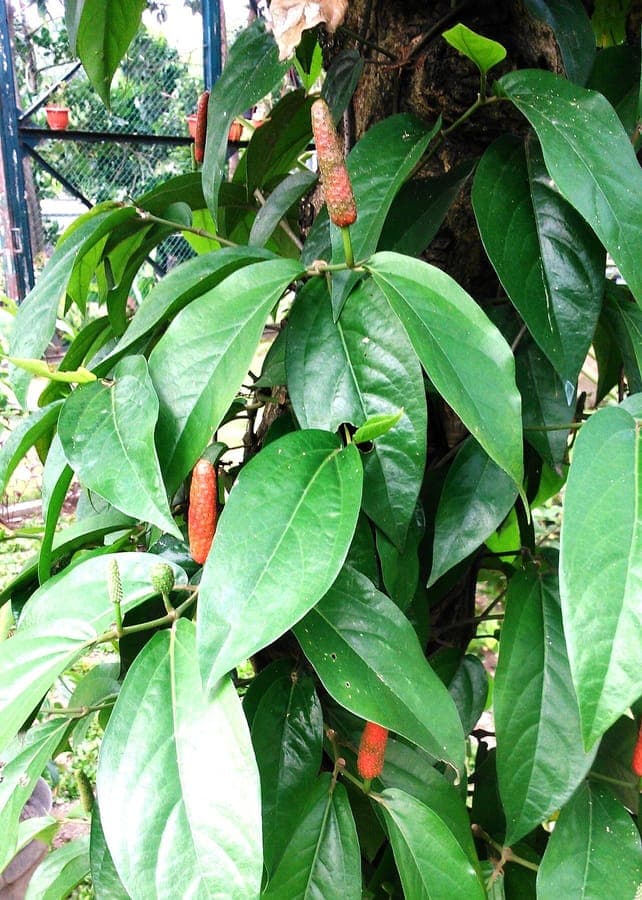
Kembangraps / CC0, via Wikimedia Commons
Piper retrofractum: complete guide
Piper retrofractum
Want to see Piper retrofractum: complete guide in your garden?
1 minute, no credit card
Overview
Piper retrofractum, better known as Javanese long pepper or "cabe jawa" in Indonesian, is a fascinating tropical climbing plant from the warmer regions of Southeast Asia. This plant grows naturally in an area spanning from Bangladesh to China (Yunnan) and various Malay islands. It is an elegant, fruit-bearing plant that in Dutch gardens is best grown in a heated greenhouse or conservatory.
The Javanese long pepper stands out for its distinctive fruit formation, which resembles long "peppers" rather than traditional round peppercorns. These little fruits are intensely aromatic and are used as a spice in their homeland.
Appearance & bloom
Piper retrofractum is an elegant, evergreen climbing plant with heart-shaped, somewhat leathery leaves. The leaves are glossy dark green with interesting venation. The plant naturally forms into a slender climber.
The flowers are discrete, small and yellow-green. They are not spectacular, but they precede the formation of much more interesting fruits. These fruits grow in long, thin catkin-like drooping strings, almost like long pepper spikes. They start green and become reddish to dark brown when ripe.
The plant is evergreen and thus offers visual interest year-round, especially when fruit-bearing branches are present.
Ideal location
Piper retrofractum requires warmth and humidity - two ingredients that are difficult to provide in Dutch outdoor gardens. Therefore, greenhouse or conservatory cultivation is almost necessary.
This plant grows best in a warm, lightly shaded position. Full sun in a greenhouse can cause leaf burn. Provide diffused light, for example through shade cloth or partially open windows.
Humidity is essential. Low air humidity can lead to lateral leaf shrinkage and increased spider mite risk. Regularly mist with water or place the pot on a saucer with pebbles and water.
Soil
Piper retrofractum grows in rich, organic matter-containing soil. Good nutrient-rich, permeable greenhouse soil or humus-rich potting soil works well. Add perlite or cork for better drainage.
The plant cannot tolerate heavy waterlogging, so ensure adequate drainage holes in pots. Repotting is best done each spring with a slightly larger pot (less than 2 cm extra diameter).
The pH should be weakly acidic to neutral (pH 6-7). This is typical for tropical plant soils.
Free design
Want to see Piper retrofractum: complete guide in your garden? Make a free design now.
Watering
During the growing season (spring and summer), Piper retrofractum should be kept moist, but not waterlogged. Water when the top centimeter feels dry.
In autumn and winter, when growth slows, moisture can be slightly lower, but the soil should never dry completely. This could lead to leaf drop.
Use lukewarm water (not cold from the tap). Hard water can lead to nutrient deficiency over time, so rainwater use is ideal.
Pruning
Piper retrofractum tolerates vigorous pruning well. In early spring, you can cut back severely to 1/3 of the original volume. This stimulates fuller, more branched growth and more fruiting.
Remove dead or weak shoots. Support the climbing plant with a trellis or thin wood, as it can only grow weakly upward naturally.
After vigorous pruning, the plant grows back quickly, especially when nutrition is adequate.
Maintenance calendar
Spring (March-May): Increase water supply. Begin feeding (monthly, half strength). Pruning and repotting.
Summer (June-August): Regular misting. Monitor for spider mites (dry conditions). Continue feeding. Keep moist.
Autumn (September-November): Gradually reduce feeding. Adjust watering to lower air temperature.
Winter (December-February): Minimal feeding. Keep moisture low. Maintain greenhouse temperature around 15-18 C.
Winter hardiness
Piper retrofractum is absolutely not winter hardy in the Netherlands. This tropical plant dies when temperatures fall below 10 C. Therefore, ensure greenhouse temperature does not drop below 15 C, ideally 18-25 C.
Companion plants
In a greenhouse or warm conservatory, Piper retrofractum can grow beautifully alongside other tropical climbers like passion fruit or clematis-like varieties. Moisture-loving groundcovers at the base can work interestingly.
Just ensure that other plants' warmth and humidity requirements don't conflict too much.
Closing
Piper retrofractum is a fascinating project for lovers of exotic plants and spices. Although this plant doesn't grow outdoors in the Netherlands, greenhouse cultivation can be very rewarding. The beautiful fruiting gives enormous satisfaction. With regular care, warmth, and humidity, you can enjoy this Asian curiosity for years.
Specialized plant nurseries supply young plants. For more inspiration, visit gardenworld.app.
Want to see Piper retrofractum: complete guide in your garden? Make a free design now.
Upload a photo, pick a style, and get a photorealistic design with plant list in under a minute.
No credit card required


Similar plants
Kava: complete guide to growing and care
Piper methysticum
Everything about kava (Piper methysticum): origin, appearance, location, soil, watering, pruning and overwintering outside the tropics.
Guinea Pepper: complete guide
Piper guineense
Guinea pepper is a tropical vine with aromatic fruits used in African cuisine. Learn how to grow this African pepper variant in warm indoor conditions.
Peperomia pellucida: complete guide to man-to-man herb
Peperomia pellucida
Master Peperomia pellucida, a compact herbaceous plant with translucent leaves ideal for indoor gardening and cool garden corners.