
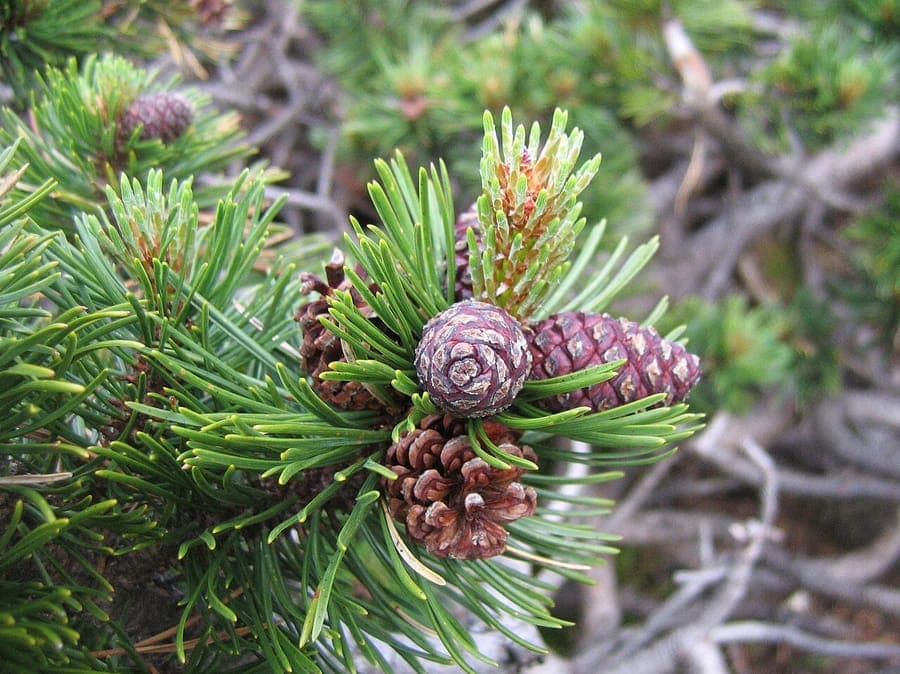
Agnieszka Kwiecień, Nova / CC BY 2.5, via Wikimedia Commons
Mountain pine: complete guide
Pinus uncinata
Want to see Mountain pine: complete guide in your garden?
1 minute, no credit card
Overview
Pinus uncinata, commonly known as mountain pine, is a hardy evergreen conifer native to the mountainous regions of central and southern Europe. It's not a common sight in typical suburban gardens, but it's a superb choice for slopes, alpine beds, or naturalistic planting schemes. Unlike its relative Pinus mugo, which spreads horizontally, Pinus uncinata grows upright, reaching 6 to 10 meters in cultivation. This makes it ideal for vertical accent in the garden, especially where space is limited.
Appearance & bloom cycle
The mountain pine has a narrow, conical habit when young, gradually becoming broader with age. Its stiff, dark green needles grow in pairs and measure 4 to 7 cm in length. They have a slightly bluish sheen, especially on new growth, giving the tree a refined texture. In May, male catkins appear in reddish-brown clusters, while female cones start as purple-red buds. After pollination, these develop into 4 to 6 cm long, curved cones – the name 'uncinata' means 'hooked'. These mature over 2 to 3 years and often remain on the tree for several seasons, adding winter interest.
The bark becomes deeply fissured with age, turning a rich reddish-brown, which contrasts beautifully with snow cover in colder climates.
Ideal location
This pine thrives in full sun but tolerates light shade, especially in hotter regions. It needs excellent air circulation to prevent fungal issues, so avoid planting in stagnant, damp corners. Mountain pine excels on slopes, where its root system helps stabilise soil and prevent erosion. It's also a great choice for rock gardens, gravel beds, or as a specimen tree near stone walls.
In urban gardens, use it to create height in a mixed border. Its upright form draws the eye upward, breaking monotony. On gardenworld.app, you can design a planting layout that integrates Pinus uncinata with other alpine species, ensuring proper spacing and sun exposure.
Soil requirements
Pinus uncinata prefers well-drained, slightly acidic to neutral soil (pH 5.5–7.0). It tolerates poor soils, mimicking its natural alpine habitat. Avoid heavy clay or waterlogged sites – these lead to root rot. If your soil is dense, raise the planting area by 30–40 cm and mix in coarse sand and leaf compost.
Do not over-amend with organic matter; this pine is adapted to low-nutrient conditions. A gravel mulch around the base improves drainage and suppresses weeds without smothering the roots.
Watering
Once established, mountain pine is highly drought tolerant. During the first two growing seasons, water deeply once a week during dry spells – about 10–15 liters per young tree. Focus on consistent moisture rather than frequent light watering.
After the third year, supplemental irrigation is rarely needed unless facing prolonged drought. Never let the base sit in water; 'wet feet' are deadly. In summer (June–August), check young trees weekly during heatwaves.
Free design
Want to see Mountain pine: complete guide in your garden? Make a free design now.
Pruning
Pruning is minimal. The tree naturally maintains a clean, upright form. If shaping is desired, pinch back the new 'candles' in late May when they're half-extended. Use fingers, not shears, to avoid browning.
Remove only dead or damaged branches, cutting flush to the trunk in dry weather to prevent fungal entry. Avoid heavy pruning – conifers don't regenerate well from old wood. Always disinfect tools between cuts.
Maintenance calendar
- January: Inspect for winter damage. Remove broken branches.
- February: No action needed.
- March: Check soil drainage. Top up gravel mulch if eroded.
- April: Monitor for pine aphids or scale. Treat early if spotted.
- May: Pinch candles if desired. Ensure good airflow.
- June: Water young trees during dry weeks.
- July: No routine care, unless drought stress appears.
- August: Final moisture check before autumn.
- September: Clear fallen cones to reduce pest habitat.
- October: Avoid pruning. Prepare for winter.
- November: Protect young trees with burlap in windy sites.
- December: Visual check for disease or rodent damage.
Winter hardiness
Pinus uncinata is cold hardy to USDA zones 3–7, surviving temperatures down to -35°C. It handles snow load well, though heavy accumulations should be gently shaken off to prevent branch breakage. Young trees may suffer from winter desiccation in exposed areas – use windbreak fabric if needed.
Avoid de-icing salts near the root zone; this pine is salt-sensitive. In milder zones, ensure winter sun doesn't cause bark splitting on south-facing trunks.
Companion plants
Pair mountain pine with drought-tolerant, sun-loving species. Consider dwarf lavender, sedum, thyme, or creeping juniper. For contrast, add ornamental grasses like Calamagrostis or low-growing erica. Avoid moisture-loving plants such as ferns or hostas.
In mixed alpine beds, combine with dwarf conifers or spring-flowering bulbs like scilla or chionodoxa. Using gardenworld.app, you can visualise these combinations in 3D, adjusting for mature sizes and seasonal colour.
Closing
Pinus uncinata is a low-maintenance, long-lived conifer that brings structure and year-round interest to challenging sites. It's perfect for gardeners seeking resilience and natural beauty. Look for healthy specimens at garden centres like B&Q, Wyevale, or local nurseries – check for firm needles and no signs of pests. With proper siting and initial care, this mountain pine will thrive for decades.
Want to see Mountain pine: complete guide in your garden? Make a free design now.
Upload a photo, pick a style, and get a photorealistic design with plant list in under a minute.
No credit card required


Similar plants
Abies delavayi: complete guide
Abies delavayi
Delavayi fir is an elegant, medium-sized coniferous tree from the Pinaceae family with dark green needles. This Asian evergreen is perfect for alpine gardens and large landscapes.
Taiwan fir: complete guide
Abies kawakamii
Discover the magnificent Taiwan fir, a rare evergreen conifer from Taiwan's mountain regions. Learn growth requirements, care tips, and why this beautiful tree is perfect for collectors of unique garden specimens.
Farges fir: complete guide
Abies fargesii
Discover the majestic Farges fir, an impressive conifer from China's mountains with elegant foliage and columnar form. Ideal for large gardens.