
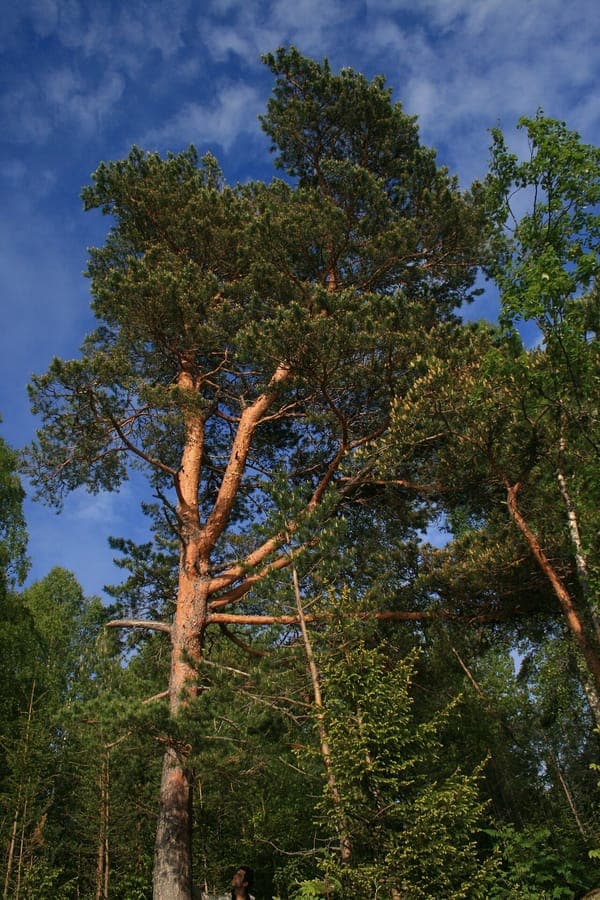
Mickaël Delcey (Silverkey) / CC BY-SA 3.0, via Wikimedia Commons
Scotch pine: complete guide
Pinus sylvestris
Want to see Scotch pine: complete guide in your garden?
1 minute, no credit card
Overview
Pinus sylvestris, commonly known as Scotch pine, is one of the most widespread conifers across Europe and Asia. Native from the Baltic States to Siberia and from Scandinavia down to the Balkans, it's a tough, adaptable tree that thrives in gardens, parks, and forest edges. In the UK and North America, it's often used in windbreaks, reforestation, and as a Christmas tree.
On gardenworld.app you can design a layout that fits the Scotch pine's mature size-typically 15 to 30 meters tall with a spread of 6 to 8 meters. It grows at a moderate rate of 30–50 cm per year. Young trees have a neat conical shape, while older specimens develop a broad, open crown and a striking orange-red bark on the upper trunk, which flakes off in thin plates.
Appearance & bloom cycle
The Scotch pine has paired needles, 4 to 7 cm long, with a blue-green hue. They're arranged in a spiral pattern and give the tree a soft, feathery look. The bark on young trees is grey and smooth, maturing into thick, orange-brown plates that peel away.
Flowering occurs in May and June. Male flowers are bright yellow and clustered at the base of new shoots, releasing clouds of pollen. Female flowers are smaller, purplish-red, and develop into woody cones 4–7 cm long. These ripen after two years and can remain on the tree for several seasons, adding winter interest.
Ideal location
Scotch pine loves full sun-aim for a light level of 8 out of 10. It needs an open, unshaded spot with good air circulation. Avoid planting under large deciduous trees where competition for light and water is high.
It's ideal as a standalone specimen, in mixed woodland borders, or as part of a shelterbelt. Keep it at least 5 meters from buildings, driveways, or underground pipes. Its root system spreads widely but isn't aggressive, though it can lift shallow paving over time.
Soil requirements
This pine is adaptable to many soil types: sandy, loamy, or gravelly. It tolerates pH from 5 to 7.5-slightly acidic to slightly alkaline. The key is good drainage. It won't survive in waterlogged clay. If your soil is heavy, plant on a mound or mix in grit to improve drainage.
Avoid rich, organic soils. Scotch pine prefers lean conditions and may suffer in overly fertile, moist beds. Don't amend the planting hole with compost-backfill with native soil.
Free design
Want to see Scotch pine: complete guide in your garden? Make a free design now.
Watering
Once established, Scotch pine is highly drought-tolerant. Water young trees weekly during the first two growing seasons, especially in dry spells. Give 10–15 liters per week, soaking deeply to encourage deep roots.
After that, supplemental watering is rarely needed. In prolonged droughts, a deep soak in the evening helps. Don't use sprinklers near the trunk-wet bark invites fungal diseases.
Pruning
Pruning is rarely necessary. Never cut back into old wood without needles-it won't regrow. Only remove dead, damaged, or crossing branches, and do so in late winter or early spring before bud break.
Avoid topping or shaping the crown. This ruins the tree's natural form and increases disease risk. If you need a smaller tree, choose a dwarf cultivar like 'Beuvronensis' or plant while young in a spacious site.
Maintenance calendar
- Jan: inspect for storm damage
- Feb: light pruning if needed
- Mar: check for pine sawfly or aphids
- Apr: no action
- May: male flowers release pollen
- Jun: female cones begin development
- Jul: monitor for drought stress
- Aug: watch for resin leaks or bark beetles
- Sep: cones mature, natural seed drop
- Oct: older needles yellow and drop-normal
- Nov: keep mulch away from trunk
- Dec: final inspection before winter
Use gardenworld.app to set up a custom care calendar with alerts tailored to your local climate and tree age.
Winter hardiness
Scotch pine is hardy in USDA zones 2 to 7, tolerating temperatures down to -40°C. It holds its color all winter and sheds only older needles annually. No winter protection is needed in most temperate regions.
Young trees in exposed sites may benefit from a windbreak or burlap wrap in harsh winters. Avoid de-icing salts near roots-use sand instead on nearby paths.
Companion plants
Pair Scotch pine with drought-tolerant, acid-loving plants. Heathers (Calluna vulgaris), bearberry (Arctostaphylos uva-ursi), and blue fescue (Festuca glauca) thrive in similar conditions. Woodland perennials like epimedium and hellebores also work well.
Avoid moisture-loving plants like hostas under the canopy. The pine's roots absorb water efficiently, creating dry shade. Use mulch to suppress weeds and retain moisture.
Closing
Scotch pine is a reliable, low-maintenance tree that brings year-round structure and texture to the garden. With its peeling bark, evergreen foliage, and resilience, it's a long-term investment. Buy young trees from garden centres like B&Q, Wyevale, or local nurseries. Plant in full sun with well-drained soil, and let it grow naturally. On gardenworld.app, you can preview how a mature Scotch pine will shape your garden's future.
Want to see Scotch pine: complete guide in your garden? Make a free design now.
Upload a photo, pick a style, and get a photorealistic design with plant list in under a minute.
No credit card required


Similar plants
Abies delavayi: complete guide
Abies delavayi
Delavayi fir is an elegant, medium-sized coniferous tree from the Pinaceae family with dark green needles. This Asian evergreen is perfect for alpine gardens and large landscapes.
Taiwan fir: complete guide
Abies kawakamii
Discover the magnificent Taiwan fir, a rare evergreen conifer from Taiwan's mountain regions. Learn growth requirements, care tips, and why this beautiful tree is perfect for collectors of unique garden specimens.
Farges fir: complete guide
Abies fargesii
Discover the majestic Farges fir, an impressive conifer from China's mountains with elegant foliage and columnar form. Ideal for large gardens.