
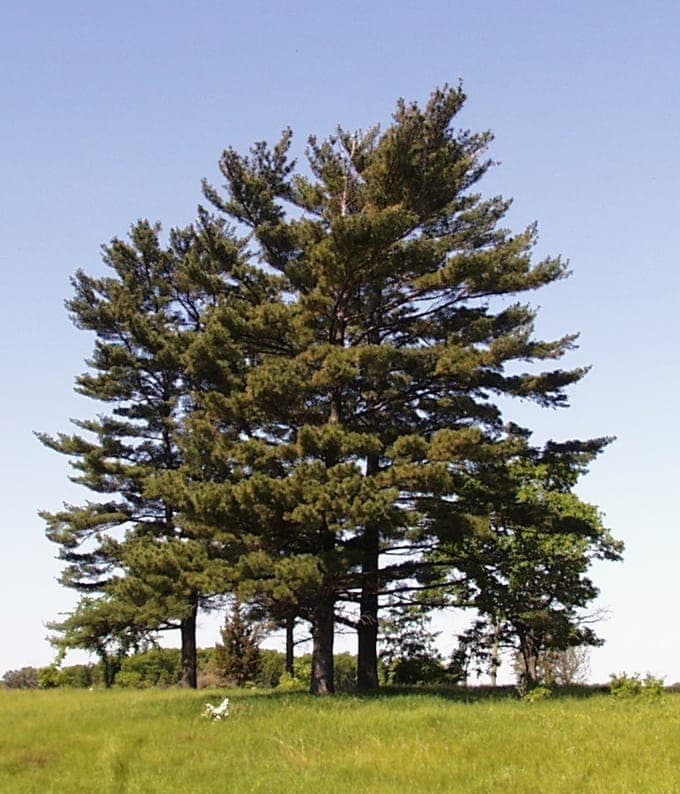
US FWS / Public domain, via Wikimedia Commons
Weymouth pine: complete guide
Pinus strobus
Want to see Weymouth pine: complete guide in your garden?
1 minute, no credit card
Overview
Pinus strobus, commonly known as the Weymouth pine, is a fast-growing, majestic evergreen native to eastern North America. It's a popular choice in larger UK and US gardens thanks to its elegant, soft-textured foliage and strong upright habit. Unlike many pines that feel stiff and dense, this species has a graceful, almost feathery appearance. It's not suited for small yards - mature trees can reach 25–35 metres tall with a spread of 8–12 metres. If you're planning to grow one, use gardenworld.app to visualise how it'll fit into your landscape over time, especially if you're using it as a windbreak or focal point.
Appearance & bloom cycle
Young Weymouth pines have a neat, pyramidal shape that matures into a broad, open crown with horizontal branching. The needles are soft, flexible, and bright green, growing in bundles of five - a key identifier. They stay on the tree for about two years before shedding. In May, small reddish-brown male flowers appear at the base of new growth, while female cones start as greenish-pink clusters higher up. After pollination, the cones develop into slender, cylindrical shapes, 10–15 cm long, turning light brown when mature. They hang gracefully from upper branches and persist into winter, offering food for birds like crossbills and chickadees.
Ideal location
This pine thrives in full sun - aim for at least 8 hours of direct light daily. It tolerates partial shade, but growth will be slower and the crown sparser. Give it plenty of space: plant at least 5 metres from buildings, driveways, or underground utilities. It's excellent as a specimen tree, in woodland edges, or in rows for wind protection. Avoid tight corners or crowded borders. Use gardenworld.app to simulate sun exposure and spacing before planting, so you avoid future conflicts with structures or other trees.
Soil requirements
Pinus strobus prefers moist, well-drained, acidic to neutral soils (pH 4.0–6.5). It does poorly in heavy clay or waterlogged ground, where root rot can set in. Sandy soils are acceptable if enriched with organic matter. Avoid lime-rich or alkaline soils - this pine is sensitive to high pH and may show signs of chlorosis (yellowing needles). At planting, mix in plenty of compost or well-rotted manure to improve soil structure and nutrient availability.
Free design
Want to see Weymouth pine: complete guide in your garden? Make a free design now.
Watering
Young trees need consistent moisture for the first 2–3 years. Water deeply once a week during dry spells, focusing on the root zone. Use a soaker hose or drip irrigation to avoid wetting the foliage. Mature trees are fairly drought-tolerant but benefit from supplemental watering during prolonged dry periods, especially in summer. Mulch around the base to retain moisture and suppress weeds - keep the mulch 10–15 cm away from the trunk to prevent rot.
Pruning
Pruning is rarely needed. The Weymouth pine naturally forms a strong central leader and well-spaced branches. Only remove dead, damaged, or crossing limbs, and do so in late winter or early spring before new growth begins. Avoid cutting into old wood - this species doesn't regenerate well from heavy pruning. You can lightly pinch back the soft candle growth in May to encourage bushiness, but only on young or ornamental specimens.
Maintenance calendar
- Jan: Inspect for storm damage and broken branches
- Feb: Prepare tools for light pruning
- Mar: Final pruning window; apply organic mulch if needed
- Apr: Check for pests; top up compost around base
- May: Blooming season; monitor candle development
- Jun: Water during dry spells; watch for needle discoloration
- Jul: Continue monitoring for pests and drought stress
- Aug: No major tasks; let tree grow naturally
- Sep: Remove fallen cones if desired; check soil moisture
- Oct: Let some cones remain for wildlife; clear debris
- Nov: Protect young trees from rodents with tree guards
- Dec: Final inspection for stability and winter readiness
Winter hardiness
Hardy in USDA zones 3–8 (down to -40°C). In milder UK zones (7–8), it faces no real winter issues. In colder areas, young trees may suffer from desiccation in dry, windy conditions. Apply a thick layer of mulch and consider burlap windbreaks in exposed sites. Some needle browning is normal in winter and resolves in spring.
Companion plants
Underplant with shade-tolerant, non-invasive species like hellebores, ferns, hostas, or carex. Avoid plants that require alkaline soil. Low-growing evergreens like Pachysandra terminalis or Juniperus horizontalis work well. Avoid aggressive spreaders like ivy or mint. Group with other acid-loving plants such as rhododendrons or blueberries for a cohesive planting scheme.
Closing
The Weymouth pine brings elegance and vertical structure to large gardens. With the right start and space to grow, it becomes a long-lived, low-maintenance feature. Just remember: sun, space, and acidic soil. For design inspiration, visit gardenworld.app to explore layout options, shadow patterns, and companion planting ideas tailored to your garden's dimensions. You'll also find local garden centres that stock healthy, well-rooted specimens.
Want to see Weymouth pine: complete guide in your garden? Make a free design now.
Upload a photo, pick a style, and get a photorealistic design with plant list in under a minute.
No credit card required


Similar plants
Abies delavayi: complete guide
Abies delavayi
Delavayi fir is an elegant, medium-sized coniferous tree from the Pinaceae family with dark green needles. This Asian evergreen is perfect for alpine gardens and large landscapes.
Taiwan fir: complete guide
Abies kawakamii
Discover the magnificent Taiwan fir, a rare evergreen conifer from Taiwan's mountain regions. Learn growth requirements, care tips, and why this beautiful tree is perfect for collectors of unique garden specimens.
Farges fir: complete guide
Abies fargesii
Discover the majestic Farges fir, an impressive conifer from China's mountains with elegant foliage and columnar form. Ideal for large gardens.