
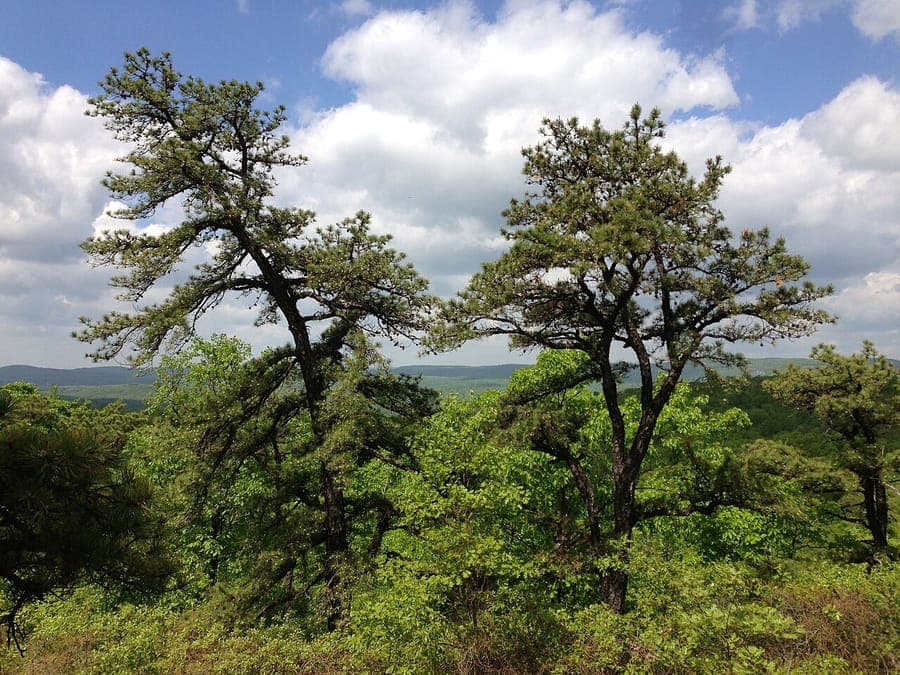
Famartin / CC BY-SA 3.0, via Wikimedia Commons
Northern pitch pine: complete guide
Pinus rigida
Want to see Northern pitch pine: complete guide in your garden?
1 minute, no credit card
Overview
Pinus rigida, commonly known as the Northern pitch pine, is a rugged, fire-adapted conifer that brings resilience and structure to larger gardens. Native to the northeastern and mid-Atlantic United States - from Maine to Georgia - it's built to survive harsh conditions: poor soil, salt spray, and extended droughts. In cultivation, it reaches 15 to 20 meters in height and spreads 6 to 8 meters wide, making it best suited for spacious plots, woodland edges, or windbreaks.
This pine isn't about neat symmetry or ornamental flowers. It's a survivor. Its twisted form, dark green needles, and deeply fissured bark add character and year-round presence. On gardenworld.app, you can visualise how this pine fits into a naturalistic garden layout, allowing space for its mature spread and casting dappled shade over understory planting.
Appearance & bloom cycle
Northern pitch pine has stiff, sharp needles 7 to 12 cm long, growing in bundles of three. They persist for 3 to 5 years before shedding, creating a persistent litter layer beneath the tree. The bark is thick, dark gray to reddish-brown, and breaks into irregular plates - giving even young trees a rugged, ancient look.
Flowering occurs in May and June. Male cones are small, yellowish, and clustered near new growth. Female cones are woody, 4 to 7 cm long, and remain closed on the branches for years. Remarkably, many only open after exposure to high heat, such as from wildfires - a trait called serotiny. Once opened, they release winged seeds that disperse by wind. These persistent cones add winter interest and provide food for birds like crossbills.
Ideal location
Plant in full sun - at least 6 hours of direct light daily. This pine won't tolerate shade and becomes leggy and sparse if light is limited. It's ideal for coastal gardens due to its resistance to salt-laden winds, making it a strong candidate for dune stabilisation or seaside shelterbelts.
Give it plenty of space: plant at least 5 meters from buildings, driveways, or underground utilities. Its root system is deep and spreading, designed to anchor in sandy soils. Use it as a specimen tree in open lawns or as part of a mixed native woodland planting. On gardenworld.app, you can map out sun exposure and root spread to avoid future conflicts with structures or utilities.
Soil requirements
The key to success is excellent drainage. Northern pitch pine thrives in sandy, acidic soils with a pH between 4.5 and 6.5. It tolerates nutrient-poor conditions and even compacted or disturbed soils, but it will fail in heavy clay or waterlogged sites. If your soil is dense, consider planting on a raised mound of sandy loam mixed with pine bark and compost.
In the wild, it often colonises burned areas or abandoned fields with sandy subsoil. Mimic these conditions in the garden by avoiding rich, moist beds typically used for perennials.
Free design
Want to see Northern pitch pine: complete guide in your garden? Make a free design now.
Watering
Water deeply once a week for the first 12 to 18 months after planting, giving 20 to 30 litres per session. After that, established trees are highly drought-tolerant and rarely need supplemental watering - even during summer heatwaves above 30°C. Overwatering, especially around the trunk base, can lead to root rot.
Use drip irrigation or a soaker hose to deliver water slowly to the root zone, and avoid wetting the foliage or trunk. Mulch with pine needles or wood chips (not piled against the trunk) to retain moisture and suppress weeds.
Pruning
Pruning is rarely needed. This pine naturally develops a strong, open framework. Only remove dead, damaged, or crossing branches, and do so in late winter (January to early March) when the tree is dormant. Avoid topping or shearing - pines don't regenerate from old wood, and cutting into bare stems results in permanent gaps.
If you must shape a young tree, use soft ties to gently guide growth rather than cutting. Always wear gloves and long sleeves - the needles are sharp and can irritate skin.
Maintenance calendar
- January: Inspect for deadwood. Light pruning if needed.
- February: Prepare for transplanting if necessary. No fertiliser.
- March: Monitor for early growth. No action required.
- April: Watch for new candle growth. Avoid disturbance.
- May: Pollen release and cone development. Keep clear of heavy activity.
- June: Check for pests like pine scale or sawfly larvae.
- July: Established trees need no watering unless in extreme drought.
- August: Watch for fungal issues in wet summers.
- September: Seed dispersal begins. Clean up if needed.
- October: Rake fallen needles if thick layer forms.
- November: Stop watering. Tree enters dormancy.
- December: Protect young trunks from rodents with wire mesh guards.
Winter hardiness
Northern pitch pine is hardy to USDA zone 4 (-34°C), making it suitable for most of the UK, northern Europe, and colder parts of North America. It holds its needles year-round, providing winter cover for birds. Young trees may suffer tip dieback in late spring frosts - avoid planting in frost pockets.
No winter protection is needed for mature trees, though young specimens in exposed sites benefit from burlap wraps for the first 2–3 winters.
Companion plants
Choose plants that tolerate dry, acidic soil and light shade. Good companions include bearberry (Arctostaphylos uva-ursi), wild lupine (Lupinus perennis), switchgrass (Panicum virgatum), and wintergreen (Gaultheria procumbens). Avoid aggressive groundcovers or heavy feeders that compete for resources.
Underplanting with native grasses or ferns creates a natural woodland floor. Leave fallen cones and needles in place if possible - they slowly acidify the soil and support beneficial fungi.
Closing
Northern pitch pine isn't a tidy, manicured tree - and that's its strength. It's ideal for low-maintenance landscapes, rewilding projects, or gardens where resilience matters more than perfection. Buy young trees (60–80 cm) from reputable garden centres or native nurseries for best results.
Use gardenworld.app to design a planting scheme that accounts for wind exposure, soil type, and long-term growth. Whether you're creating a coastal buffer or a native woodland garden, Pinus rigida offers structure, habitat, and enduring character.
Want to see Northern pitch pine: complete guide in your garden? Make a free design now.
Upload a photo, pick a style, and get a photorealistic design with plant list in under a minute.
No credit card required


Similar plants
Abies delavayi: complete guide
Abies delavayi
Delavayi fir is an elegant, medium-sized coniferous tree from the Pinaceae family with dark green needles. This Asian evergreen is perfect for alpine gardens and large landscapes.
Taiwan fir: complete guide
Abies kawakamii
Discover the magnificent Taiwan fir, a rare evergreen conifer from Taiwan's mountain regions. Learn growth requirements, care tips, and why this beautiful tree is perfect for collectors of unique garden specimens.
Farges fir: complete guide
Abies fargesii
Discover the majestic Farges fir, an impressive conifer from China's mountains with elegant foliage and columnar form. Ideal for large gardens.