
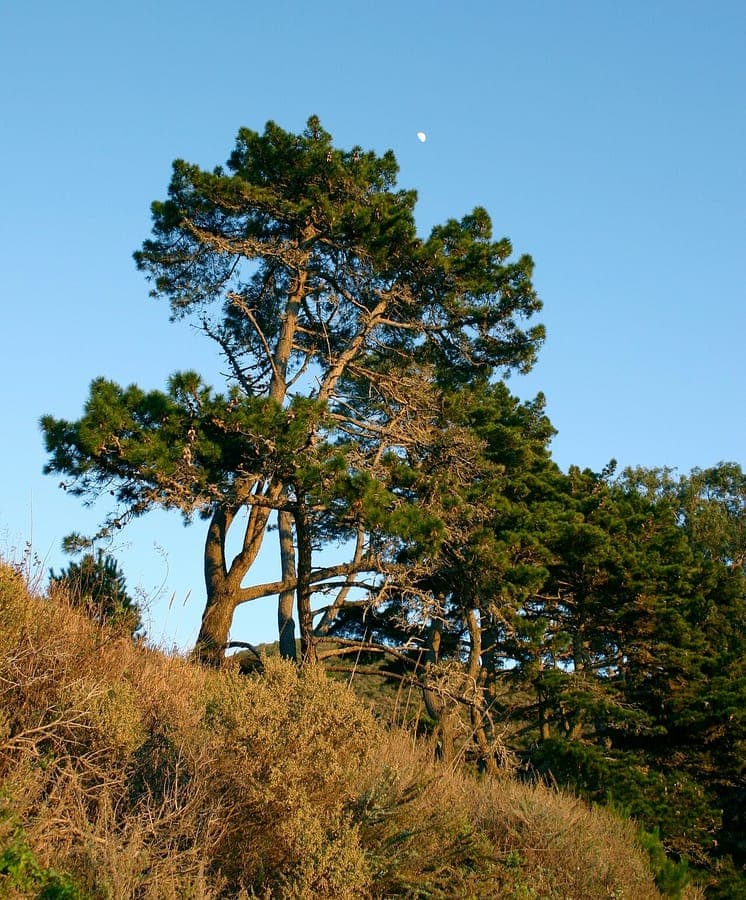
dalvenjah on Flickr / CC BY-SA 2.0, via Wikimedia Commons
Insignis pine: complete guide
Pinus radiata
Want to see Insignis pine: complete guide in your garden?
1 minute, no credit card
Overview
Pinus radiata, commonly known as Insignis pine or Monterey pine, is a fast-growing evergreen native to central California and parts of northwestern Mexico. In the UK and other temperate regions, it's valued for its upright habit, soft green needles, and rapid vertical growth-up to 60–80 cm per year under good conditions. While it can reach 30 meters at maturity, it's best suited to large gardens, estates, or rural landscapes due to its eventual size. It's not ideal for small urban gardens.
This pine is evergreen, retaining its foliage year-round. Young trees have a conical shape that broadens with age into a more irregular, open crown. It's often planted as a single specimen or in rows for screening. However, be aware: it's only reliably hardy in USDA zones 8–10. In cooler zones like 7b (-15°C), young trees may suffer winter burn or dieback in harsh conditions.
On gardenworld.app, you can simulate how a mature Insignis pine will fit into your garden layout, helping you plan spacing and long-term growth.
Appearance & bloom cycle
The Insignis pine has soft, flexible needles arranged in bundles of three, 10–15 cm long, with a bright to dark green hue. They emit a mild, resinous scent when crushed. The bark on young trees is smooth and greyish, turning fissured and reddish-brown in maturity.
Flowering occurs in spring, typically March to April. Male flowers are small, yellow, and clustered near the base of new shoots. Female flowers are reddish and appear near the tips. After pollination, they develop into cones-oval, 7–15 cm long, with a slightly curved tip. These cones can remain closed on the tree for years, opening only after exposure to heat, such as from a wildfire.
Ideal location
This pine needs full sun-rate it an 8 out of 10 for light. Choose a south- or southwest-facing spot with no overhead shade. Allow at least 6 meters of clearance from buildings and other trees to accommodate its mature spread of 6–8 meters. Avoid planting near patios or driveways, as falling cones and resin can be messy.
Due to its shallow root system, it's prone to windthrow in exposed or sandy sites. Stake young trees for the first 2–3 years, especially in coastal or windy areas.
Soil requirements
Pinus radiata prefers acidic soils with a pH between 4.5 and 5.2. It thrives in sandy, free-draining soils and struggles in heavy clay or waterlogged ground. If your soil is clay-rich, consider planting in a raised mound with added grit and ericaceous compost. Never add lime-this species is sensitive to alkalinity and will show signs of chlorosis (yellowing needles) in high-pH soils.
Use gardenworld.app to compare soil test results and determine if your garden meets the acidity needs of the Insignis pine.
Free design
Want to see Insignis pine: complete guide in your garden? Make a free design now.
Watering
Water deeply once a week during the first growing season, applying 10–15 liters per tree. Use a slow-release watering method like a drip bottle or soaker hose. Mulch with pine bark or wood chips (keep 10 cm from the trunk) to retain moisture and suppress weeds. After three years, the tree usually becomes drought-tolerant, though prolonged dry spells may require supplemental watering.
Avoid overwatering-soggy soil promotes root rot, a common killer of young pines.
Pruning
Pruning is rarely needed. The tree naturally forms a strong central leader and symmetrical shape. If shaping is desired, do it in late spring when new candles (soft growth tips) emerge. Pinch back up to half the candle length to encourage bushier growth. Never cut into old wood-pines don't regenerate well from bare branches.
Only remove dead, damaged, or diseased limbs, and do so in dry weather to reduce fungal spread.
Maintenance calendar
- January: Inspect for winter damage. No pruning.
- February: Check stakes on young trees. Replace if loose.
- March: Watch for emerging candles. Begin monitoring for pests.
- April: Male flowers release pollen. Avoid pruning.
- May: Ideal time for light candle pruning.
- June: Water during dry spells. Apply mulch if needed.
- July: Monitor for pine bark beetles or aphids. Treat organically if infested.
- August: Minimal care. Water only in extended drought.
- September: Let fallen needles decompose-they acidify the soil slightly.
- October: Check for fungal spots or weak branches.
- November: Protect young trunks from rodents with spiral guards.
- December: Shake snow off branches to prevent breakage.
Winter hardiness
Hardy to USDA zone 8a (-12°C). In colder zones, especially 7 and below, young trees are vulnerable to frost and desiccation. Wrap the trunk with hessian in late autumn for the first 2–3 winters. Avoid exposed, windy sites in cold regions.
Companion plants
Pair with other acid-loving plants like rhododendrons, heathers, or blueberries. Ground covers such as Pachysandra or Vinca minor work well beneath, but keep them 50 cm from the trunk. Avoid moisture-hungry perennials like hostas, which compete for water.
Closing
The Insignis pine is a striking, fast-growing tree that adds vertical structure and year-round greenery. With proper siting, acidic soil, and protection in youth, it can thrive for decades. Buy young trees from reputable garden centres in spring, and give them space to grow. Plan wisely-its size catches many gardeners off guard.
Want to see Insignis pine: complete guide in your garden? Make a free design now.
Upload a photo, pick a style, and get a photorealistic design with plant list in under a minute.
No credit card required


Similar plants
Abies delavayi: complete guide
Abies delavayi
Delavayi fir is an elegant, medium-sized coniferous tree from the Pinaceae family with dark green needles. This Asian evergreen is perfect for alpine gardens and large landscapes.
Taiwan fir: complete guide
Abies kawakamii
Discover the magnificent Taiwan fir, a rare evergreen conifer from Taiwan's mountain regions. Learn growth requirements, care tips, and why this beautiful tree is perfect for collectors of unique garden specimens.
Farges fir: complete guide
Abies fargesii
Discover the majestic Farges fir, an impressive conifer from China's mountains with elegant foliage and columnar form. Ideal for large gardens.