
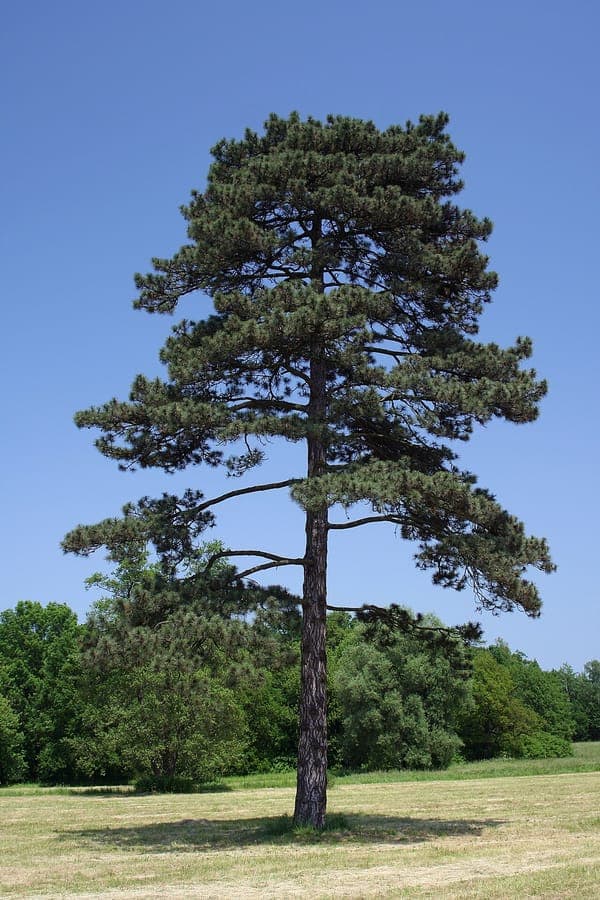
Przykuta / CC BY 3.0, via Wikimedia Commons
Austrian pine: complete guide
Pinus nigra
Want to see Austrian pine: complete guide in your garden?
1 minute, no credit card
Overview
Pinus nigra, commonly known as Austrian pine, is a bold evergreen conifer that brings year-round presence and structure to large gardens, parks, and open landscapes. Despite its name, it's not native to Austria alone but spreads across southern Europe-from Greece and Albania to Corsica and southern France. It's a tough, adaptable species that thrives in challenging conditions, making it a reliable choice for gardeners looking for a low-maintenance, long-lived tree.
This pine grows at a moderate to fast rate, adding 30 to 50 cm in height annually during its youth. Mature trees reach 20 to 35 meters tall, with a spread of 6 to 10 meters. The crown starts pyramidal but gradually becomes broad and rounded, sometimes irregular with age. That natural shaping makes it useful in both formal and naturalistic garden designs.
It's often mistaken for the Aleppo pine or Scots pine, but Pinus nigra has darker bark and stouter, darker green needles. It's best planted young, as it doesn't transplant well once established.
On gardenworld.app, you can visualise how an Austrian pine will shape your garden's structure over time, including shadow patterns and root spread.
Appearance & bloom cycle
The Austrian pine has a commanding presence. Young trees show smooth, grey bark that turns deeply fissured and dark grey to almost black as the tree ages. Branches grow horizontally or slightly upward, bearing pairs of stiff needles 8 to 15 cm long. The needles are dark green to blue-green, lasting five to seven years before shedding.
It flowers in spring, typically from April to May. Male cones appear as small, yellow-brown clusters at the base of new shoots, releasing pollen. Female cones start reddish and form at shoot tips. After pollination, they mature into woody cones 5 to 10 cm long, taking two to three years to ripen. These cones often persist on the tree for years, providing winter interest.
Ideal location
Plant Austrian pine in a spacious, sunny spot. It needs room to grow-keep it at least 6 meters from buildings, driveways, or underground utilities. It tolerates partial shade but performs best in full sun.
It's highly wind-resistant and works well as a windbreak on exposed sites or coastal areas. Stake young trees for the first three years, especially in windy gardens, to prevent rocking and root damage.
Use gardenworld.app to check spacing and future canopy coverage before planting. That way, you avoid overcrowding or conflicts with other garden elements down the line.
Soil requirements
This pine isn't fussy about soil type. It grows well in sandy, loamy, or clay soils, as long as drainage is good. Avoid waterlogged sites-especially in winter, when wet roots lead to rot. On heavy clay, consider planting on a mound or adding gravel to improve drainage.
It tolerates a pH range from 5.5 to 7.5. Nutrient-poor soils slow growth but don't harm the tree. In weak soils, apply a slow-release organic fertiliser or compost in early spring to encourage healthy growth.
Free design
Want to see Austrian pine: complete guide in your garden? Make a free design now.
Watering
Young trees need regular watering for the first two to three years. Give 10 litres per week during dry spells, applied slowly at the base. Avoid overhead watering to prevent fungal issues.
Once established, Austrian pine is highly drought-tolerant. Mature trees rarely need supplemental watering, except during prolonged heatwaves. When you do water, soak deeply but infrequently to promote deep root development.
Pruning
Pruning is rarely needed. The tree naturally forms a strong central leader and well-spaced branches. Only remove broken, damaged, or diseased wood, and do so in late winter or early spring before new growth begins.
Never cut back into old, needle-free wood-pines don't re-sprout from bare stems. If you want to slow growth, pinch back half of the new candle growth in May. This controls size without ruining the tree's shape.
Maintenance calendar
- January: Check for storm damage, remove heavy snow from branches
- February: No action needed unless broken branches
- March: Inspect for pests, secure stakes if needed
- April: Light feeding on poor soils, check for new growth
- May: Pinch candles on young trees, monitor for cones
- June: No maintenance, water only if dry
- July: Deep water during heatwaves
- August: Leave undisturbed
- September: Remove fallen cones, check for needle discoloration
- October: Ensure good drainage before winter
- November: No action
- December: Protect young trees from frost scorch with burlap if exposed
Winter hardiness
Pinus nigra is hardy to -25°C (USDA zone 5). Young trees may suffer from winter burn in harsh, dry winds-especially on the south or east side. Wrap the crown with hessian in the first few winters if needed. Mature trees handle snow load and cold snaps without issue.
Companion plants
Underplant with low-growing, drought-tolerant species like Thymus vulgaris, Sedum 'Autumn Joy', or Nepeta faassenii. Avoid vigorous groundcovers like ivy or periwinkle that might climb the trunk.
Group with other conifers-such as Picea pungens or Larix decidua-for a layered evergreen effect. Use Juniperus scopulorum or Cotoneaster dammeri for mid-level texture.
Closing
Austrian pine isn't for small gardens, but it's a powerhouse for large-scale planting. It's tough, long-lived, and needs little care once established. Give it space, sun, and well-drained soil, and it'll reward you with decades of structure and shade. Buy from reputable garden centres that sell healthy, nursery-grown stock-avoid wild-dug specimens. With smart planning-like using gardenworld.app to map out growth and spacing-you'll integrate this tree seamlessly into your garden's long-term vision.
Want to see Austrian pine: complete guide in your garden? Make a free design now.
Upload a photo, pick a style, and get a photorealistic design with plant list in under a minute.
No credit card required


Similar plants
Abies delavayi: complete guide
Abies delavayi
Delavayi fir is an elegant, medium-sized coniferous tree from the Pinaceae family with dark green needles. This Asian evergreen is perfect for alpine gardens and large landscapes.
Taiwan fir: complete guide
Abies kawakamii
Discover the magnificent Taiwan fir, a rare evergreen conifer from Taiwan's mountain regions. Learn growth requirements, care tips, and why this beautiful tree is perfect for collectors of unique garden specimens.
Farges fir: complete guide
Abies fargesii
Discover the majestic Farges fir, an impressive conifer from China's mountains with elegant foliage and columnar form. Ideal for large gardens.