
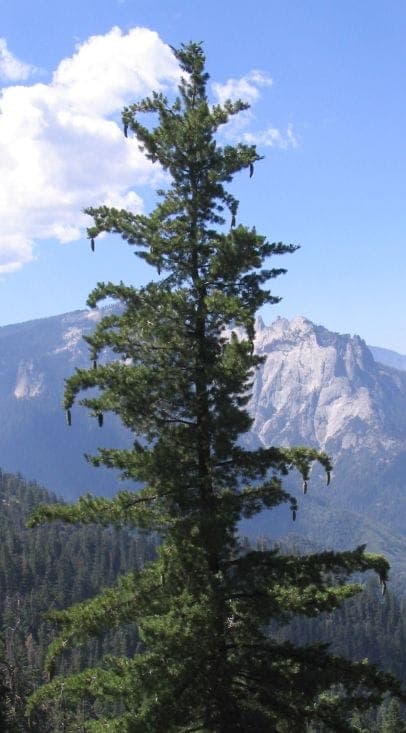
Willmcw / Public domain, via Wikimedia Commons
Sugar pine: complete guide
Pinus lambertiana
Want to see Sugar pine: complete guide in your garden?
1 minute, no credit card
Overview
The Sugar pine (Pinus lambertiana) is a true giant among conifers, native to the mountainous regions of California, southern Oregon, western Nevada, and northwest Mexico. It's the tallest and largest pine species in the world, capable of reaching over 60 meters in its natural habitat. In garden settings across temperate zones, it typically matures at 25–30 meters, making it suitable for large estates, parks, or rural properties. This slow-growing tree can live for more than 500 years, developing a stately presence that becomes a focal point over decades.
Known for its sweet, edible resin-once harvested by Indigenous peoples as a natural sweetener-the Sugar pine is more than just a visual spectacle. It supports wildlife, stabilizes soil, and adds long-term value to any landscape. If you're planning a sustainable, nature-inspired garden, this tree deserves serious consideration. With gardenworld.app, you can map out mature canopy spread and root zones to ensure your Sugar pine has room to thrive.
Appearance & bloom cycle
The Sugar pine features a straight, slender trunk with smooth, greyish bark when young, developing deep fissures and a scaly texture with age. Its crown is open and pyramidal, becoming more irregular in very old specimens. The needles grow in bundles of five, are 8–12 cm long, and maintain a rich green color year-round.
The most distinctive feature is its enormous cones-the longest of any conifer, reaching up to 50 cm. These appear in late spring, starting green and turning brown as they mature over two years. Male flowers are small and brown, releasing pollen in May, while female cones start reddish before swelling and hardening. Seed dispersal occurs in autumn, so be mindful of self-seeding in confined spaces.
Ideal location
Plant your Sugar pine in full sun-minimum 6 hours of direct light daily. It tolerates partial shade when young but thrives best in open areas. Allow at least 8 meters of clearance from buildings, driveways, or power lines. This tree needs deep root space and unrestricted vertical growth. Avoid planting near patios or lawns that you want to keep sunny, as the mature canopy casts dense shade.
Use gardenworld.app to simulate future shading patterns and ensure your garden design accounts for the tree's long-term footprint.
Soil requirements
Sugar pine adapts to a wide pH range (5.6–8.0) and grows well in sandy, loamy, or gravelly soils as long as drainage is excellent. Avoid heavy clay or waterlogged sites, which promote root rot. A deep, well-aerated soil is ideal. If your garden has compacted soil, consider deep tilling or raised mounding before planting.
Free design
Want to see Sugar pine: complete guide in your garden? Make a free design now.
Watering
Young trees need consistent moisture for the first 2–3 years. Water deeply once a week during dry spells, applying 20–30 liters per session. Mature trees are highly drought-tolerant and rarely need supplemental watering, except during prolonged droughts in the first few summers. Overwatering can be more harmful than underwatering-always check soil moisture before irrigating.
Pruning
Pruning is rarely necessary. The Sugar pine naturally develops a strong central leader and balanced form. Only remove dead, damaged, or crossing branches, and do so in late winter before new growth begins. Use sterilized tools to prevent disease spread. Avoid topping or heavy pruning, as pines do not regenerate well from old wood.
Maintenance calendar
- Jan: Inspect for winter damage, remove deadwood
- Feb: Final window for light structural pruning
- Mar: Check for pests, secure young trees if needed
- Apr: Apply balanced granular fertilizer if soil is poor
- May: Pollen release; monitor for fungal issues in wet springs
- Jun: Minimal care; watch for drought stress in young trees
- Jul: No fertilizing; reduce watering unless extreme heat
- Aug: Cones mature; collect seeds if desired
- Sep: Evaluate growth, prepare for autumn leaf drop
- Oct: Clear fallen cones and needles; mulch lightly
- Nov: Final deep watering for young trees
- Dec: Protect thin bark from rodents with tree guards
Winter hardiness
Hardy in USDA zones 6–8, the Sugar pine handles most winter conditions in the UK, Pacific Northwest, and similar climates. Young trees may suffer bark splitting in harsh freezes-wrap the trunk with burlap or use a spiral guard for the first 2–3 winters. Avoid fertilizing late in the season to prevent tender growth before frost.
Companion plants
Plant drought-tolerant, shade-adapted perennials beneath mature Sugar pines. Good choices include Heuchera, Carex, Pachysandra, and Helleborus. Avoid aggressive groundcovers or high-water-demand plants. For larger companions, consider oaks or other native conifers like Douglas fir, spaced well apart to prevent competition.
Closing
The Sugar pine isn't for small gardens, but for those with space, it's a legacy tree. Its slow growth pays off in resilience and beauty over time. Look for young stock at garden centres like those in the UK, or specialty nurseries. With proper planning and patience, this magnificent pine will become a centerpiece for generations. Plan smart today with gardenworld.app and watch your landscape evolve with purpose.
Want to see Sugar pine: complete guide in your garden? Make a free design now.
Upload a photo, pick a style, and get a photorealistic design with plant list in under a minute.
No credit card required


Similar plants
Abies delavayi: complete guide
Abies delavayi
Delavayi fir is an elegant, medium-sized coniferous tree from the Pinaceae family with dark green needles. This Asian evergreen is perfect for alpine gardens and large landscapes.
Taiwan fir: complete guide
Abies kawakamii
Discover the magnificent Taiwan fir, a rare evergreen conifer from Taiwan's mountain regions. Learn growth requirements, care tips, and why this beautiful tree is perfect for collectors of unique garden specimens.
Farges fir: complete guide
Abies fargesii
Discover the majestic Farges fir, an impressive conifer from China's mountains with elegant foliage and columnar form. Ideal for large gardens.