
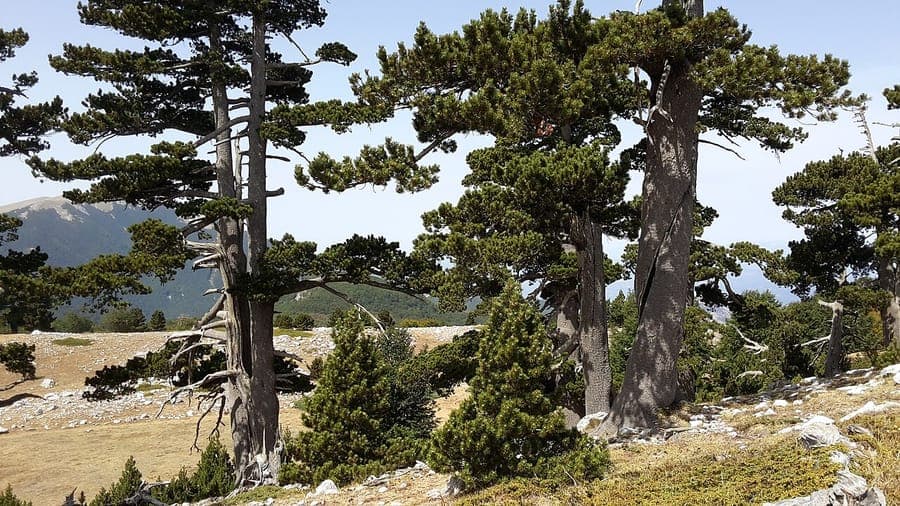
Fuoco Fatuo / CC0, via Wikimedia Commons
Heldreich pine: complete guide
Pinus heldreichii
Want to see Heldreich pine: complete guide in your garden?
1 minute, no credit card
Overview
Pinus heldreichii, commonly known as the Heldreich pine or Bosnian pine, is a rugged evergreen conifer native to the mountainous regions of Albania, Greece, Bulgaria, and parts of southern Italy and former Yugoslavia. This slow-growing pine typically reaches 10–15 meters in height in the wild but stays more compact in cultivation, averaging 6–8 meters over 20 years. Its striking, plated bark and dense, pyramidal form make it a standout choice for gardeners seeking architectural structure and year-round interest.
On gardenworld.app, you can visualise how a Heldreich pine fits into your garden layout, especially in sunny, well-drained spots where low-maintenance evergreens thrive.
Appearance & bloom cycle
One of the most distinctive features of the Heldreich pine is its thick, scaly bark, which develops deep fissures and grey-brown plates by maturity-giving it a reptilian appearance, hence the German name Schlangenhautkiefer (snake-skin pine). The needles are dark green, stiff, and grow in pairs, measuring 6–10 cm long. They persist for 3–5 years, ensuring the tree maintains a full crown throughout the year.
Flowering occurs in late spring. Male cones appear in April as small reddish clusters, releasing pollen. Female cones are purplish-brown and form upright on new growth. After pollination, the cones take three full years to mature into ovoid, woody cones 5–8 cm long. This slow development means seed production is infrequent in garden specimens.
Ideal location
Full sun is essential-aim for at least 6–8 hours of direct sunlight daily. While the Heldreich pine can tolerate light shade, growth slows and the crown may become sparse. Ideal settings include rock gardens, slopes, or as a specimen tree in formal or Mediterranean-style landscapes.
Allow at least 3 meters of clearance from buildings and other trees to accommodate its mature spread. On gardenworld.app, use the garden planner to test spacing and sunlight exposure before planting.
Soil requirements
This pine is adaptable to poor soils but demands excellent drainage. Heavy clay or waterlogged soils will lead to root rot. The ideal soil is sandy, gravelly, or loamy, with a pH between 5.5 and 7.5. If planting in heavy soil, amend with coarse sand, pumice, or gravel to improve aeration.
Avoid adding organic matter directly to the planting hole, as this can create a moisture trap. Instead, apply a thin layer of gravel mulch around the base to reduce weeds and reflect heat-just keep it away from the trunk to prevent moisture buildup.
Free design
Want to see Heldreich pine: complete guide in your garden? Make a free design now.
Watering
During the first growing season, water deeply once a week-about 10–15 liters per tree-especially during dry spells. After establishment (year 2+), the Heldreich pine is highly drought-tolerant and rarely needs supplemental watering, except during prolonged droughts lasting over four weeks.
Use drip irrigation or water at the base to prevent fungal issues. Never overhead water the canopy, as this encourages needle cast diseases.
Pruning
Pruning is generally unnecessary. The Heldreich pine naturally develops a strong central leader and symmetrical shape. Only remove dead, broken, or diseased branches, and do so in early spring (March) before new growth begins.
Avoid cutting into old wood, as pines don't regenerate from bare branches. Use sterilised tools to prevent disease spread. If you must shape the tree, pinch new candles in late spring-but do so sparingly.
Maintenance calendar
- January: Inspect for winter damage and rodent activity.
- February: Clean and sterilise pruning tools.
- March: Remove dead wood; check for aphids or pine beetles.
- April: Monitor male cone development; no fertiliser needed.
- May: Water during extended dry periods.
- June: No maintenance required.
- July: Keep base clear of weeds and grass.
- August: Watch for drought stress in young trees.
- September: Leave mature cones for wildlife or collect seeds.
- October: Apply gravel or stone mulch around the base.
- November: Protect young trunks from rabbits with wire mesh.
- December: Check for snow load damage on lower branches.
Winter hardiness
Extremely hardy, the Heldreich pine thrives in USDA zones 4–8, tolerating temperatures down to -25°C. It handles snow load well due to its strong branching structure. In exposed sites, winter desiccation can cause needle scorch-especially in young trees. Use burlap wraps or windbreaks in windy, north-east facing gardens.
Snow accumulation on branches is usually not a problem, but gently shake off heavy loads to prevent breakage.
Companion plants
Pair the Heldreich pine with drought-tolerant, sun-loving plants. Excellent companions include Lavandula angustifolia, Thymus vulgaris, Sedum spectabile, and low-growing junipers like Juniperus communis 'Compressa'. Underplant with Cistus x hybridus or Phlomis fruticosa for texture and seasonal bloom.
Avoid vigorous groundcovers with invasive roots. Stick to species that don't compete heavily for moisture.
Closing
The Heldreich pine isn't a fast grower, but it rewards patience with decades of reliable structure, minimal care needs, and a commanding presence. It's perfect for rock gardens, slopes, and low-maintenance landscapes where character and resilience matter.
You can find young specimens at garden centres across the UK, or explore visual planting ideas on gardenworld.app to see how this pine enhances a structured, naturalistic garden design.
Want to see Heldreich pine: complete guide in your garden? Make a free design now.
Upload a photo, pick a style, and get a photorealistic design with plant list in under a minute.
10,000+ gardens designed already
No credit card required


Similar plants
Abies delavayi: complete guide
Abies delavayi
Delavayi fir is an elegant, medium-sized coniferous tree from the Pinaceae family with dark green needles. This Asian evergreen is perfect for alpine gardens and large landscapes.
Taiwan fir: complete guide
Abies kawakamii
Discover the magnificent Taiwan fir, a rare evergreen conifer from Taiwan's mountain regions. Learn growth requirements, care tips, and why this beautiful tree is perfect for collectors of unique garden specimens.
Farges fir: complete guide
Abies fargesii
Discover the majestic Farges fir, an impressive conifer from China's mountains with elegant foliage and columnar form. Ideal for large gardens.