
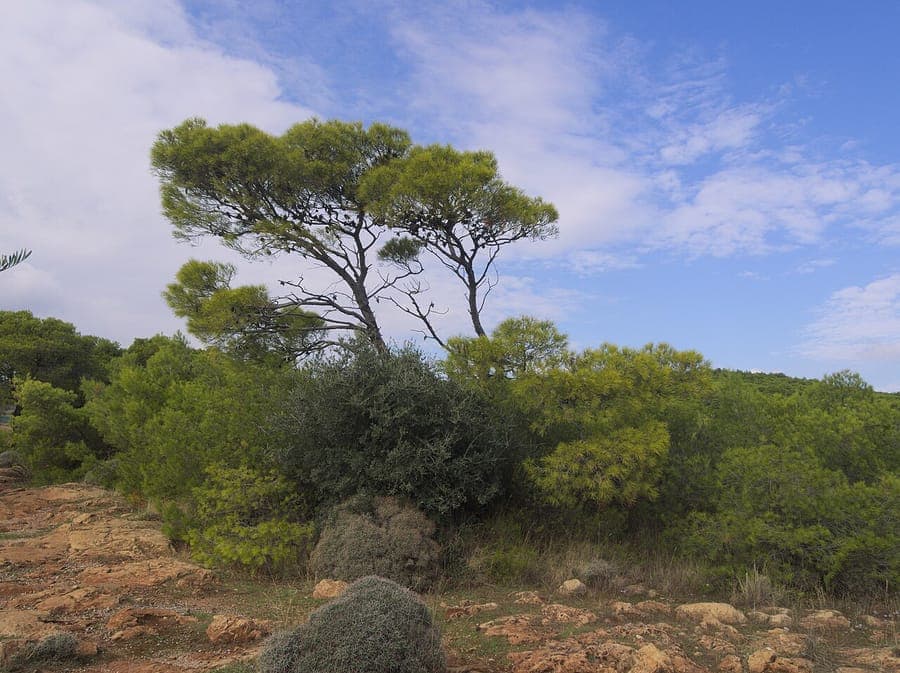
C messier / CC BY-SA 4.0, via Wikimedia Commons
Jerusalem pine: complete guide
Pinus halepensis
Want to see Jerusalem pine: complete guide in your garden?
1 minute, no credit card
Overview
Pinus halepensis, commonly known as Jerusalem pine, is a hardy evergreen tree native to the Mediterranean basin. It thrives naturally in countries like Greece, southern France, Italy, and Lebanon, where hot, dry summers and mild winters are the norm. This pine adapts well to coastal conditions, tolerating salt spray and sandy soils, making it a top pick for seaside gardens. In cooler climates, it performs best in sheltered, sunny spots.
Mature trees reach 15 to 20 meters in height with a spread of 6 to 10 meters, depending on growing conditions. Growth rate is moderate to fast-expect 30 to 50 cm per year under optimal conditions. The open, irregular crown gives it a sculptural quality, perfect for informal and naturalistic garden designs. If you want a tree that adds height and character without dominating the space, Jerusalem pine fits the bill.
On gardenworld.app you can design a garden layout that complements the Jerusalem pine's structure-think gravel paths, warm stone, and companion plants from similar climates.
Appearance & bloom cycle
The Jerusalem pine features long, slender needles growing in pairs, 6 to 12 cm in length. They range from light green to a silvery grey-green, creating a fine-textured, airy canopy. Cones are ovoid, 5 to 10 cm long, and take about three years to mature. They remain closed until exposed to high heat-like a wildfire-then release seeds, a clever evolutionary adaptation.
While it doesn't produce showy flowers, it does have reproductive structures: male catkins are yellow and form at the base of new shoots in early spring (March-April), while female cones start reddish and mature higher in the crown. Wind disperses the seeds once cones open.
Ideal location
Plant in full sun-rate 8 on the light scale-for best growth. Allow at least 5 meters between the tree and buildings or other large plants to prevent crowding. It tolerates light morning or evening shade but performs poorly in deep or prolonged shade.
This pine is ideal for USDA zones 8 to 11. In cooler zones like 7b, protect young trees during the first few winters. Planting near a south-facing wall helps retain heat. Avoid locations with strong, cold winds, which can dry out needles and damage young growth.
Soil requirements
Jerusalem pine isn't fussy about soil. It grows well in sandy, loamy, or rocky substrates as long as drainage is excellent. The ideal pH is slightly alkaline: 7.0 to 7.5. Poor, low-nutrient soils are fine-this pine evolved in tough conditions.
Never amend the planting hole with rich compost or manure. Excess nutrients can harm root development. If planting in heavy clay, raise the tree on a 30-40 cm mound to improve drainage and prevent root rot.
Free design
Want to see Jerusalem pine: complete guide in your garden? Make a free design now.
Watering
Water deeply once a week during the first growing season, applying 10-15 liters per tree. After year one, the tree becomes highly drought-tolerant and rarely needs supplemental watering, except during extreme droughts lasting more than six weeks.
Use deep, infrequent watering to encourage roots to grow downward. Avoid frequent light sprinkling, which promotes shallow roots and weakens drought resistance.
Pruning
Pruning is rarely needed. The tree's natural form is attractive and healthy. Only remove dead, broken, or crossing branches, and do so in late spring or early summer (May-June). Avoid heavy pruning-pines don't regenerate well from old wood.
If shaping a young tree, consider gently tipping the central leader to encourage lateral branching. But most gardeners prefer to let it grow wild and free.
Maintenance calendar
- Jan: Inspect for storm damage and broken branches.
- Feb: No action required.
- Mar: Check for male catkins; water young trees if soil is dry.
- Apr: Continue watering saplings during dry spells.
- May: Light pruning window opens; watch for pests.
- Jun: No feeding or extra care needed.
- Jul: Prevent stem scorch by avoiding reflective mulch or light-colored stones near the trunk.
- Aug: Monitor for drought stress-water only if essential.
- Sep: No maintenance.
- Oct: Look for fallen cones and natural seed dispersal.
- Nov: Wrap young trunks with burlap in cold regions.
- Dec: Final winter check: stability, signs of pests or disease.
Winter hardiness
Hardy in USDA zones 8–11. Tolerates brief dips to -12°C once mature, but young trees are vulnerable below -10°C. In marginal zones, use frost cloth or burlap wraps for the first 2–3 winters. Mulch lightly, but keep it away from the trunk to prevent rot.
Companion plants
Pair Jerusalem pine with drought-tolerant Mediterranean species: Cistus, Lavandula, Rosmarinus officinalis, and Yucca gloriosa. These share its preference for sun, dry soil, and good drainage. Avoid moisture-loving plants like hostas or ferns.
On gardenworld.app, you can explore plant combinations that mimic natural Mediterranean ecosystems-perfect for low-maintenance, climate-smart gardens.
Closing
Jerusalem pine is a resilient, low-maintenance tree that brings architectural interest to gardens. With proper siting and care in its early years, it becomes a long-lived focal point. Purchase from reputable garden centres, especially those specializing in Mediterranean plants. Once established, it asks for little-just space, sun, and time.
Want to see Jerusalem pine: complete guide in your garden? Make a free design now.
Upload a photo, pick a style, and get a photorealistic design with plant list in under a minute.
No credit card required


Similar plants
Abies delavayi: complete guide
Abies delavayi
Delavayi fir is an elegant, medium-sized coniferous tree from the Pinaceae family with dark green needles. This Asian evergreen is perfect for alpine gardens and large landscapes.
Taiwan fir: complete guide
Abies kawakamii
Discover the magnificent Taiwan fir, a rare evergreen conifer from Taiwan's mountain regions. Learn growth requirements, care tips, and why this beautiful tree is perfect for collectors of unique garden specimens.
Farges fir: complete guide
Abies fargesii
Discover the majestic Farges fir, an impressive conifer from China's mountains with elegant foliage and columnar form. Ideal for large gardens.