
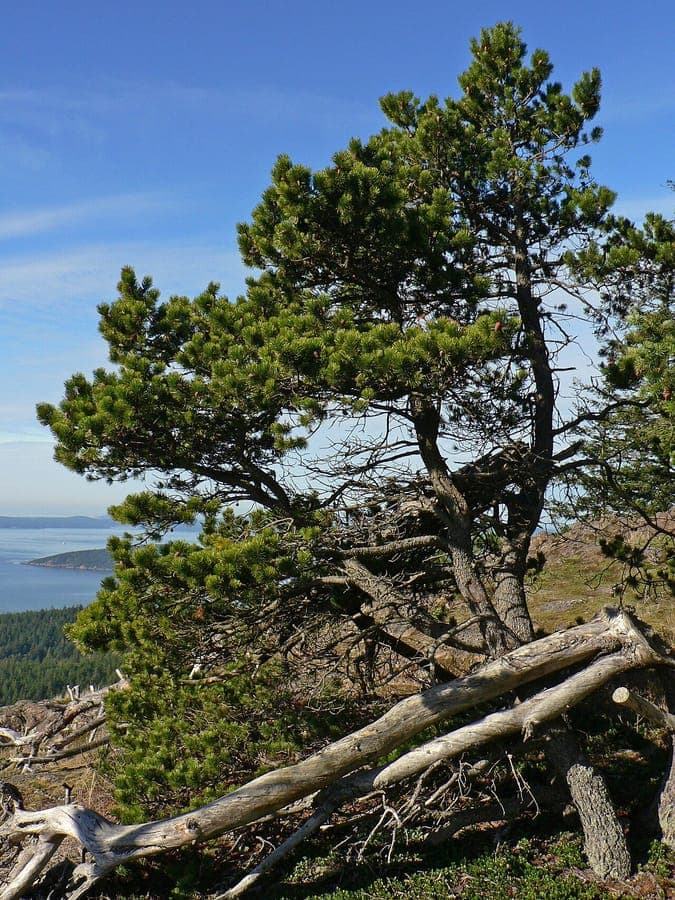
Walter Siegmund / CC BY 2.5, via Wikimedia Commons
Lodgepole pine: complete guide
Pinus contorta
Want to see Lodgepole pine: complete guide in your garden?
1 minute, no credit card
Overview
Pinus contorta, commonly known as Lodgepole pine, is a resilient evergreen tree native to western North America, stretching from Alaska down to northern Mexico. In the UK and other temperate regions, it's increasingly used in large gardens, rewilding projects, and as a windbreak or specimen tree. It grows fast when young, reaching up to 25 meters in height with a spread of 5 to 6 meters, making it a bold choice for spacious landscapes.
On gardenworld.app you can visualise how a mature Lodgepole pine fits into your garden layout, especially when planning for long-term structure or screening.
Appearance & bloom cycle
The Lodgepole pine gets its name from the often twisted trunk and branches – a trait more pronounced in older trees. Young trees have a narrow, conical shape that opens up with age. The bark is thin, scaly, and ranges from grey to dark brown. Needles grow in pairs, are 4 to 8 cm long, and stay on the tree for 2 to 3 years, giving a consistently green canopy.
Flowering occurs in May and June. Male cones are small, yellowish, and clustered near new shoots. Female cones are oval, 3 to 5 cm long, and remain closed for years – sometimes only opening after exposure to fire, a natural adaptation for seed dispersal. These serotinous cones add visual interest in winter, clinging tightly to branches.
Ideal location
Lodgepole pine needs full sun – a 7 out of 10 on the light scale. That means at least 6 hours of direct sunlight daily, with no shading from buildings or larger trees. In shaded spots, growth slows, the crown becomes sparse, and the tree leans toward the light.
Plant it in an open area, at least 6 meters from structures or underground services. This tree doesn't like competition. Use gardenworld.app to model spacing and growth projections so your design accommodates its long-term size.
Soil requirements
This pine is adaptable but prefers well-drained soil. Ideal pH ranges from 6.2 to 7.5 – slightly acidic to neutral. It tolerates sandy, loamy, and gravelly soils as long as water doesn't pool. Heavy clay or waterlogged sites lead to root rot, especially in young trees.
Avoid low-lying areas with poor drainage. If planting in clay, amend the hole with sand and compost to improve texture. A slight slope helps with runoff – ideal for sloped gardens.
Free design
Want to see Lodgepole pine: complete guide in your garden? Make a free design now.
Watering
Once established, Lodgepole pine is highly drought tolerant. But in the first two growing seasons, regular watering is crucial. Provide 10 to 15 litres per week during dry spells, especially in summer. Use a slow drip method or water deeply at the base to encourage deep rooting.
After year two, rainfall is usually sufficient. Only supplement during prolonged droughts, particularly for trees under 3 meters.
Pruning
Pruning is rarely needed. The natural form is strong and upright. Only remove dead, damaged, or crossing branches in late winter or early spring, before bud break. Use clean, sharp tools and avoid cutting into the branch collar.
No pruning required? Even better. This low-maintenance tree suits naturalistic or low-intervention gardens.
Maintenance calendar
- January: Inspect for storm or snow damage. Remove broken branches.
- February: Check for pests or fungal signs. Treat organically if needed.
- March: Final pruning window. Apply mulch with bark chips.
- April: Monitor bud swell. No fertiliser needed.
- May: Flowering begins. No intervention required.
- June: Peak growth. Water young trees if dry.
- July: Watch for signs of stress in heat. Check for deadwood.
- August: Reduce watering. No pruning.
- September: Avoid feeding. Keep soil lightly moist.
- October: Clear debris. Use fallen needles as light mulch.
- November: Protect young trunks from rabbits with tree guards.
- December: Winter check. Ensure no waterlogging at base.
Winter hardiness
Lodgepole pine is hardy in USDA zones 4 to 7, tolerating temperatures down to -34°C. In the UK (zone 7b to 8a), it withstands winter with no issues. Young trees may bend under heavy snow but usually recover.
Use spiral tree guards to protect saplings from voles and rabbits during winter months.
Companion plants
Pair with low-growing, drought-tolerant plants that don't compete for moisture. Good companions include heather (Calluna vulgaris), sheep's fescue (Festuca ovina), birch (Betula spp.) at a distance, and lavender (Lavandula angustifolia) in sunny borders. Avoid invasive rooters like bamboo or ground-covering ivy.
On gardenworld.app, you can design planting schemes that balance structure and texture using these companion plants.
Closing
The Lodgepole pine is a tough, attractive tree that demands space but repays with decades of low-maintenance presence. It's ideal for large gardens, rural settings, or as a windbreak. With proper siting and care in the first years, it becomes a striking focal point. Remember: this tree can live over 100 years. Buy healthy stock from reputable garden centres – look for straight trunks and well-developed root balls.
Want to see Lodgepole pine: complete guide in your garden? Make a free design now.
Upload a photo, pick a style, and get a photorealistic design with plant list in under a minute.
No credit card required


Similar plants
Abies delavayi: complete guide
Abies delavayi
Delavayi fir is an elegant, medium-sized coniferous tree from the Pinaceae family with dark green needles. This Asian evergreen is perfect for alpine gardens and large landscapes.
Taiwan fir: complete guide
Abies kawakamii
Discover the magnificent Taiwan fir, a rare evergreen conifer from Taiwan's mountain regions. Learn growth requirements, care tips, and why this beautiful tree is perfect for collectors of unique garden specimens.
Farges fir: complete guide
Abies fargesii
Discover the majestic Farges fir, an impressive conifer from China's mountains with elegant foliage and columnar form. Ideal for large gardens.