
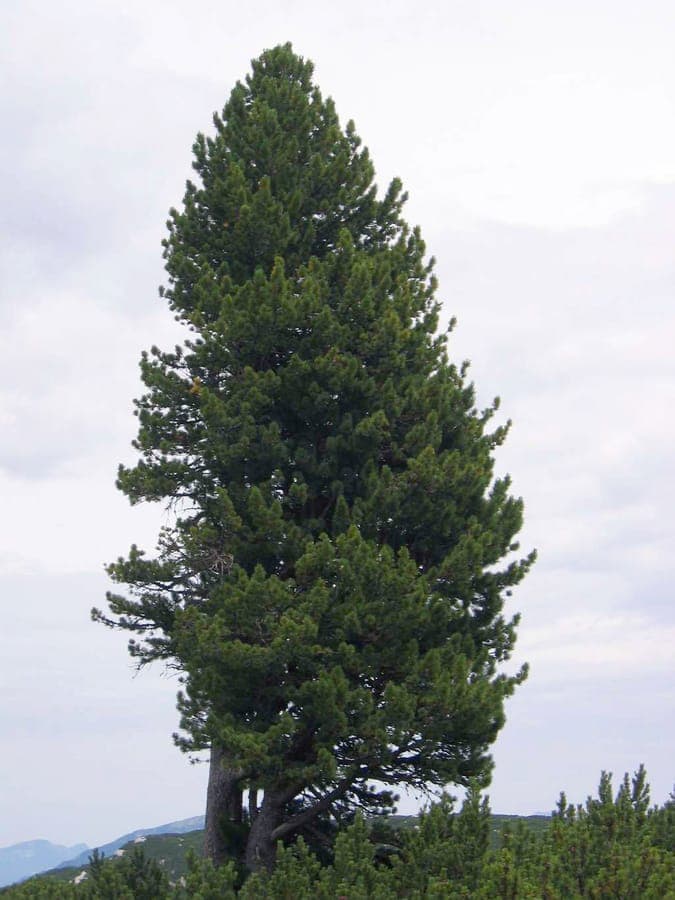
Tigerente at German Wikipedia / CC BY-SA 3.0, via Wikimedia Commons
Arolla pine: complete guide
Pinus cembra
Want to see Arolla pine: complete guide in your garden?
1 minute, no credit card
Overview
Pinus cembra, commonly known as the Arolla pine, is a slow-growing conifer native to the high-altitude regions of the Alps and Carpathians. In the UK and northern Europe, it's not commonly seen in suburban gardens, but for those who appreciate rugged, long-lived trees with alpine character, it's a standout choice. Mature trees reach 20–25 meters in the wild, but in cultivated gardens, they typically grow to 10–15 meters over several decades. With a lifespan often exceeding 500 years, this is a tree for the long haul.
On gardenworld.app you can design a garden layout that accounts for the Arolla pine's mature spread and longevity, ensuring it has room to thrive without crowding other plants or structures.
Appearance & bloom cycle
Young Arolla pines have a neat, conical shape that becomes broader and more irregular with age. The bark starts smooth and silvery-grey, developing deep fissures and a rugged texture over time. The needles are soft, bluish-green, and grow in bundles of five – a hallmark of the white pine group. They remain on the tree for up to five years, giving the crown a dense, evergreen look.
In June, the tree produces small flowers: male catkins in bright yellow that release clouds of pollen, and female cones in a deep purple hue. These female flowers mature slowly into oval, upright cones that stay closed for up to two years. When they finally open in warm, dry weather, they release edible seeds known as Swiss pine nuts, prized by birds and squirrels alike.
Ideal location
This pine thrives in full sun – aim for a light rating of 8 out of 10. Choose an open, unshaded site with good air circulation. While it tolerates light shade, growth will be slower and the crown less dense. In exposed coastal or windy areas, young trees may benefit from temporary windbreaks. Avoid planting near buildings or paved areas that radiate heat, as this can stress the tree.
Use gardenworld.app to visualise how the tree will fit into your space over time, especially if you're planning other structural elements like paths or seating.
Soil requirements
Pinus cembra prefers well-drained, slightly acidic to neutral soil with a pH between 5.5 and 6.5. It struggles in heavy clay or waterlogged ground. If your soil is compacted, amend it with coarse sand, composted pine bark, and grit to improve drainage. Never add lime – this pine is lime-averse and may show signs of chlorosis if the pH rises too high.
In containers, use a mix of loam-based compost, perlite, and pine fines to mimic alpine conditions.
Free design
Want to see Arolla pine: complete guide in your garden? Make a free design now.
Watering
During the first two to three growing seasons, water deeply once a week during dry spells. After establishment, the Arolla pine is highly drought-tolerant thanks to its deep root system. Overwatering is a bigger threat than underwatering – soggy soil leads to root rot. In prolonged summer droughts, give a thorough soak, but let the soil dry out between waterings.
Rainwater is ideal, as tap water can build up salts and affect soil pH over time.
Pruning
Pruning is rarely needed. The natural form is attractive and balanced. Only remove dead, broken, or crossing branches, and do so in late winter or early spring before new growth starts. Avoid topping or shaping – this disrupts the tree's rhythm and can invite disease.
If grown in a container, root pruning during repotting can help maintain size, but do it sparingly.
Maintenance calendar
- Jan: Inspect for storm damage
- Feb: No action required
- Mar: Remove dead wood
- Apr: Light organic mulch if needed
- May: Monitor young trees in dry periods
- Jun: Observe flowering
- Jul: No care needed
- Aug: Check for drought stress
- Sep: Leave fallen needles as natural mulch
- Oct: Check for pests or fungal spots
- Nov: Tree enters dormancy
- Dec: Protect young trees from frost scorch with hessian wrap
Winter hardiness
Extremely hardy, Pinus cembra survives in USDA zones 3 to 7 (-40°C). It handles snow load well and resists cold winds. Young trees may suffer from winter desiccation in exposed, sunny spots – wrap the crown with hessian for the first few winters if needed.
No winter protection is necessary for mature specimens.
Companion plants
Pair with plants that enjoy similar conditions: full sun, sharp drainage, and acidic soil. Good companions include heather (Calluna vulgaris), dwarf junipers (Juniperus communis 'Compressa'), alpine strawberries (Fragaria vesca), and rock roses (Helianthemum nummularium). Avoid moisture-loving plants like ferns or hostas nearby.
In mixed borders, it works well as a backdrop for low perennials like sedums or thymes.
Closing
The Arolla pine isn't for gardeners in a hurry. It grows slowly, asking for little in return. But over time, it becomes a focal point – stately, serene, and enduring. Buy healthy stock from reputable garden centres, and give it space to grow. Whether in a country estate or a compact alpine rockery, this pine adds timeless character. For design inspiration, browse gardenworld.app, where real gardens showcase how Pinus cembra integrates beautifully into long-term landscape plans.
Want to see Arolla pine: complete guide in your garden? Make a free design now.
Upload a photo, pick a style, and get a photorealistic design with plant list in under a minute.
No credit card required


Similar plants
Abies delavayi: complete guide
Abies delavayi
Delavayi fir is an elegant, medium-sized coniferous tree from the Pinaceae family with dark green needles. This Asian evergreen is perfect for alpine gardens and large landscapes.
Taiwan fir: complete guide
Abies kawakamii
Discover the magnificent Taiwan fir, a rare evergreen conifer from Taiwan's mountain regions. Learn growth requirements, care tips, and why this beautiful tree is perfect for collectors of unique garden specimens.
Farges fir: complete guide
Abies fargesii
Discover the majestic Farges fir, an impressive conifer from China's mountains with elegant foliage and columnar form. Ideal for large gardens.