
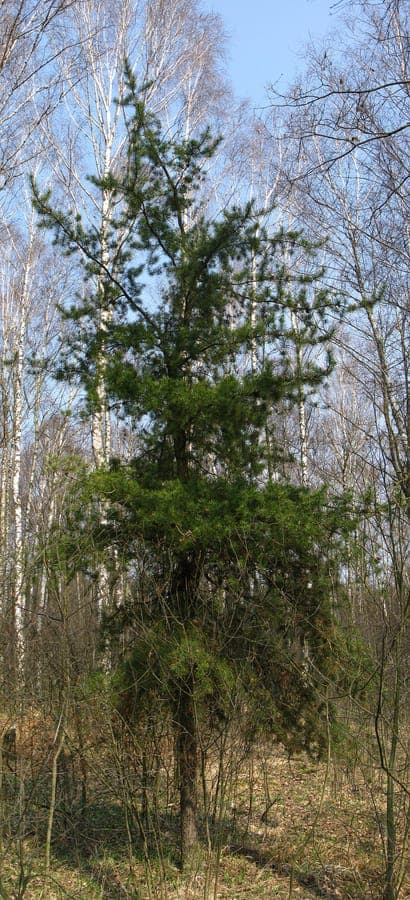
Crusier / CC BY 3.0, via Wikimedia Commons
Jack pine: complete guide
Pinus banksiana
Want to see Jack pine: complete guide in your garden?
1 minute, no credit card
Overview
Jack pine (Pinus banksiana) is a rugged, medium-sized conifer native to the boreal forests of Canada and the northern United States - from Alberta to Maine. It's not a common sight in ornamental gardens, but its toughness, adaptability, and unique form are earning it a place in naturalistic and low-maintenance landscapes. Reaching 6 to 10 meters in height with a spread of 4 to 6 meters, it grows slowly at about 20–30 cm per year. Its shrubby, irregular shape and ability to thrive on poor soils make it ideal for challenging sites where other trees struggle.
On gardenworld.app, you can design a planting layout that highlights the Jack pine's structural presence, especially in large gardens or open, windy areas.
Appearance & bloom cycle
Jack pine has short, twisted needles - 3 to 5 cm long - arranged in pairs. They're yellow-green, giving the tree a slightly golden hue, especially in spring and summer. The bark is thin, scaly, and ranges from reddish-brown to grey, becoming more furrowed with age. One of its most distinctive features is its cones: small (3–5 cm), curved like a shepherd's crook, and often persisting on the tree for years. These cones are serotinous, meaning they remain closed until exposed to high heat - typically from wildfires - which triggers seed release.
The tree flowers in May. Male cones are small and purplish, found near the base of new growth, while female cones are reddish and located near the tips of branches. After pollination, they mature into the tough, resin-sealed cones that can stay on the tree for up to a decade.
Ideal location
Full sun is essential - aim for at least 6 to 8 hours of direct sunlight daily. Jack pine won't thrive in shade; it becomes leggy and loses its dense form. It's exceptionally wind-tolerant, making it a solid choice for exposed coastal gardens, slopes, or open fields. It also handles urban pollution well, so it can survive in city environments with poor air quality.
Avoid planting it in tight corners or under dense tree canopies where airflow is restricted. Poor ventilation increases the risk of fungal issues.
Soil requirements
Jack pine isn't picky about soil as long as it drains well. It prefers sandy or gravelly soils and tolerates acidic conditions down to pH 6. The ideal pH range is 6 to 8.2. It struggles in heavy clay or waterlogged ground - root rot is a real threat. If your soil is dense, create a raised bed at least 30 cm high with a mix of sand and crushed stone to improve drainage.
Don't enrich the planting hole with compost or manure. Jack pine thrives on lean soil; too much fertility leads to weak, frost-sensitive growth.
On gardenworld.app, you can use the soil analysis tool to determine if your garden's conditions suit Jack pine - and get recommendations for site prep.
Free design
Want to see Jack pine: complete guide in your garden? Make a free design now.
Watering
During the first growing season, water weekly with about 10 liters per tree. Use a slow drip method to encourage deep root development. After year one, established trees are highly drought-tolerant and rarely need supplemental watering, even during dry spells of 4–6 weeks. Only water if the soil is bone dry and leaves start to yellow or wilt.
Avoid overhead watering, which can promote needle cast diseases. Water at the base instead.
Pruning
Pruning is rarely needed. Jack pine naturally develops an interesting, asymmetrical shape. If required, remove dead, broken, or crossing branches in late winter (February) using clean, sterilized tools. Never cut into old wood without foliage - pines don't regenerate from bare stems. Avoid shearing or formal shaping.
Resin can gum up your tools. Clean blades with rubbing alcohol or mineral spirits after use.
Maintenance calendar
- January: inspect for storm damage
- February: light pruning if needed
- March: check for insect larvae, especially pine budworm
- April: no action required
- May: flowering; monitor young trees in dry areas
- June–August: minimal care
- September: inspect for fungal spots after wet periods
- October: remove fallen cones to reduce self-seeding
- November: no maintenance
- December: check for snow load on lower branches
Winter hardiness
Jack pine is extremely cold-hardy, thriving in USDA zones 2 to 6. It can survive temperatures as low as -40°C. In the UK and northern Europe (zone 7), it performs well with no winter protection. Snow usually doesn't damage it - branches bend but rarely break. Needles stay green year-round, though they may show minor winter burn in harsh, sunny conditions.
Companion plants
Pair Jack pine with other tough, native species. Good companions include Eastern red cedar (Juniperus virginiana), grey birch (Betula populifolia), and bearberry (Arctostaphylos uva-ursi). Ground-level partners could include lowbush blueberry (Vaccinium angustifolium) or wild lupine (Lupinus perennis). Avoid aggressive groundcovers that climb the trunk and trap moisture.
Closing
Jack pine isn't a show-off, but it's a resilient, long-lived tree that brings texture and year-round interest to the garden. It asks for little and gives back in strength and character. Look for young plants (40–60 cm) at garden centres across the UK and North America. Give it sun, space, and well-drained soil, and it'll serve as a quiet anchor in your landscape for decades. Available at major retailers like garden centres across Canada and the northern US.
Want to see Jack pine: complete guide in your garden? Make a free design now.
Upload a photo, pick a style, and get a photorealistic design with plant list in under a minute.
No credit card required


Similar plants
Abies delavayi: complete guide
Abies delavayi
Delavayi fir is an elegant, medium-sized coniferous tree from the Pinaceae family with dark green needles. This Asian evergreen is perfect for alpine gardens and large landscapes.
Taiwan fir: complete guide
Abies kawakamii
Discover the magnificent Taiwan fir, a rare evergreen conifer from Taiwan's mountain regions. Learn growth requirements, care tips, and why this beautiful tree is perfect for collectors of unique garden specimens.
Farges fir: complete guide
Abies fargesii
Discover the majestic Farges fir, an impressive conifer from China's mountains with elegant foliage and columnar form. Ideal for large gardens.