
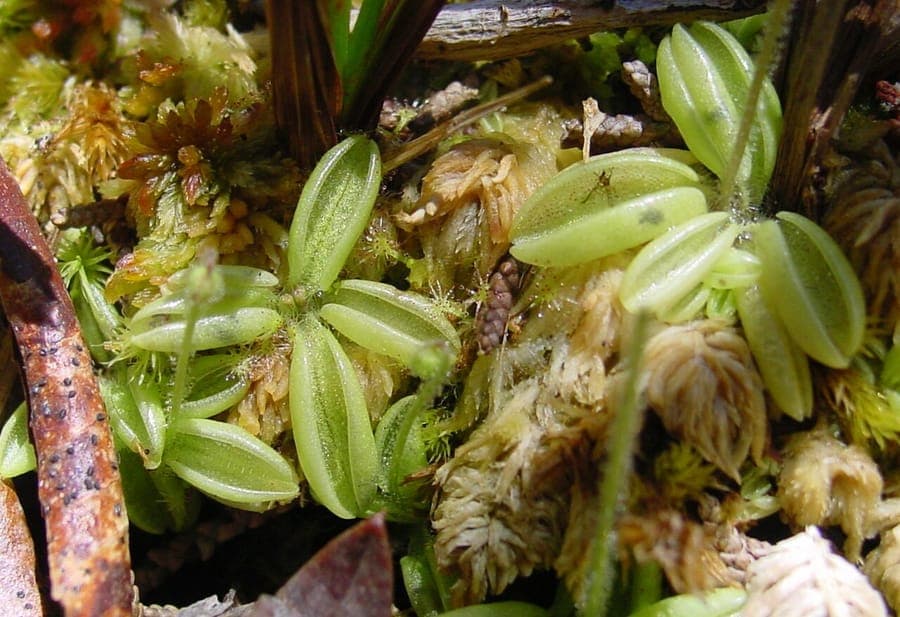
Noah Elhardt / Public domain, via Wikimedia Commons
Pinguicula lusitanica: complete guide
Pinguicula lusitanica
Want to see Pinguicula lusitanica: complete guide in your garden?
1 minute, no credit card
Overview
Pinguicula lusitanica, commonly known as pale butterwort or Portuguese butterwort, is an extremely fascinating carnivorous plant from the Lentibulariaceae family. This small but remarkable species occurs naturally in Western Europe, primarily in Portugal, Spain, France, and the United Kingdom, growing in moist, nutrient-poor boggy areas.
The plant is famous for its sticky leaves that trap and digest small insects, a unique adaptation to nutrient-poor conditions. Despite being an exotic carnivorous plant, pale butterwort can be grown relatively easily indoors or in a greenhouse.
This special plant is a favorite among carnivorous plant enthusiasts and forms an interesting educational project for anyone wanting to understand how plants adapt to their environment.
Appearance and bloom
Pale butterwort reaches a maximum height of approximately 10 to 15 centimeters. The plant forms a rosette of about 4 to 8 centimeters diameter. The leaves are rounded to oval, very soft, and covered with a glossy, sticky substance - this is actually a special glandular secretion.
This sticky layer traps small flies, midges, and other tiny insects. The plant then secretes enzymes that break down and digest the insect, after which nutrients are absorbed.
The flowers are beautifully soft lavender to white and appear on slender flower stalks from May to July. Each flower has five rounded petals and a characteristic shape. After blooming, the plant produces small seed capsules.
Ideal location
Pale butterwort thrives best in locations with bright light but without direct sunlight, especially in very warm climates. In less sunny areas (such as the Netherlands, Belgium, and much of Germany), full sun may be acceptable.
The plant has a strong preference for a humid environment. While it can grow in normal room temperature (14-22 degrees Celsius), this plant feels most comfortable in slightly cooler conditions.
Better yet, place pale butterwort in a glass greenhouse, propagation case, terrarium, or on a windowsill in a damp room with high humidity. The plant appreciates regular ventilation and good air circulation.
Soil
Pale butterwort absolutely does not need standard soil and does not grow well in normal potting soil. Instead, the plant should be planted in a very nutrient-poor, acidic mixture.
The ideal mixture consists of 3 parts sphagnum or sedge peatmoss, 1 part sand, and 1 part perlite. This recreates the natural nutrient-poor, acidic bog soils where this plant is native.
Alternatives are pure living sphagnum moss or a mixture of peatmoss with sand. Avoid all commercial potting soil, fertilizers, or soil with humus. These can damage the plant.
Free design
Want to see Pinguicula lusitanica: complete guide in your garden? Make a free design now.
Watering
Pale butterwort must always be kept moist - never drying out, but also not waterlogged. Water from above or below (by placing the pot in water for 10-15 minutes).
Only rainwater or distilled water should be used. Tap water contains minerals that can damage the sensitive leaves and cause harm. This is crucial!
During the growing season (May to October), the plant must remain almost constantly moist. In winter, watering can be slightly reduced, but the soil should never dry out completely.
In very dry environments, a water layer of 1-2 centimeters can be maintained beneath the pot, allowing the plant to absorb water through capillary action.
Pruning
Pruning is not necessary. Wilted flowers can be carefully removed, as well as dying leaves. For the most part, the plant takes care of itself.
Some gardeners remove flowers or leaves in winter to keep the plant more compact, but this is purely cosmetic.
Maintenance calendar
Spring (March-May): Plant emerges from winter dormancy. Gradually increase watering. Look for flowers appearing. Monitor humidity.
Summer (June-August): Blooming period. Plant is at its most active. Ensure a very constantly humid environment. Lightly mist on very hot days.
Autumn (September-October): Growth slows. Water remains constantly needed. Plant begins preparing for winter dormancy.
Winter (November-February): Plant goes dormant. Much less growth. Water slightly less, but ensure soil never dries out completely. Keep in a cool location.
Winter hardiness
Pale butterwort is not truly winter hardy in the strict sense. In countries like the Netherlands, Belgium, and Germany, this plant cannot overwinter outdoors. It can only be kept outdoors in very mild winters in southwestern France, Spain, and Portugal.
Elsewhere, pale butterwort must be grown indoors. In winter, the plant feels most at home on a cool windowsill (around 10-15 degrees Celsius) where light is still adequate.
Protection from frost is essential - even one night below 0 degrees can be fatal.
Companion plants
In terrariums or propagation cases, pale butterwort grows well together with other carnivorous or bog-growing plants:
- Drosera species (sundews)
- Cephalotus follicularis
- Nepenthes species (pitcher plants)
- Sphagnum moss
- Lycopodium species
- Small ferns
This collection creates a fascinating miniature ecosystem.
Closing
Pale butterwort offers a unique opportunity to grow a true carnivorous plant with minimal complexity. This plant fascinates with its sticky leaves and elegant flowers, and forms a continuously interesting subject for observation.
You'll find specialized carnivorous plant nurseries online or through specialized plant forums. For UK and Northern European gardeners, we recommend online nurseries specializing in carnivorous plants. In Germany, some garden centers carry carnivorous plant collections.
GardenWorld.app can help you design your indoor garden and plant ecosystem. With proper care, pale butterwort will be a fascinating, educational houseguest for many years.
Want to see Pinguicula lusitanica: complete guide in your garden? Make a free design now.
Upload a photo, pick a style, and get a photorealistic design with plant list in under a minute.
10,000+ gardens designed already
No credit card required


Similar plants
Zigzag bladderwort: complete guide
Utricularia subulata
Utricularia subulata, a carnivorous aquatic marvel. Discover care requirements, cultivation tips and fascinating hunting mechanisms.
Gibba bladderwort: complete guide
Utricularia gibba
Explore the gibba bladderwort, a fascinating carnivorous plant: aquatic requirements, feeding mechanism, temperature, and care for water gardens.
Hairy butterwort: complete guide
Pinguicula villosa
Pinguicula villosa is a rare carnivorous plant from subarctic regions with delicate purple flowers. Perfect for bog gardens and wet sites.