Diego Delso / CC BY-SA 3.0, via Wikimedia Commons
Friendship plant: care guide
Pilea involucrata
Want to see Friendship plant: care guide in your garden?
Full design in HD: €7.99
Look after your Friendship plant with the GardenWorld app
Identify plants with your camera and get a care calendar with reminders for this plant.


Overview
The friendship plant, Pilea involucrata, is a compact foliage plant from the nettle family (Urticaceae), grown almost entirely for its leaves. Each leaf looks quilted: small cushions puff up between deeply sunken veins, and the colouring runs from bronze and chocolate brown to a fresh lime green. In the wild it grows in the humid forests of Mexico, Central America, the Caribbean and northern South America as far as Peru, where it spreads across the shady forest floor. That origin tells you exactly what it wants indoors: soft light, steady warmth and moist air.
The common name comes from how easily it roots from cuttings. Do not confuse it with the aluminium plant (Pilea cadierei), which has silver markings on smooth leaves, or with the Chinese money plant (Pilea peperomioides) and its round, shield-shaped leaves. Pilea involucrata has its own character: low, dense and richly textured.
It stays small, grows at a good pace and fits a windowsill, a bright bathroom or an open terrarium. If you like your indoor and outdoor spaces to feel connected, you can have a garden design made at gardenworld.app for your patio or conservatory, so the mood of your windowsill carries on outside.
Appearance and flowering
The plant reaches 15 to 30 cm in height and about the same across. Its stems are succulent and often reddish, upright at first and later gently arching; where they touch the compost they sometimes root. The leaves sit in opposite pairs and are oval to broadly elliptic, 4 to 8 cm long, with finely toothed edges. The upper surface carries short hairs, while the underside is frequently reddish purple.
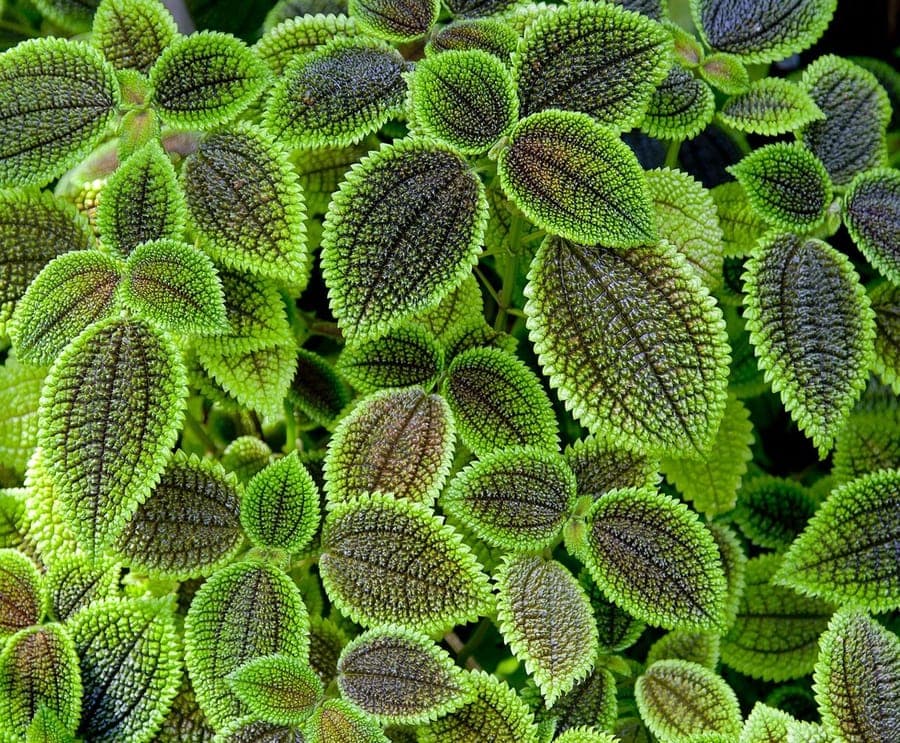
Several forms are sold. 'Moon Valley' is the best known, with deeply crinkled bright green leaves and dark brown veins; some botanists place this form under a closely related species, but it is sold under the name Pilea involucrata. 'Norfolk' has darker, almost blackish bronze leaves with silvery bands. The photo shows a dense carpet of leaves with dark bronze centres, lime-green toothed margins and a bumpy surface covered in tiny raised points.
Flowering is modest. In spring and summer small, tight clusters of greenish to pinkish flowers appear in the leaf axils, surrounded by bracts. That ring of bracts is what the species name involucrata refers to. The flowers are not showy; leave them or pinch them out so the plant puts its energy into foliage.
Where to put it indoors
Choose a warm spot without draughts, away from an outside door that opens often and not directly above a radiator. An east-facing windowsill, a shelf a couple of metres from a south window or a bathroom with natural light all suit it well. Because it grows low and wide, it looks best on a table or in a shallow bowl where you can see the leaves from above. An open glass container or a ventilated terrarium also works nicely, since the air inside stays more humid.
Light
Bright, indirect light is ideal. Morning sun is fine, but strong midday sun through glass bleaches the colours and can scorch the leaves. In too little light the stems stretch, the leaf pairs space out and the patterning loses its depth. Give the pot a quarter turn every few weeks so it grows evenly. During the darkest months a simple grow light, placed 30 to 40 cm above the plant, makes a real difference.
Humidity
This is where most problems start. Pilea involucrata wants at least 50 % relative humidity. In dry, centrally heated air the leaf edges turn brown and spider mites and thrips move in more quickly. Stand the pot on a tray of gravel with a little water, making sure the base of the pot sits above the water, or group it with other plants. A humidifier in the living room helps most in winter. We would not mist the leaves: the hairy surface holds droplets, and that can lead to rot.
Potting mix and repotting
Use an airy houseplant compost that holds moisture without packing down. A good blend is two parts multipurpose houseplant compost, one part perlite and, if you have it, a little fine coir or orchid bark. A pot with a drainage hole is essential. The roots are fine and shallow, so a wide, fairly shallow pot suits it better than a tall one.
Repot in spring, and only when roots fill the pot, which is usually every other year. Go up no more than 2 cm in diameter. After two or three years the plant often becomes bare at the base and leggy. At that point, simply replace it with a few fresh cuttings; that is quicker than trying to rejuvenate an old plant.
Free preview
Want to see Friendship plant: care guide in your garden? Make a free preview of your design.
Watering and feeding
Keep the compost lightly moist but never wet. Water as soon as the top 1 to 2 cm feels dry, and tip away any water left in the saucer after fifteen minutes. In summer that often means once or twice a week, in winter much less. Use water at room temperature; rainwater or water that has stood overnight is ideal. Aim at the compost rather than the leaves.
Overwatering is the main cause of death: the stems turn soft at the base and the plant collapses. Underwatering shows as limp, drooping leaves that recover quickly after a drink. From April to September, feed every two to three weeks with liquid houseplant fertiliser at half strength. Do not feed in winter.
Propagation
Propagation is easy, which is precisely how the plant earned its common name. In spring or summer, cut a tip cutting of 5 to 8 cm with at least two leaf nodes. Remove the lowest pair of leaves and stand the cutting in a glass of water or in moist cutting compost. A clear bag or lidded box over the top keeps the air humid. At 20 to 22 °C roots form within two to three weeks. Pot three to five cuttings together for a fuller plant. Pinch out the tips of established plants regularly too; they branch and stay compact.
Maintenance calendar
March-April: Growth picks up. Repot if needed, pinch out the tips and start feeding.
May-June: Best time to take cuttings. Keep the compost evenly moist and shield the plant from harsh sun.
July-August: Check the undersides of the leaves for spider mites and mealybugs, especially in hot, dry weather. Feed every two to three weeks.
September-October: Stop feeding. Move the plant a little closer to the window as the light fades.
November-February: Rest period. Water less, keep humidity up and avoid cold windows. To keep track of everything, add watering, feeding and repotting to the planting calendar on gardenworld.app.
Temperature and winter care
Pilea involucrata grows best between 18 and 24 °C. Below 15 °C growth stops and the plant becomes vulnerable; cold, wet compost then quickly leads to root rot. It is not frost hardy and belongs indoors all year round. In summer it can sit on a sheltered, shady patio while nights stay above 15 °C, though it gains little from the move. In winter watch out for cold windowsills and for curtains that trap the plant between the glass and the room at night.
Toxicity to pets
According to the ASPCA, the American animal welfare organisation that keeps a database of toxic and non-toxic plants, Pilea involucrata is non-toxic to dogs, cats and horses. That makes it a sensible choice for a home with animals. Non-toxic does not mean every mouthful is harmless, though: a cat that eats a lot of leaves can still get a mild stomach upset or vomit. No toxicity to people is known either.
Companion plants
The friendship plant pairs well with other plants that enjoy shade and humid air. In a terrarium or a wide bowl, combine it with Selaginella kraussiana, the tiny leaves of Soleirolia soleirolii or the moss-like Pilea microphylla. The soft green fronds of a maidenhair fern (Adiantum raddianum) contrast beautifully with the crinkled bronze leaves. A Begonia rex adds even more leaf colour and has almost identical needs. If you collect pileas, set it beside Pilea peperomioides: two completely different leaf shapes from one genus. Avoid pairing it with cacti or succulents, which need far drier conditions.
Final thoughts
Pilea involucrata is a small plant with a great deal of texture. Give it bright, indirect light, a warm spot, humid air and compost that never dries out completely but never stays wet either. Pinch out the tips and replace the plant every few years with its own cuttings, and it will stay compact and full. It is safe around pets and easy to share, so it earns its friendly name every time you hand a cutting on.

See it in your garden
See Friendship plant in your garden
One photo of your garden and a few questions. You see the result in about a minute.
Try it with a photoIdentify this plant in your own garden. Identify a plant
Similar plants
Krauss Spikemoss (Selaginella kraussiana): complete guide
Selaginella kraussiana
Krauss spikemoss is an elegant, moss-like plant ideal for shade gardens. Learn about cultivation, care, and design integration.
Soleirolia soleirolii: complete guide
Soleirolia soleirolii
Soleirolia soleirolii, the baby's-tears or Corsican carpet, is a delicate trailing plant with tiny leaves. Learn care requirements and humidity management.
Delta Maidenhair Fern: complete guide
Adiantum raddianum
Discover Adiantum raddianum, an elegant fern with delicate silky fronds. Care guide for indoor and shaded garden spots.
