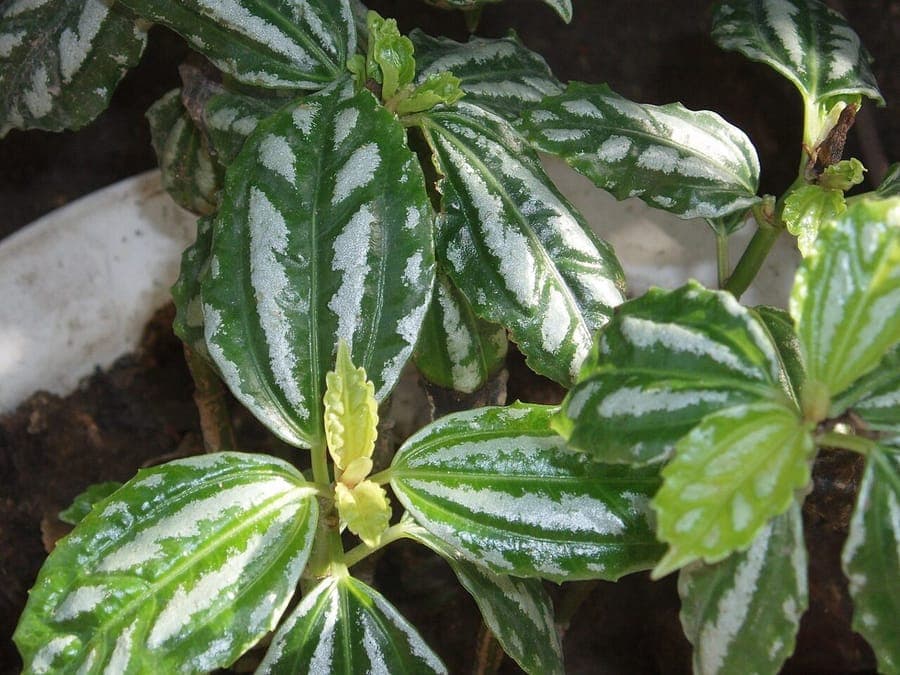
Taken by Fanghong / CC BY-SA 3.0, via Wikimedia Commons
Aluminium plant: complete guide
Pilea cadierei
Want to see Aluminium plant: complete guide in your garden?
Full design in HD: €7.99
Look after your Aluminium plant with the GardenWorld app
Identify plants with your camera and get a care calendar with reminders for this plant.


Overview
The aluminium plant (Pilea cadierei) is a houseplant you do not easily forget. Its dark green leaves carry silvery patches that look as if someone has dabbed them on with a brush dipped in metallic paint, which is where the name comes from. It is also called the watermelon pilea, because the striped pattern recalls the rind of a watermelon.
Pilea cadierei belongs to the nettle family (Urticaceae), but there is nothing to fear: it does not sting. It comes from the damp, shady forests of Vietnam and southern China and was named after Léopold Cadière, a French missionary who worked there in the early twentieth century. It is a compact, fast-growing plant that thrives in a bright spot out of harsh sun, and it holds the RHS Award of Garden Merit. It is also one of the few striking houseplants that the ASPCA lists as non-toxic to cats and dogs. Want indoors and outdoors to feel like one green whole? On gardenworld.app you can have a garden design made that ties in with the style of your interior.
Appearance and flowering
The aluminium plant forms a branching, upright bush 20 to 40 cm tall. The stems are succulent and green, becoming somewhat woody at the base on older plants. The leaves are arranged in opposite pairs, oval to egg-shaped, 5 to 10 cm long and finely toothed along the edge. Between the deeply sunken veins the leaf puckers slightly upwards, and the silver patches sit on exactly those raised areas, giving the foliage a quilted look. The young leaves at the tips are paler, almost yellow-green, as you can see in the photo above.
Flowers are of minor interest. In summer, small greenish-white clusters sometimes appear in the leaf axils. They are barely noticeable, and many growers pinch them out so the plant puts its energy into new leaves. A more compact form, 'Minima', has smaller leaves.
Light and position
Pilea cadierei likes plenty of light but not direct midday sun. A spot one to two metres from an east- or west-facing window is ideal. Near a south-facing window, keep it a little further back from the glass or behind a sheer curtain. In harsh sun the leaves bleach and develop brown patches; in too little light the stems grow long and weak and the markings fade.
Give the pot a quarter turn every few weeks so the plant grows evenly instead of leaning towards the light. Avoid spots directly above a radiator or in the draught of a frequently opened door. In summer, once nights stay above 15 °C, it can go outside in a sheltered, shady spot.
Compost and repotting
Use an open houseplant compost that holds moisture but lets excess water drain freely. Multipurpose compost with about a fifth of perlite mixed in works well. A pot with a drainage hole is essential, because waterlogged roots are the most common cause of death.
Repot in spring when roots start growing out of the drainage hole, usually every one to two years. Choose a pot only a few centimetres larger; an oversized pot stays wet for too long. Mature plants usually sit happily in a pot 12 to 15 cm across. From April to September, feed every two to four weeks with a liquid houseplant fertiliser at half strength. Do not feed in winter.
Watering and humidity
During the growing season, keep the compost lightly moist but never soggy. Water when the top 2 cm feels dry, and tip away any water left in the saucer after ten minutes. In winter the plant grows more slowly and needs less: let the compost dry out a little further. Drooping leaves almost always mean the plant is too dry or too wet, so always check with your finger first.
Use water at room temperature, ideally rainwater or tap water left to stand overnight. Pilea cadierei enjoys high humidity. A bathroom with a window, a kitchen or a spot among other plants suits it well. A tray of wet gravel under the pot also helps. Misting the leaves is not recommended, as it leaves limescale marks on the silver pattern and can encourage fungal problems.
Free preview
Want to see Aluminium plant: complete guide in your garden? Make a free preview of your design.
Pruning and propagation
Regular pinching keeps the plant compact. In spring and summer, snip the tips off long stems just above a pair of leaves. Two new shoots will grow from that point and the plant becomes fuller. Without pruning it shoots upwards and goes bare at the base.
After two or three years an aluminium plant often becomes woody and scruffy, even with good care. That is the moment to renew it from cuttings. Take pieces 8 to 10 cm long with at least two pairs of leaves, remove the lowest leaves and stand them in a glass of water or in moist cutting compost. At 20 °C they root within two to three weeks. Pot three or four rooted cuttings together for a bushy plant.
Maintenance calendar
March–April: Repot if needed. Cut back long stems and take cuttings. Start feeding.
May–August: Peak growth. Water regularly and feed every two to four weeks. Pinch out tips for a compact shape. It can stand outside in shade on warm nights.
September: Bring the plant back in before nights drop below 15 °C. Taper off feeding.
October–February: Slower growth. Less water, no feed. Brightest spot in the house without direct sun, away from radiators. Check for spider mite and mealybug.
Temperature
The aluminium plant is a true houseplant and is not hardy. The ideal range is 15 to 24 °C. Below 12 °C growth stops, and below 10 °C it suffers cold damage: black, limp leaves and rotting stems. Outdoors it only survives in tropical climates without winter.
Things can go wrong indoors in winter too: a windowsill behind cold glass or a spot near a draughty door can cool down sharply at night. On cold nights, move the plant a little away from the window. Dry central-heating air is the other risk, causing brown leaf edges and giving spider mite free rein.
Toxicity to pets
Good news for cat and dog owners. The ASPCA, the American animal welfare organisation that keeps a widely used list of toxic plants, lists Pilea cadierei as non-toxic to dogs, cats and horses. You can keep it at home without much worry.
Non-toxic does not mean your pet can chew on it freely, though. Large amounts of plant material can cause mild stomach upset in cats and dogs, such as vomiting or loose stools. A plant that has just been treated with a pesticide or leaf-shine product can be harmful too, so do not use chemical products on plants within reach of animals. The plant is also considered harmless to children. If you are ever worried about your pet after it has eaten a plant, always contact your vet.
Companion plants
Pilea cadierei looks good grouped with other houseplants that like filtered light and a bit of extra humidity, and plants grouped together raise the humidity around each other. The Chinese money plant (Pilea peperomioides) is a relative with round, fresh green leaves that make a lovely contrast. Spider plant (Chlorophytum comosum) and mind-your-own-business (Soleirolia soleirolii) are also non-toxic to pets and need the same care.
For more colour, rex begonia (Begonia rex) and silver inch plant (Tradescantia zebrina) make attractive partners with similar light and water needs. Be aware that those two are not suitable for a home with cats or dogs that like to nibble. In a glass terrarium or bottle garden, the compact form 'Minima' does well thanks to the high humidity.
Final thoughts
The aluminium plant is a rewarding houseplant with exceptional foliage. Give it plenty of light without harsh sun, evenly moist compost without waterlogging and a warm spot above 15 °C, and it soon grows into a full bush. Take cuttings every few years so you always have a young, fresh plant. And because it is non-toxic to cats and dogs, it is a safe choice for a home with pets.
Want to know the best time to repot, feed or take cuttings? The plant calendar on gardenworld.app lines it all up for you, so your aluminium plant looks its best all year round.
Frequently asked questions about Aluminium plant
When and how do you prune Aluminium plant?
Regular pinching keeps the plant compact. In spring and summer, snip the tips off long stems just above a pair of leaves.
How much water does Aluminium plant need?
During the growing season, keep the compost lightly moist but never soggy. Water when the top 2 cm feels dry, and tip away any water left in the saucer after ten minutes.

See it in your garden
See Aluminium plant in your garden
One photo of your garden and a few questions. You see the result in about a minute.
Try it with a photoIdentify this plant in your own garden. Identify a plant
Similar plants
Chinese Money Plant: complete guide
Pilea peperomioides
Chinese Money Plant (Pilea peperomioides) is a trendy houseplant from China featuring distinctive round, mint-green leaves. This Instagram-famous plant has become a favorite for modern homes with its elegant appearance and easy-care nature.
Chlorophytum comosum: complete guide
Chlorophytum comosum
Discover everything about Chlorophytum comosum (spider plant). Learn care requirements, propagation, location and maintenance for thriving indoor plants.
Soleirolia soleirolii: complete guide
Soleirolia soleirolii
Soleirolia soleirolii, the baby's-tears or Corsican carpet, is a delicate trailing plant with tiny leaves. Learn care requirements and humidity management.
