
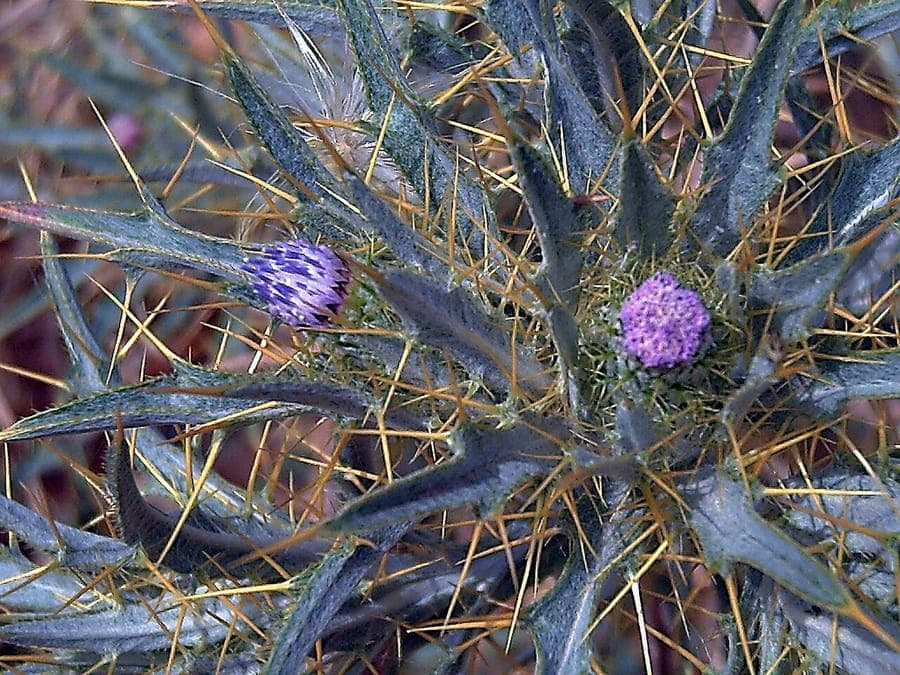
Javier martin / Public domain, via Wikimedia Commons
Picnomon acarna: complete guide
Picnomon acarna
Want to see Picnomon acarna: complete guide in your garden?
1 minute, no credit card
Overview
The Picnomon acarna, also known as Soldier thistle, is a robust, biennial plant from the Asteraceae family that naturally occurs in the Mediterranean region, from southern Europe to Afghanistan. This resilient plant is perfect for garden designers who want to cope with drought stress and full sun zones. With its striking purple flowers and dense, spiny foliage, this plant adds unmistakable character to gardens.
Appearance and bloom
Soldier thistle grows to about 60-90 cm tall with a broad, diffuse form. The leaves are grayish-green, deeply lobed and equipped with strong thorns, offering protection from browsers. Flowers appear from June to August as purple to violet flowers, about 2-3 cm in diameter, gathered in dense flowering heads. These attractive flowers attract bees and butterflies.
Ideal location
This plant blooms best in full sun (at least 6-8 hours of direct sunlight). In temperate climates, half-shade can be tolerated but full sun leads to better bloom and more compact forms. Plant in a location with good air flow to prevent fungi and root rot. Protect from extremely heavy rains that can damage the plant.
Soil
Ideal soil is very well-draining, preferably sand to gravel with minimal organic matter. pH 7.5-8 (alkaline) is ideal. This plant performs poorly in rich, moist soils. In clay soils, extra gravel or sand must be worked in. Poor drainage causes immediate root rot.
Free design
Want to see Picnomon acarna: complete guide in your garden? Make a free design now.
Watering
Seek minimal water needs once established. Young plants need regular water until fully rooted (6-8 weeks). Once established, this plant tolerates long drought periods without issue. No supplementary water needed in regions with normal winter rains.
Pruning
Pruning is however not needed. Remove only flowering head buds at the end of the season to prevent self-seeding, if desired. The plant naturally assumes a neat form.
Maintenance calendar
Spring: Water young plants regularly. Summer: Monitor for watering needs; enjoy long bloom. Fall: Lower watering; leave seed heads for birds. Winter: No care needed; this plant dies out but self-seeds each year.
Winter hardiness
Soldier thistle is suitable for USDA zones 6-9. In zones 5 and colder, this can be annual plants that self-seed each year. In zones 9-10 it can be established as an informal, evergreen plant.
Companion plants
Plant this thistle with other drought-tolerant species like sage, lavender and oregano. It provides contrast with softer-shaped plants. Works well in Mediterranean or xeriscape planting schemes.
Closing
Picnomon acarna offers an easy, low-maintenance option for dry, sunny locations. Plant it in full sun with well-drained soil and enjoy years of beautiful purple flowers. Consult local nurseries for seed. This is ideal for urban gardens, roofs or water-restricted gardens. Visit gardenworld.app for more information about drought-tolerant plants for your climate. Soldier thistle deserves a place in every dry garden, especially if you value native Mediterranean flora. Discover more Mediterranean plants at gardenworld.app for diverse design schemes.
Want to see Picnomon acarna: complete guide in your garden? Make a free design now.
Upload a photo, pick a style, and get a photorealistic design with plant list in under a minute.
No credit card required


Similar plants
Calendula stellata: complete guide
Calendula stellata
Complete guide to Calendula stellata, the star-flowered marigold from Sicily: location, soil, watering and companion planting tips.
Korean chrysanthemum: complete guide
Chrysanthemum x rubellum
Chrysanthemum x rubellum is a hardy autumn perennial with single pink to copper flowers from August to November. Care and combinations.
Helianthus divaricatus: complete guide
Helianthus divaricatus
Helianthus divaricatus is a North American woodland sunflower with yellow summer blooms, ideal for naturalistic borders and shady edges.