
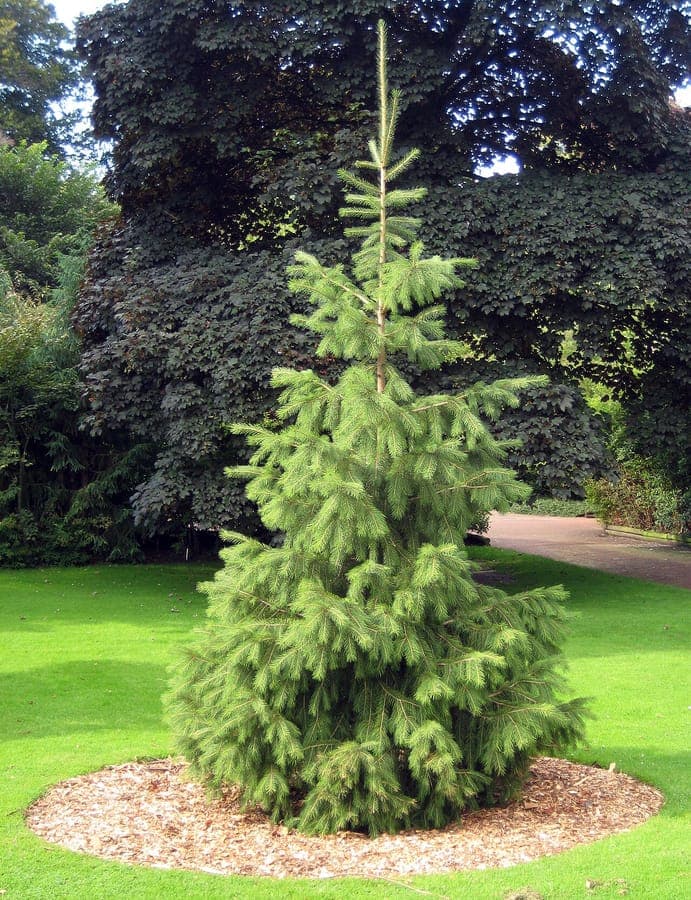
Lokal_Profil / CC BY-SA 2.5, via Wikimedia Commons
Morinda spruce: complete guide
Picea smithiana
Want to see Morinda spruce: complete guide in your garden?
1 minute, no credit card
Overview
Picea smithiana, commonly known as the Morinda spruce, is a graceful evergreen conifer native to the western Himalayas – found from eastern Afghanistan through northern Pakistan, Nepal, and into Tibet. In cultivation, it's still a relatively uncommon sight in most UK and North American gardens, but it's a standout for those seeking vertical drama and soft texture. On gardenworld.app you can visualise how this spruce fits into your garden layout before planting.
It grows slowly at first, then picks up pace after 10–15 years, eventually reaching 30–40 m in height with a spread of 6–8 m. That makes it unsuitable for small urban plots unless planted as a young tree in a large container. It's best suited for parks, large estates, or rural gardens where it has room to develop its signature weeping habit.
Appearance & bloom cycle
What sets the Morinda spruce apart is its long, drooping branchlets that give the tree a soft, cascading silhouette. The needles are 2.5–4 cm long, arranged in flattened sprays, with a bright green upper surface and a striking silvery-white underside. This contrast becomes especially noticeable in breezy conditions or when backlit by the sun.
It produces small, purplish male cones in spring (April–May) near the base of new growth, while female cones start pinkish and mature into long, cylindrical cones up to 12 cm in length. These ripen in autumn of the second year and release seeds gradually. The persistent cones add winter interest and provide food for birds like siskins and crossbills.
Ideal location
Full sun to light shade is ideal. The Morinda spruce thrives in open, airy sites with good air circulation. Avoid planting near roads with heavy salt use or in areas with high pollution – it's sensitive to both. A sheltered woodland edge, a spacious lawn, or a backdrop to a mixed border works well. Make sure it has at least 5–6 m clearance from buildings or power lines.
If you're unsure about spacing, use gardenworld.app to map out your garden and simulate how the tree will look in 20 or 30 years. This helps avoid future conflicts with structures or other plants.
Soil requirements
It tolerates a range of soil types but prefers moist, well-drained, humus-rich soil. Heavy clay is acceptable if drainage is improved with organic matter. Sandy soils should be amended with compost to retain moisture. The ideal pH range is slightly acidic to neutral (5.5–7.0). Avoid highly calcareous or waterlogged soils, which can lead to root rot.
Before planting, test your soil at a local garden centre or with a home kit – many garden centres stock pH testers and can advise on amendments.
Free design
Want to see Morinda spruce: complete guide in your garden? Make a free design now.
Watering
Young trees need consistent moisture for the first 2–3 years. Water deeply once a week during dry spells, especially in summer. Once established, the Morinda spruce is moderately drought-tolerant but performs best with some supplemental watering during prolonged dry periods.
Container-grown specimens require more frequent watering – check the soil weekly. Use rainwater when possible, as tap water high in lime can cause needle browning over time.
Pruning
Pruning is rarely needed. The tree's natural form is elegant and self-sufficient. If shaping is necessary, limit cuts to early summer (May–June), removing only wayward or damaged branches. Avoid cutting into old wood, as spruces do not regenerate well from dormant buds. Always use sharp, clean tools to prevent disease.
Maintenance calendar
- Jan: Check for snow load; gently shake branches to prevent breakage
- Feb: Inspect for winter damage or animal chewing
- Mar: Apply a light mulch of compost if needed
- Apr: Begin monitoring for new growth and aphids
- May: Light shaping if required; watch for cone development
- Jun: Final pruning window; ensure young trees are well-watered
- Jul: Monitor for spider mites or spruce aphids in hot, dry weather
- Aug: Continue watering during droughts
- Sep: Apply slow-release organic fertiliser if soil is poor
- Oct: Cones mature; collect seed if desired
- Nov: Mulch around the base to protect roots
- Dec: Protect container plants from freezing cycles
Winter hardiness
Hardy in USDA zones 6–8 (-23°C to -12°C). It handles cold winters well but can suffer in areas with heavy, wet snow that accumulates on drooping branches. In exposed sites, stake young trees for the first few winters. Container plants should be moved to a sheltered spot and the pot insulated with hessian or bubble wrap.
Companion plants
Pair with other conifers like Cedrus deodara or Abies koreana for a textured evergreen backdrop. Underplant with shade-tolerant perennials such as Epimedium, Helleborus, or Carex morrowii. Spring bulbs like Erythronium or Muscari look striking beneath its canopy before the tree fully leafs out.
Avoid aggressive groundcovers like ivy or bamboo, which compete for moisture. Grass under the tree should be kept short or replaced with mulch to reduce competition and prevent lawn mower damage to the trunk.
Closing
The Morinda spruce is not your average garden spruce, and that's what makes it special. Its weeping form, soft texture, and silvery foliage bring a unique elegance to any large garden. While it demands space and patience, the payoff is a living sculpture that evolves over decades. If you're planning a bold, long-term garden design, this spruce deserves consideration. Check availability at garden centres or through specialist suppliers – sometimes it needs to be ordered in advance. With proper placement and care, it can become the centrepiece of your garden for generations. Use gardenworld.app to plan its future impact and visualise how it integrates with your landscape.
Want to see Morinda spruce: complete guide in your garden? Make a free design now.
Upload a photo, pick a style, and get a photorealistic design with plant list in under a minute.
No credit card required


Similar plants
Abies delavayi: complete guide
Abies delavayi
Delavayi fir is an elegant, medium-sized coniferous tree from the Pinaceae family with dark green needles. This Asian evergreen is perfect for alpine gardens and large landscapes.
Taiwan fir: complete guide
Abies kawakamii
Discover the magnificent Taiwan fir, a rare evergreen conifer from Taiwan's mountain regions. Learn growth requirements, care tips, and why this beautiful tree is perfect for collectors of unique garden specimens.
Farges fir: complete guide
Abies fargesii
Discover the majestic Farges fir, an impressive conifer from China's mountains with elegant foliage and columnar form. Ideal for large gardens.