
Karduelis / Public domain, via Wikimedia Commons
Caucasian spruce: complete guide
Picea orientalis
Want to see Caucasian spruce: complete guide in your garden?
1 minute, no credit card
Overview
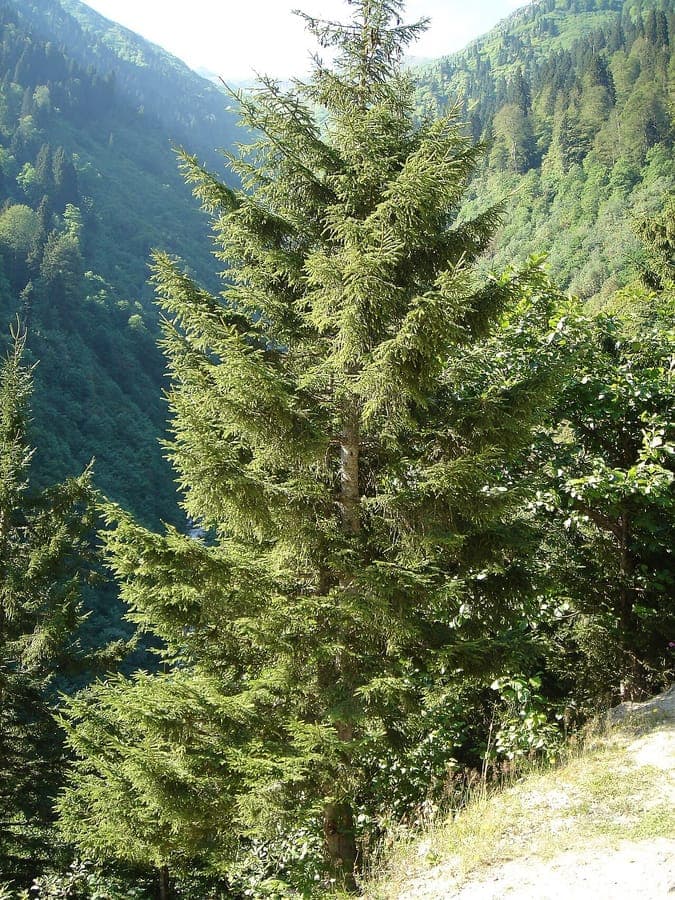
The Caucasian spruce (Picea orientalis) is a striking evergreen conifer that brings year-round structure and elegance to the garden. Native to the forests of the North Caucasus, Transcaucasia and northeastern Turkey, this spruce thrives in temperate climates across USDA zones 5 to 7, making it a solid choice for gardens in the UK and northern US. It grows slowly, adding just 20–30 cm per year, eventually reaching 12–18 m in height with a spread of 4–6 m over several decades. Its narrow, pyramidal shape and dense foliage make it ideal as a specimen tree or for tall screening.
One of the most appealing traits of the Caucasian spruce is its natural symmetry and minimal need for pruning. On gardenworld.app, you can design a landscape layout that integrates this spruce into your garden's long-term vision, accounting for growth rate, shade patterns and spacing.
Appearance & bloom cycle
This spruce has flat, feathery branchlets with soft, dark green needles arranged in two neat rows. The needles are 1–1.5 cm long, glossy on top and silvery-white beneath, creating a shimmering effect in sunlight. The undersides become especially visible when the wind gently lifts the branches.
In May, small male and female cones appear. The female cones start purplish and mature into upright, cylindrical cones 5–7 cm long, turning brown by autumn. These persist on the tree for years, adding winter interest. While not showy like flowering plants, the cone cycle plays a key role in the tree's rhythm and wildlife value.
Ideal location
Plant your Caucasian spruce in full sun to light shade. Full sun promotes the densest growth and richest color, while deep shade leads to sparse branching. Allow at least 3–4 m clearance from buildings or other trees to accommodate its mature size and ensure air flow. Avoid exposed, windy sites, especially for young trees, which can suffer from winter desiccation.
If planting in a coastal or windy garden, consider a sheltered spot or temporary windbreak. On gardenworld.app, you can simulate wind exposure and microclimates to find the best planting location before you dig.
Soil requirements
Picea orientalis prefers moist, well-drained, humus-rich soil with a slightly acidic to neutral pH (5.5–7.0). It tolerates clay soils if they don't stay waterlogged, but struggles in constantly wet or very sandy conditions. At planting time, mix in generous compost or well-rotted manure to improve soil structure.
Avoid soil compaction-don't walk or store heavy items near the root zone. Apply a 3–5 cm layer of organic mulch (such as bark or leaf mould) to retain moisture and suppress weeds, but keep it a few inches away from the trunk to prevent rot.
Free design
Want to see Caucasian spruce: complete guide in your garden? Make a free design now.
Watering
Young trees need consistent moisture for the first 2–3 years. During dry spells, give 10–15 litres per week, soaking deeply rather than spraying lightly. Use a slow-release watering spike or bucket with holes to deliver water to the root zone.
Mature trees are more drought-tolerant but benefit from supplemental watering during prolonged dry summers. Overwatering, especially in poorly drained soils, can lead to root rot. Check soil moisture by inserting a trowel 10 cm deep-water only if the soil feels dry at that level.
Pruning
Pruning is rarely needed, as the tree naturally develops a strong, symmetrical shape. Remove only dead, damaged or crossing branches in late winter or early spring, before new growth begins. Avoid cutting into old wood without needles-conifers won't re-sprout from bare stems.
If shaping for a hedge or formal design, pinch or lightly trim the soft new growth (called 'candles') in May or early June. Never cut beyond the green, needle-bearing portion. Use clean, sharp shears to prevent disease spread.
Maintenance calendar
- Jan: Check for snow load; gently shake branches if needed.
- Feb: Inspect for winter damage; plan light pruning.
- Mar: Remove broken branches; monitor for swelling buds.
- Apr: Apply slow-release conifer fertiliser; top up mulch.
- May: Candles emerge-ideal time for light shaping; watch for aphids.
- Jun: Water during dry periods; inspect for pests.
- Jul: Monitor for spider mites in hot weather; maintain mulch.
- Aug: Reduce watering if rainfall is sufficient.
- Sep: Final fertiliser application; clear debris.
- Oct: Collect fallen cones; check for fungal spots.
- Nov: Protect young trees from winter drying with burlap wraps.
- Dec: Inspect for ice damage; avoid salt near roots.
Winter hardiness
Hardy to USDA zone 5 (-20°C), the Caucasian spruce handles cold winters well. However, young trees can suffer from winter burn-browning needles caused by wind and sun drying out foliage. Protect with a windscreen or burlap wrap, especially on south-facing sites. Avoid de-icing salt near the root zone.
Mature trees are resilient but can be affected by prolonged wet winters. Ensure good drainage to prevent root rot.
Companion plants
The dark green canopy makes an excellent backdrop for shade-tolerant perennials. Try hellebores, epimediums, or hostas, which thrive in dappled light and moist, rich soil. For early spring interest, plant snowdrops (Galanthus) or crocuses under the canopy.
Avoid invasive groundcovers like ivy, which can compete aggressively for water and nutrients. Use gardenworld.app to map companion plant zones and avoid root competition in your design.
Closing
The Caucasian spruce is a low-maintenance, long-lived evergreen that adds dignity and structure to any garden. With a slow but steady growth rate, it rewards patience with decades of beauty. Buy healthy stock from reputable garden centres, check root condition before planting, and give it a strong start with proper soil and watering. Over time, it becomes a living landmark-tall, serene and enduring.
Want to see Caucasian spruce: complete guide in your garden? Make a free design now.
Upload a photo, pick a style, and get a photorealistic design with plant list in under a minute.
No credit card required


Similar plants
Abies delavayi: complete guide
Abies delavayi
Delavayi fir is an elegant, medium-sized coniferous tree from the Pinaceae family with dark green needles. This Asian evergreen is perfect for alpine gardens and large landscapes.
Taiwan fir: complete guide
Abies kawakamii
Discover the magnificent Taiwan fir, a rare evergreen conifer from Taiwan's mountain regions. Learn growth requirements, care tips, and why this beautiful tree is perfect for collectors of unique garden specimens.
Farges fir: complete guide
Abies fargesii
Discover the majestic Farges fir, an impressive conifer from China's mountains with elegant foliage and columnar form. Ideal for large gardens.