
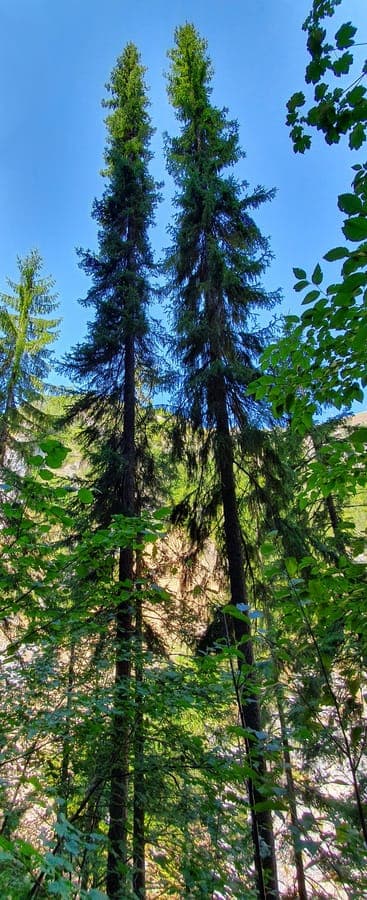
mikepirie / CC BY 4.0, via Wikimedia Commons
Serbian spruce: complete guide
Picea omorika
Want to see Serbian spruce: complete guide in your garden?
1 minute, no credit card
Overview
Picea omorika, commonly known as the Serbian spruce, is a striking evergreen conifer native to the mountainous regions of western Serbia and eastern Bosnia - formerly part of Yugoslavia. Unlike many spruces that spread wide, this species grows in a narrow, columnar shape, making it a top choice for small gardens, urban courtyards, or as a vertical accent in landscape designs.
In its natural habitat, the Serbian spruce can reach heights of up to 20 meters, but in garden settings, it typically matures between 10 and 15 meters tall, with a spread of just 2 to 3 meters. It grows at a steady pace of about 20–30 cm per year, which makes it easy to manage over time.
One of the biggest advantages of this tree is its adaptability. It doesn't demand constant attention and fits well into both formal and naturalistic planting schemes. On gardenworld.app, you can create a layout that highlights the Serbian spruce's upright form while ensuring enough space for long-term growth.
Appearance & bloom cycle
The Serbian spruce has a graceful, pyramidal shape with ascending upper branches and gracefully drooping lower ones. This combination gives it a soft, elegant profile that stands out in winter landscapes.
Its needles are about 1.5 cm long, glossy dark green on top, and marked by two bright silvery-white stomatal bands underneath. This creates a shimmering effect when the wind moves the branches. The bark on young trees is smooth and grey-brown; it becomes fissured and darker with age.
This species is monoecious, meaning it produces both male and female cones on the same tree. In late spring (May), small reddish-purple male cones appear and release pollen. The female cones are upright, cylindrical, and turn from green to brown as they mature, reaching 5–7 cm in length. They persist on the tree for several months, adding seasonal interest.
While not a flowering plant in the traditional sense, these reproductive structures contribute to the tree's year-round appeal.
Ideal location
For best results, plant your Serbian spruce in full sun to partial shade. It performs best with at least 6 hours of direct sunlight daily, which promotes dense foliage and strong structure. However, it can tolerate light shade, especially on the lower trunk, without losing too much density.
Avoid deep shade, as this leads to sparse growth and bare lower branches. Also, protect young trees from harsh, drying winds, especially in exposed sites. A sheltered spot near a wall or fence works well, as long as drainage is good.
Because of its narrow profile, it's excellent for tight spaces - think side gardens, driveways, or as a living screen. On gardenworld.app, you can test how this spruce fits into narrow planting beds or tight urban plots.
Soil requirements
The Serbian spruce prefers moist, well-drained, slightly acidic to neutral soils (pH 5.5–7.0). It tolerates a range of soil types, including loam and sandy soils, but struggles in heavy, waterlogged clay.
If you're planting in clay, improve drainage by mixing in compost, coarse sand, or organic matter. Raised beds or mounded planting areas also help prevent root rot.
For container-grown specimens, use a high-quality potting mix designed for conifers, with added perlite or pine bark for aeration. Ensure the pot has drainage holes and isn't too small - aim for at least 40–50 cm in diameter for young trees.
Free design
Want to see Serbian spruce: complete guide in your garden? Make a free design now.
Watering
Young Serbian spruces need consistent moisture during their first 2–3 years. Water deeply once or twice a week during dry spells, especially in summer. Mature trees are more drought-tolerant but still benefit from occasional deep watering during prolonged dry periods.
Avoid frequent shallow watering, which encourages weak surface roots. Instead, soak the root zone thoroughly and let the soil dry slightly between sessions.
Use rainwater when possible, as tap water with high lime content can raise soil pH and lead to iron chlorosis (yellowing needles).
Pruning
Pruning is rarely needed. The tree's natural shape is attractive and requires no corrective trimming. If you must prune, do so in late spring after new growth has emerged but before it hardens off.
Only remove dead, damaged, or crossing branches. Never cut back into old wood without foliage, as spruces don't regenerate from bare stems. Use clean, sharp tools to prevent disease.
Avoid heavy pruning - it ruins the tree's form and stresses the plant.
Maintenance calendar
- January–February: Check for snow or ice damage. Gently shake off heavy snow from branches.
- March: Inspect for pests or fungal issues. Start light fertilizing if soil is poor.
- April–May: Monitor for new growth (candles). Water during dry spells. Male cones develop.
- June–August: Watch for drought stress. Water deeply as needed, especially for young trees.
- September: Apply potassium-rich fertilizer to boost winter hardiness.
- October–December: Reduce watering. Clear fallen debris to prevent fungal buildup.
Winter hardiness
The Serbian spruce is exceptionally cold hardy, thriving in USDA zones 4 to 7 (–34°C to –15°C). It remains evergreen year-round and handles snow and ice well.
Young trees in containers are more vulnerable - insulate pots with bubble wrap and elevate them off the ground. In areas with heavy snow load, loosely tie branches together to prevent splitting.
Avoid de-icing salts near the root zone, as they can damage roots and cause needle browning.
Companion plants
Pair the Serbian spruce with low-growing, shade-tolerant plants that won't compete for space. Good choices include Epimedium, Helleborus, or ferns like Dryopteris. For contrast, use ornamental grasses such as Carex or Hakonechloa.
Evergreen groundcovers like Pachysandra or Vinca minor work well beneath it. You can also plant dwarf conifers like Juniperus communis 'Compressa' or Chamaecyparis obtusa 'Nana' nearby for texture.
Planning combinations? Use gardenworld.app to visualize how companion plants interact with the spruce over time.
Closing
The Serbian spruce is a low-maintenance, elegant evergreen that brings vertical structure and year-round greenery to any garden. Its narrow form, resilience, and adaptability make it a standout choice for modern landscapes.
Whether you're screening a neighbour's view, defining a border, or adding winter interest, this spruce delivers. You'll find it at garden centres across the UK and US, often in 100–150 cm specimens ready for planting.
And remember: on gardenworld.app, you can simulate how the Serbian spruce ages and fits into your evolving garden design.
Want to see Serbian spruce: complete guide in your garden? Make a free design now.
Upload a photo, pick a style, and get a photorealistic design with plant list in under a minute.
No credit card required


Similar plants
Abies delavayi: complete guide
Abies delavayi
Delavayi fir is an elegant, medium-sized coniferous tree from the Pinaceae family with dark green needles. This Asian evergreen is perfect for alpine gardens and large landscapes.
Taiwan fir: complete guide
Abies kawakamii
Discover the magnificent Taiwan fir, a rare evergreen conifer from Taiwan's mountain regions. Learn growth requirements, care tips, and why this beautiful tree is perfect for collectors of unique garden specimens.
Farges fir: complete guide
Abies fargesii
Discover the majestic Farges fir, an impressive conifer from China's mountains with elegant foliage and columnar form. Ideal for large gardens.