
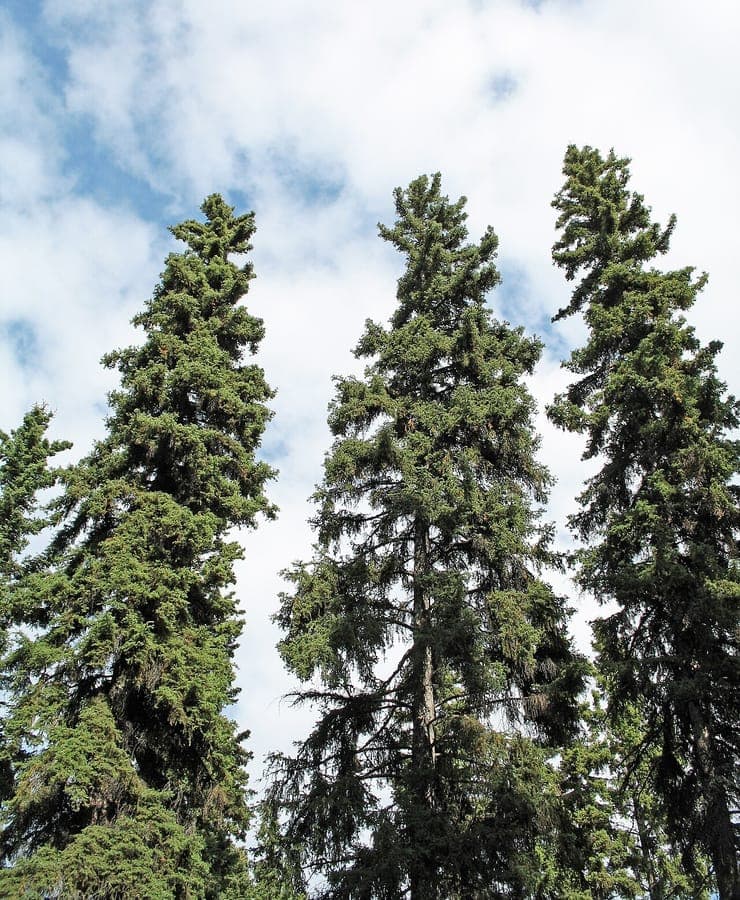
dmcdevit / CC BY-SA 2.0, via Wikimedia Commons
Western white spruce: complete guide
Picea glauca
Want to see Western white spruce: complete guide in your garden?
1 minute, no credit card
Overview
Picea glauca, commonly known as western white spruce, is a dependable and graceful evergreen that brings year-round structure to the garden. Native to northern North America, especially Canada and the northern United States, this spruce thrives in cold climates and adapts well to garden conditions across USDA zones 2 to 7. In the UK and Ireland (zone 7), it handles temperatures down to -35°C without issue. It grows upright with a dense, conical shape, reaching 12 to 18 meters at maturity over 30–50 years, adding roughly 20–30 cm annually. Its slow, predictable growth makes it ideal for formal or naturalistic designs.
On gardenworld.app, you can generate a custom garden layout that accounts for the spruce's mature spread and shade footprint, ensuring long-term harmony in your planting scheme.
Appearance & bloom cycle
The western white spruce has short, stiff needles about 1.5 to 2 cm long, arranged densely along the stems. The foliage is a soft blue-green, often with a silvery-white bloom – the origin of the name 'glauca'. This waxy coating protects the needles from moisture loss and gives the tree a frosted appearance in winter. The bark on young trees is smooth and grey, becoming scaly with age.
Though not a flowering plant, it produces small, purplish female cones in spring (April to May), which mature into pale brown, cylindrical cones 3 to 6 cm long. These hang downward and often remain on the tree through winter, adding visual interest. Male cones are smaller and release pollen in late spring, but are less noticeable.
Ideal location
Plant in full sun to light shade. At least six hours of direct sunlight daily ensures dense growth and strong form. In deep shade, the tree becomes leggy and sparse. Allow a minimum of 2.5 meters clearance from buildings or other trees to accommodate its mature width of 3 to 5 meters.
It works well as a specimen tree on a lawn, in windbreaks, or as a backdrop in mixed borders. Avoid exposed, windy sites, especially for young trees. If planting in an open area, consider temporary wind protection or companion planting with shrubs to reduce wind scorch.
Soil requirements
This spruce prefers well-drained, slightly acidic to neutral soil (pH 5.5–7.0). It tolerates clay if drainage is improved with grit or compost. Avoid waterlogged soils, as they promote root rot, particularly in winter. Sandy soils are acceptable but may require more frequent watering during dry spells.
Do not plant in highly alkaline conditions – this can lead to chlorosis, visible as yellowing needles. If your soil pH is above 7.5, consider amending with sulfur or choosing a raised bed with ericaceous compost.
Free design
Want to see Western white spruce: complete guide in your garden? Make a free design now.
Watering
Water deeply once a week during the first growing season, applying 10–15 liters per tree. After the first year, it becomes more drought-tolerant but still benefits from supplemental watering during prolonged dry periods (over 14 days without rain), especially for trees under 2 meters tall. Use a tree gator or soaker hose to deliver water slowly to the root zone.
Avoid overhead watering, which can encourage fungal diseases. In winter, no additional watering is needed unless the ground is frozen for weeks and snow cover is absent.
Pruning
Picea glauca rarely needs pruning. Its natural shape is elegant and self-sufficient. Only remove broken, diseased, or crossing branches, ideally in early March before new growth begins. Do not cut back into old wood – conifers don't regenerate well from bare stems.
If you must control size, pinch back half of the new candle growth in late May. Use your fingers or clean shears. Never prune after mid-June, as this may leave wounds open to disease before winter.
Maintenance calendar
- January: Check for snow damage. Gently shake snow from branches.
- February: No action needed. Monitor for animal damage.
- March: Prune damaged wood. Plant or transplant if soil is workable.
- April: Inspect for adelgids or needle cast. Treat early with horticultural oil if needed.
- May: Pinch new candles if desired. Apply mulch to retain moisture.
- June: No pruning. Water during dry spells.
- July: Monitor for signs of drought stress. Replenish mulch.
- August: Final pest check. Stop fertilizing.
- September: Allow tree to harden off. Avoid watering unless extreme drought.
- October: Rake fallen needles and cones. Avoid composting if disease was present.
- November: Protect young trunks from rodents with tree guards.
- December: Watch for winter desiccation. Avoid de-icing salts nearby.
Winter hardiness
Extremely cold hardy, surviving USDA zones 2–7. In zone 7, it withstands typical winters but can suffer from winter burn in exposed, sunny locations. Prevent this by watering thoroughly in autumn and using burlap screens in windy gardens. Mulch with 5 cm of bark or compost to insulate roots from freeze-thaw cycles.
Companion plants
Pair with other conifers like Thuja occidentalis or Juniperus scopulorum. Underplant with shade-tolerant perennials such as Hosta, Carex, or Epimedium. Avoid invasive groundcovers like ivy, which can climb and weaken the trunk.
Use the companion planner on gardenworld.app to find plants that match the spruce's growing conditions and aesthetic.
Closing
The western white spruce is a low-maintenance, long-lived evergreen that adds dignity and structure to any garden. With proper siting and minimal care, it thrives for decades. Purchase healthy specimens from reputable garden centres, ensuring the root ball is moist and undisturbed. Always consider future size – this tree needs space to shine. Plan wisely, and it will reward you with decades of quiet strength.
Want to see Western white spruce: complete guide in your garden? Make a free design now.
Upload a photo, pick a style, and get a photorealistic design with plant list in under a minute.
No credit card required


Similar plants
Abies delavayi: complete guide
Abies delavayi
Delavayi fir is an elegant, medium-sized coniferous tree from the Pinaceae family with dark green needles. This Asian evergreen is perfect for alpine gardens and large landscapes.
Taiwan fir: complete guide
Abies kawakamii
Discover the magnificent Taiwan fir, a rare evergreen conifer from Taiwan's mountain regions. Learn growth requirements, care tips, and why this beautiful tree is perfect for collectors of unique garden specimens.
Farges fir: complete guide
Abies fargesii
Discover the majestic Farges fir, an impressive conifer from China's mountains with elegant foliage and columnar form. Ideal for large gardens.