
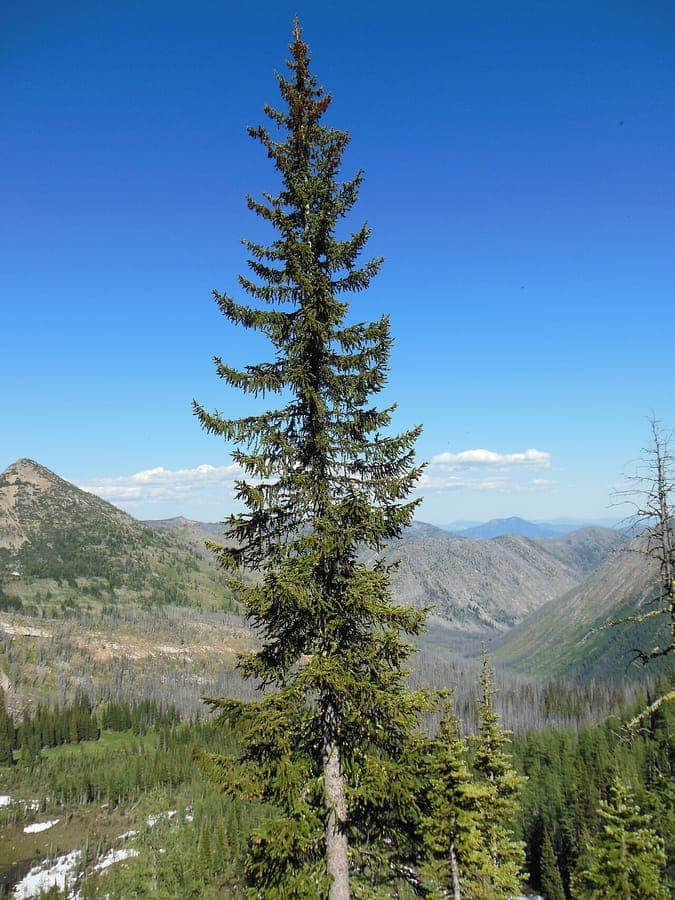
Jsayre64 / CC BY-SA 3.0, via Wikimedia Commons
Mountain spruce: complete guide
Picea engelmannii
Want to see Mountain spruce: complete guide in your garden?
1 minute, no credit card
Overview
Picea engelmannii, commonly known as mountain spruce, is a tall, graceful evergreen native to the western mountains of North America. Found from British Columbia down to Arizona and New Mexico, it thrives at elevations between 1,800 and 3,000 meters. This spruce is built for cold, snowy climates and grows slowly but steadily, eventually reaching heights of 30 to 45 meters with a spread of 6 to 9 meters. It's not a common sight in UK or US suburban gardens due to its size, but for large landscapes, it's a stunning, low-maintenance choice.
The mountain spruce has a narrow conical form with horizontal branches that sweep slightly upward at the tips. Its bark is thin and gray on young trees, developing shallow fissures with age. Named after botanist George Engelmann, this spruce is closely related to the more common Sitka spruce but handles colder, drier conditions better.
If you're planning a large property or woodland garden, use gardenworld.app to map out spacing and future shade zones. This helps avoid overcrowding as trees mature.
Appearance & bloom cycle
Needles are 1.5 to 2 cm long, stiff, and bluish-green with a silvery sheen. They spiral around the twigs, giving the foliage a full but airy texture. In spring (May to June), small purple female cones and yellow male pollen cones appear. The mature seed cones are 4 to 7 cm long, cylindrical, and hang down from the branches. They ripen to a light brown and disintegrate in autumn to release seeds.
Unlike some spruces, Picea engelmannii doesn't produce dense lower foliage when shaded, so it's best planted where it receives full sun from the ground up. The tree develops a strong central leader naturally, requiring no staking in most conditions.
Ideal location
Plant in full sun (6+ hours daily) for best growth and dense branching. Light shade is tolerated, but expect a more open, leggy form. Allow at least 8 meters between trees and keep it 6 meters from buildings or driveways. The tree is suited to USDA zones 3 to 7, meaning it handles temperatures down to -40°C.
Avoid exposed, windy sites, especially in coastal or prairie areas. The shallow root system makes it prone to windthrow if not well anchored. For visual planning, gardenworld.app lets you simulate tree growth over decades, helping you position your spruce without future regrets.
Free design
Want to see Mountain spruce: complete guide in your garden? Make a free design now.
Soil requirements
Prefers moist, well-drained loam or sandy loam with a pH between 6.0 and 8.0. It tolerates clay if drainage is improved with organic matter. Avoid highly acidic soils or compacted construction fill. When planting, mix in compost or aged bark to boost structure and water retention. Do not bury the root collar-plant at the same depth as in the container.
Watering
Water deeply twice a week during the first growing season. Use 15–20 liters per session to encourage deep root development. After year one, reduce to once every 10–14 days during dry spells. Mulch with 5–7 cm of wood chips to conserve moisture and suppress weeds. Never let the root zone stay soggy-this spruce dislikes waterlogged soil.
Pruning
Pruning is rarely needed. Only remove dead, damaged, or crossing branches in late winter before bud break. Avoid topping or cutting back leaders-this ruins the natural shape and can invite disease. Use clean, sharp tools and disinfect between cuts. Never shear this spruce like a hedge; it won't regrow from old wood.
Maintenance calendar
- Jan: Inspect for winter damage, remove broken limbs
- Feb: Final light pruning if needed
- Mar: Apply compost around base, avoid touching trunk
- Apr: Monitor new growth for drying out
- May: Pollen release, female cones develop
- Jun: Active growth phase, no intervention needed
- Jul: Water during prolonged dry periods
- Aug: Continue monitoring soil moisture
- Sep: Check for storm damage, secure young trees
- Oct: Let fallen needles decompose as natural mulch
- Nov: Water deeply if soil is dry before freeze
- Dec: Shake heavy snow off branches to prevent breakage
Winter hardiness
Extremely cold-hardy (USDA zone 3). In zones 4–7, it faces no winter issues. Young trees may suffer from winter burn in sunny, windy spots-use burlap wraps for the first two winters. Ensure the tree enters winter well-hydrated, especially in dry autumns.
Companion plants
Pair with shade-tolerant, non-invasive plants: foamflower (Tiarella), coral bells (Heuchera), wild ginger (Asarum), or native sedges like Carex. Avoid aggressive groundcovers like ivy or periwinkle. In sunny outer zones, consider lavender or yarrow. For a natural woodland look, combine with paper birch or serviceberry.
Closing
The mountain spruce is a long-term investment. It grows slowly but rewards patience with decades of elegant presence. Buy container-grown trees (20–30L pots) from reputable garden centres in spring or early fall. Look for healthy, evenly branched specimens with moist root balls. Avoid field-dug trees unless professionally transplanted. With proper siting and early care, Picea engelmannii becomes a cornerstone of any cold-climate landscape.
Want to see Mountain spruce: complete guide in your garden? Make a free design now.
Upload a photo, pick a style, and get a photorealistic design with plant list in under a minute.
No credit card required


Similar plants
Abies delavayi: complete guide
Abies delavayi
Delavayi fir is an elegant, medium-sized coniferous tree from the Pinaceae family with dark green needles. This Asian evergreen is perfect for alpine gardens and large landscapes.
Taiwan fir: complete guide
Abies kawakamii
Discover the magnificent Taiwan fir, a rare evergreen conifer from Taiwan's mountain regions. Learn growth requirements, care tips, and why this beautiful tree is perfect for collectors of unique garden specimens.
Farges fir: complete guide
Abies fargesii
Discover the majestic Farges fir, an impressive conifer from China's mountains with elegant foliage and columnar form. Ideal for large gardens.