
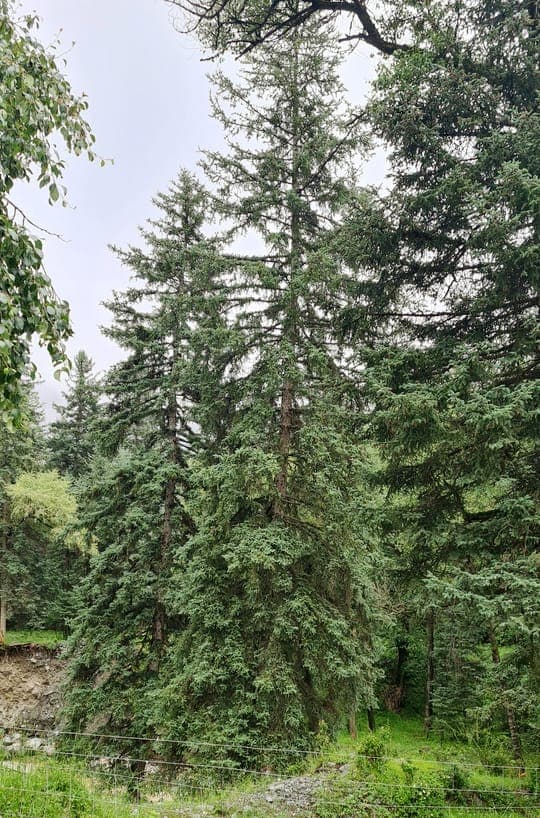
no rights reserved / CC0, via Wikimedia Commons
Picea crassifolia: complete guide
Picea crassifolia
Want to see Picea crassifolia: complete guide in your garden?
1 minute, no credit card
Overview
Picea crassifolia, commonly known as Qinghai spruce, is an ornamental conifer from the Pinaceae family. This alpine tree originates from the Qinghai and Qilian Shan mountain regions of China, growing wild at elevations of 2000-3500 meters. The plant is celebrated for its compact form, fine needles, and pyramidal silhouette.
Qinghai spruce is a fascinating choice for gardens seeking to emphasize height variation or add an architectural element. The tree grows relatively slowly and typically reaches mature heights of 15-25 meters, though in garden conditions often remains smaller. This makes it excellent for medium-sized gardens where you want to create a permanent evergreen focal point.
Appearance and Growth
Qinghai spruce displays a neat, pyramidal silhouette with dense needle coverage. The needles are relatively short (1-2 cm), four-sided in cross-section, and dark green. They grow radially around the branches in a rounded form. Young shoots are glossy reddish-brown, providing beautiful winter contrast.
The trunk grows upright with a central leader. The tree develops in layered progression, with lower branches sometimes dying back as the tree grows. This is normal and not a disease. The tree produces cones (seeds) that are green in the first year and later turn brown.
Growth is moderate to slow, depending on location and nutrition. In optimal conditions, Qinghai spruce grows approximately 30-45 cm per year.
Ideal Location
Qinghai spruce performs best in locations with abundant sunlight. The tree requires at least 6-8 hours of direct sunlight daily for healthy, full growth. In partial shade the tree still grows but becomes more open and less attractive. Full shade is unsuitable.
The tree is very hardy and tolerates strong wind, though protection from severe winter winds in early years is beneficial. Plant on an east-facing slope if available, providing protection against afternoon sun scalding during cold periods (preventing winter sunscald damage).
Important: Qinghai spruce dislikes warm, humid summers. In southern Europe with very hot summers this can be problematic. In temperate oceanic or continental climates it thrives excellently.
Soil
Qinghai spruce prefers well-draining, acidic to neutral soil (pH 5.0-7.0). The tree grows in sandy, clay, and loamy soils provided drainage is excellent. For best results add compost or peat moss when planting.
The tree cannot tolerate waterlogging and wet roots, which causes rotting. Add perlite or sand to heavy clay soils. A drainage layer is essential in low-lying areas. After planting apply a mulch layer, but ensure it doesn't contact the trunk directly.
Important: Qinghai spruce is an alpine plant and prefers cooler soils. In very warm climates, poor root development and soil overheating can occur.
Free design
Want to see Picea crassifolia: complete guide in your garden? Make a free design now.
Watering
Watering is essential, especially in early years after planting and during the growing period (spring and summer). Water regularly to keep soil moist but not soggy. Once established, Qinghai spruce is moderately drought tolerant.
During dry summers water especially in morning and evening for cooling. A thick mulch layer (7-10 cm) of straw around (but not against) the stem helps moisture retention and soil cooling. This is especially important in the first growing year.
During very dry periods (longer than 3 weeks without rain), extra watering may be needed. Winter watering is rarely needed in temperate climates with regular precipitation. In very dry winters watering can be beneficial.
Pruning and Maintenance
Qinghai spruce requires minimal maintenance. The tree naturally grows in an attractive pyramidal form and doesn't require pruning. You can remove damaged or diseased branches in spring. Always cut before the branch collar, never through the wood.
Old, lower branches slowly die back as the tree grows. This is normal and can be left as-is. They contribute nothing to beauty and their removal provides more light to lower branches.
During winter frosts young shoots can suffer damage. This is rarely a problem, but if it occurs, simply cut back damaged sections in spring. The tree recovers quickly.
Maintenance Calendar
January-February: Check winter protection, prepare for growing season. March: Remove damaged branches, begin watering. April-May: Vigorous growth period, regular watering, supplement mulch. June-August: Continued growth, watering important during dry periods. September-October: Growth slows, prepare for winter. November-December: Winter preparation, protect young trees.
Winter Hardiness
Qinghai spruce is exceptionally winter hardy and tolerates temperatures down to -30 to -35 degrees Celsius. In all Dutch USDA zones (5-7) this tree grows without difficulty. The tree is even suitable for very cold alpine climates.
Young plants can suffer from extreme winter desiccation. Protect young trees with jute wraps or screens against wind drying in December-February if you live in a very windy location.
Winter sunscald (sun scalding of sunny sides during winter) can occur if the tree transitions abruptly from summer warmth to extreme winter frost. This damages the bark. Severe: this is rarely fatal but can be unsightly.
Companion Plants
Qinghai spruce combines beautifully with:
- Dwarf rowans - orange autumn berries contrast nicely
- Mountain figs - small foliage complementary
- Rhododendrons - purple blooms against green background
- Heathers - low, colorful underplanting
- Ornamental grasses - texture contrast
- Junipers - complementary conifer texture
- Saxifrage - alpine plants around base
- Lavender - blue blooms against green conifer
Conclusion
Qinghai spruce is a unique choice for gardens seeking an architectural, permanently evergreen plant. Its graceful form and fine texture immediately create a refined garden appearance. In the right location (good drainage, sunny, not too warm) your Qinghai spruce will grow beautifully for many years.
This tree is ideal as a focal plant in small to medium-sized gardens. Slow growth means it maintains form for years without extensive pruning. Plant Qinghai spruce where it receives full 6-8 hours of sunlight and the soil is well-draining. GardenWorld can help you select the perfect location in your front garden.
Want to see Picea crassifolia: complete guide in your garden? Make a free design now.
Upload a photo, pick a style, and get a photorealistic design with plant list in under a minute.
No credit card required


Similar plants
Abies delavayi: complete guide
Abies delavayi
Delavayi fir is an elegant, medium-sized coniferous tree from the Pinaceae family with dark green needles. This Asian evergreen is perfect for alpine gardens and large landscapes.
Taiwan fir: complete guide
Abies kawakamii
Discover the magnificent Taiwan fir, a rare evergreen conifer from Taiwan's mountain regions. Learn growth requirements, care tips, and why this beautiful tree is perfect for collectors of unique garden specimens.
Farges fir: complete guide
Abies fargesii
Discover the majestic Farges fir, an impressive conifer from China's mountains with elegant foliage and columnar form. Ideal for large gardens.