
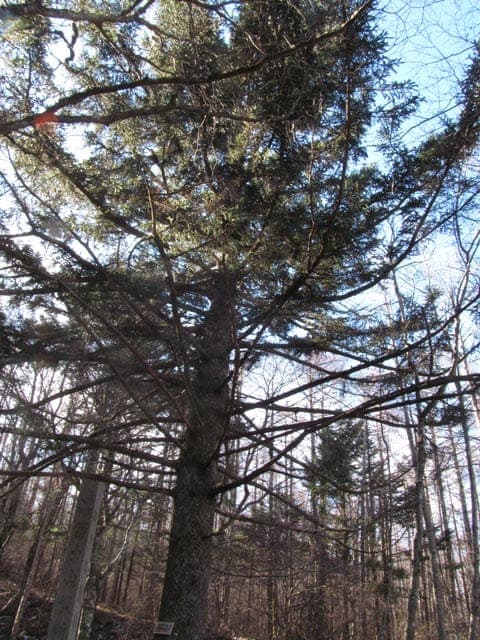
Inti-sol / CC BY-SA 3.0, via Wikimedia Commons
Alcock's spruce: complete guide
Picea alcoquiana
Want to see Alcock's spruce: complete guide in your garden?
1 minute, no credit card
Overview
Picea alcoquiana, known as Alcock's spruce, is a graceful conifer native to the mountainous forests of Honshu, Japan. It's not as common in Western gardens as Norway or Colorado blue spruce, but it's gaining attention for its elegant form, soft blue-green needles, and striking silvery bark. In its natural habitat, it reaches up to 15 meters, but in cultivation, it grows slowly-about 15–20 cm per year-and rarely exceeds 6–8 meters over 20–30 years. This makes it ideal for smaller gardens or as a specimen tree in structured landscapes.
If you're planning a tranquil, minimalist space, Alcock's spruce fits perfectly. On gardenworld.app, you can simulate how this spruce integrates into your garden layout, considering scale, light, and long-term growth.
Appearance & bloom cycle
The tree has a neat pyramidal shape with ascending branches that create an airy, open structure. The bark on mature trees becomes silvery-gray and exfoliates in thin patches, adding winter interest. Needles are 1.5–2.5 cm long, bluish-green with a waxy bloom, and arranged radially around the stems, giving off a soft, feathery look. They're not prickly, making this spruce pleasant to touch-unlike many other spruces.
It produces small, inconspicuous flowers in April. Male cones are reddish and clustered at the base of new growth; female cones are purple-tinged and develop into cylindrical seed cones 6–9 cm long. These mature in autumn, turning brown, and release seeds in late fall. While not showy, the persistent cones add subtle texture to the winter silhouette.
Ideal location
Plant Alcock's spruce in full sun to light shade. It performs best with at least 6 hours of direct sunlight daily to maintain dense foliage and vibrant needle color. In deep shade, growth slows and the crown becomes sparse. Give it at least 2 meters of clearance on all sides to allow for air circulation and to showcase its natural form. Avoid exposed, windy sites-especially for young trees-as the root system is relatively shallow and can be prone to rocking.
A sheltered south- or west-facing spot works well. Use gardenworld.app to visualize how this spruce will grow over time and whether it might shade other plants in your garden.
Soil requirements
It prefers moist, well-drained, slightly acidic to neutral soil (pH 5.5–7.0). It struggles in heavy clay unless amended with grit and organic matter to improve drainage. Sandy soils should be enriched with compost or leaf mold to retain moisture. Avoid waterlogged conditions-this spruce is susceptible to root rot in stagnant water. A 5–10 cm mulch layer of pine bark helps regulate moisture and suppress weeds.
Free design
Want to see Alcock's spruce: complete guide in your garden? Make a free design now.
Watering
Water deeply and regularly during the first two growing seasons, especially in dry spells. Provide 10–15 liters per week during prolonged drought. Once established, it's moderately drought-tolerant but benefits from occasional deep watering in summer. Use rainwater when possible, as tap water high in lime can affect soil pH over time.
Pruning
Pruning is rarely needed. Alcock's spruce maintains its shape naturally. Only remove dead, damaged, or diseased branches in early spring (March). Avoid cutting into old wood, as it doesn't regenerate well. Light tip pruning can be done in late spring to encourage denser growth, but it's usually unnecessary.
Maintenance calendar
- Jan: Check for snow load; gently shake off heavy snow
- Feb: Inspect for pests and damaged branches
- Mar: Prune if needed; check root collar for girdling
- Apr: Monitor for aphids and spider mites
- May: Apply slow-release conifer fertilizer (optional)
- Jun: Water during dry periods
- Jul: Continue monitoring for pests; ensure mulch is intact
- Aug: No pruning-new growth is hardening
- Sep: Let fallen needles decompose as natural mulch
- Oct: Collect seeds if propagating; check for cone drop
- Nov: Add fresh mulch; protect young trees from wind
- Dec: Inspect for winter damage; avoid de-icing salts nearby
Winter hardiness
Hardy in USDA zones 6–8 (-23°C to -12°C). In zone 6, young trees may need protection from desiccating winter winds-use burlap wraps for the first 2–3 years. Mature trees handle cold well but can suffer from frost cracking on thin bark in rapid temperature swings. Avoid planting near reflective surfaces that intensify winter sun.
Companion plants
Pair with other acid-loving evergreens like Rhododendron or dwarf conifers such as Picea glauca 'Conica'. Add texture with Hakone grass (Hakonechloa macra) or ferns like Dryopteris erythrosora. For a Japanese-inspired garden, plant near Acer palmatum or mosses. Avoid invasive groundcovers like ivy that compete for moisture.
Closing
Alcock's spruce brings understated elegance to any garden. Its silver bark, soft needles, and slow growth make it a long-term investment with lasting appeal. Available at quality garden centres across the UK and North America, it's worth seeking out. Look for healthy stock at local nurseries or trusted chains. And when planning your layout, don't forget to use gardenworld.app to preview how this spruce evolves over the seasons in your space.
Want to see Alcock's spruce: complete guide in your garden? Make a free design now.
Upload a photo, pick a style, and get a photorealistic design with plant list in under a minute.
No credit card required


Similar plants
Abies delavayi: complete guide
Abies delavayi
Delavayi fir is an elegant, medium-sized coniferous tree from the Pinaceae family with dark green needles. This Asian evergreen is perfect for alpine gardens and large landscapes.
Taiwan fir: complete guide
Abies kawakamii
Discover the magnificent Taiwan fir, a rare evergreen conifer from Taiwan's mountain regions. Learn growth requirements, care tips, and why this beautiful tree is perfect for collectors of unique garden specimens.
Farges fir: complete guide
Abies fargesii
Discover the majestic Farges fir, an impressive conifer from China's mountains with elegant foliage and columnar form. Ideal for large gardens.