
Ivar Leidus / CC BY-SA 3.0 ee, via Wikimedia Commons
Common spruce: complete guide
Picea abies
Want to see Common spruce: complete guide in your garden?
1 minute, no credit card
Overview
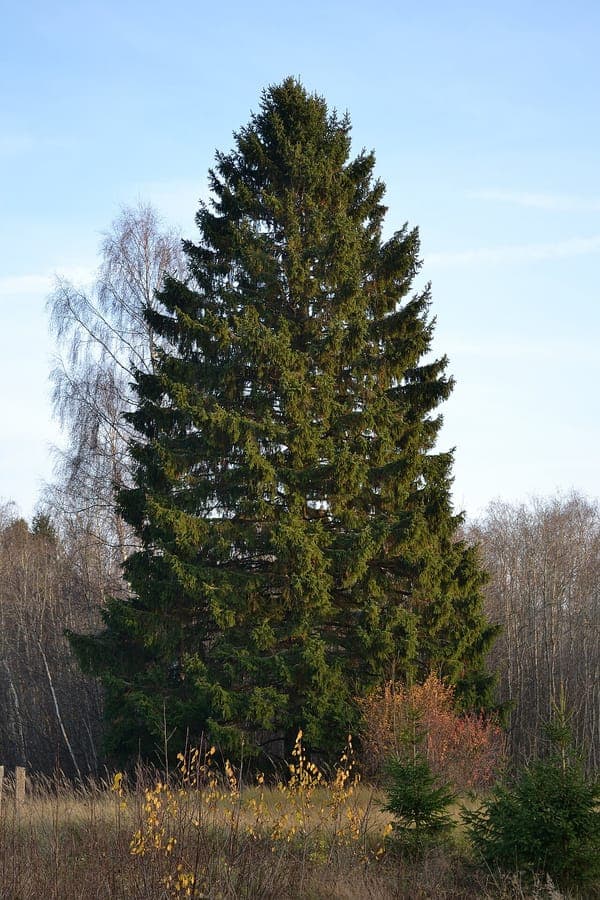
The common spruce, or Picea abies, is a staple in many temperate gardens across Europe and North America. Native to regions from the Baltic States to Finland and central Russia, this evergreen conifer belongs to the Pinaceae family and is known for its dense, pyramidal shape and year-round greenery. It typically reaches heights of 20 to 40 meters at maturity, with a spread of 5 to 8 meters, making it unsuitable for small gardens. Young trees grow at a moderate pace of around 30 to 50 cm per year, depending on site conditions. Its upright habit and dark green needles make it a popular choice for windbreaks, hedges, or as a solitary specimen.
On gardenworld.app, you can create a garden design that accounts for the mature size of the common spruce, ensuring it fits your long-term landscape plan.
Appearance & bloom cycle
The common spruce has a classic conical form with slightly drooping branchlets. The needles are 1 to 2 cm long, four-sided, and arranged spirally around the twigs. They are glossy green and remain on the tree for 5 to 7 years before shedding. In late spring, small purple male and female cones appear at the tips of upper branches. The female cones mature into erect, cylindrical seed cones that are 8 to 15 cm long, turning from green to brown as they ripen. These cones often persist on the tree for several years, adding winter interest.
Unlike flowering trees, the common spruce doesn't bloom in the traditional sense, but its cone production is a key seasonal highlight. It's fully evergreen, providing year-round structure and privacy.
Ideal location
This spruce thrives in full sun to light shade, requiring a light level of 7 out of 10. That means at least 5 to 6 hours of direct sunlight daily. Avoid planting under dense tree canopies where light is limited. In too much shade, the lower branches thin out and the crown becomes sparse.
Give the tree plenty of space-plant it at least 5 meters from buildings or other large trees to prevent root competition and allow room for full development. On gardenworld.app, use the space planner tool to visualise how a fully grown spruce will impact your garden layout.
Soil requirements
Picea abies prefers moist, well-drained soils with a pH between 5.0 and 7.0. It grows best in loamy or sandy loam soils rich in organic matter. Avoid heavy clay soils that retain water, as well as very dry, sandy soils with low nutrient content. Incorporate compost or well-rotted leaf mould at planting time to improve soil structure and water retention.
Poor drainage is a major issue-standing water leads to root rot, especially in young trees. Raised beds or mounded planting sites can help in poorly drained areas.
Free design
Want to see Common spruce: complete guide in your garden? Make a free design now.
Watering
Young common spruces need consistent moisture during their first two to three growing seasons. Water deeply once a week during dry spells, ensuring the root zone is saturated. After establishment, the tree becomes more drought-tolerant but still performs better with occasional deep watering during extended dry periods, especially in USDA zones 5 and 6.
Use rainwater when possible, as spruces can be sensitive to high calcium levels in tap water.
Pruning
Minimal pruning is required. Remove only dead, damaged, or crossing branches to maintain health and structure. Avoid topping the leader, as this can ruin the tree's natural form and lead to weak growth. Prune in late spring or early summer to allow time for healing before winter.
Shearing is not recommended unless you're training the tree for a specific purpose, such as a hedge. Even then, Picea abies is not ideal for tight clipping.
Maintenance calendar
- Jan: Inspect for storm damage and broken branches.
- Feb: Check for signs of rodent activity at the base.
- Mar: Monitor for aphids or adelgids on new growth.
- Apr: Apply a layer of compost around the base as natural feed.
- May: Water regularly if rainfall is below average.
- Jun: Observe cone development; no action needed.
- Jul: Continue watering during dry periods.
- Aug: Cease pruning-growth slows as summer ends.
- Sep: Leave fallen needles as natural mulch to protect roots.
- Oct: Inspect for fungal spots or insect infestations.
- Nov: Protect young trees from rabbits with wire guards.
- Dec: Secure loose branches before winter storms.
Winter hardiness
The common spruce is extremely cold hardy, suited to USDA zones 3 through 7. It can withstand temperatures as low as -35°C. However, young trees may suffer from winter burn in exposed, sunny locations where frozen soil prevents root uptake while needles lose moisture. Prevent this by watering deeply in autumn and using burlap wraps if needed.
Companion plants
Plant under or near the common spruce with shade-tolerant, acid-loving species. Consider ferns like Dryopteris filix-mas, wild ginger (Asarum europaeum), or winter heather (Erica carnea). Low-growing perennials such as ajuga or tiarella also work well. Avoid moisture-hungry plants that compete for water in the dry zone beneath the canopy.
Closing
The common spruce is a reliable, low-maintenance evergreen that adds structure and year-round presence to larger gardens. With proper siting and care, it can thrive for decades. When purchasing, look for healthy specimens with firm, green needles and a solid root ball. Garden centres in the UK and US often stock young trees around 1.5 to 2 meters tall. Always check for signs of pests or root girdling before planting.
Want to see Common spruce: complete guide in your garden? Make a free design now.
Upload a photo, pick a style, and get a photorealistic design with plant list in under a minute.
No credit card required


Similar plants
Abies delavayi: complete guide
Abies delavayi
Delavayi fir is an elegant, medium-sized coniferous tree from the Pinaceae family with dark green needles. This Asian evergreen is perfect for alpine gardens and large landscapes.
Taiwan fir: complete guide
Abies kawakamii
Discover the magnificent Taiwan fir, a rare evergreen conifer from Taiwan's mountain regions. Learn growth requirements, care tips, and why this beautiful tree is perfect for collectors of unique garden specimens.
Farges fir: complete guide
Abies fargesii
Discover the majestic Farges fir, an impressive conifer from China's mountains with elegant foliage and columnar form. Ideal for large gardens.