
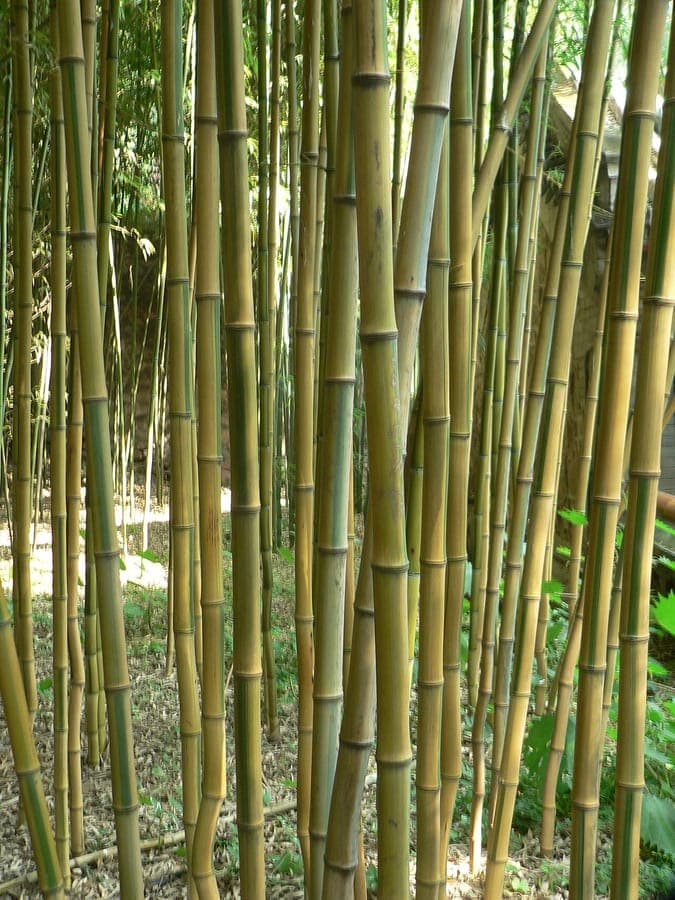
Wikimedia Commons / CC BY-SA 3.0, via Wikimedia Commons
Phyllostachys aureosulcata: complete guide
Phyllostachys aureosulcata
Want to see Phyllostachys aureosulcata: complete guide in your garden?
1 minute, no credit card
Overview
Phyllostachys aureosulcata, commonly known as yellow groove bamboo or stake-and-forage bamboo, is an elegant exotic species native to southeastern China. This bamboo is celebrated for its striking golden-yellow culms (stems) with distinctive green lengthwise grooves, creating a stunning contrast pattern. It remains a popular choice for gardeners seeking vertical elements with exotic character. Scientifically described around 1945, this species has since become widely distributed as an ornamental worldwide.
Appearance and bloom
Yellow groove bamboo reaches heights of 6-8 meters under optimal conditions, though this varies considerably based on climate and growing conditions. The leaves are narrow and deep green, elegant and typical of the Phyllostachys genus. The culms display the characteristic yellow coloring with green lengthwise grooves, hence the name aureosulcata. This combination makes the plant exceptionally decorative, particularly against dark backdrops. Growth is fairly rapid, allowing the plant to become an impressive presence relatively quickly.
Flowering is rare in garden conditions; in the wild, it occurs sporadically. When bloom does appear, the flowers are inconspicuous and emerge from the nodes.
Ideal location
This bamboo performs best with at least 4-6 hours of direct sunlight daily. In very hot summer locations, afternoon shade may be beneficial, especially in Mediterranean climates. The plant tolerates partial shade reasonably well, though growth becomes less vigorous. The yellow coloring of the culms is most striking in full sun.
Select a sheltered position, as strong winds can damage the elegant foliage crowns. A location providing northwesterly wind protection works ideally. Avoid spots where water pools, as this creates root problems.
Soil
Yellow groove bamboo thrives in well-draining, fertile soil. A mixture of garden compost, sand and organic matter provides optimal conditions. Soil pH should be slightly acidic to neutral, ideally between 5.5 and 7.0. The soil should remain moist but never waterlogged.
Prepare the planting site by incorporating organic material such as leaf mold or compost. This improves both water retention and drainage capacity. Avoid heavy clay soils without amendment, as these can cause root rot.
Watering
During the growing season (spring and summer), bamboo requires regular watering, especially in the first years after planting. Water when the top 2-3 cm of soil feels dry. Twice-weekly watering is generally sufficient in moderate temperatures, but in hot periods daily watering may be necessary.
Ensure water drains well; stagnant water is harmful. In autumn and winter, watering can be reduced considerably. Once established, this bamboo is fairly drought-tolerant, though regular water supports growth.
Free design
Want to see Phyllostachys aureosulcata: complete guide in your garden? Make a free design now.
Pruning
Pruning is primarily directed toward shaping and maintaining desired form. Remove dead or damaged culms in early spring. Remove low-hanging branches for a neat appearance and improved sight lines. Pruning can be performed without harming the plant.
In dense plantings, thinning may be necessary to allow air and light penetration. This promotes health and prevents fungal issues. Pruning wounds heal quickly because bamboo is a vigorous grower.
Maintenance calendar
Spring (March-May): Check for winter damage, fertilize, clear debris. Summer growth surge begins.
Summer (June-August): Water regularly, watch for drought stress. Remove wilted branches. This is the growth peak.
Autumn (September-October): Gradually reduce watering as temperatures decline. Collect fallen leaves for composting.
Winter (November-February): Minimal feeding and water. Check protection against extreme frost.
Winter hardiness
Phyllostachys aureosulcata is reasonably cold-hardy to approximately -15 to -18 degrees Celsius. This enables survival in many temperate climates. However, in regions with severe winters or regular sub-20 degree Celsius freezes, protection is advisable.
In the first winter after planting, protection is recommended. Wrap young plants in burlap or place screens around exposed portions. Mulch around the base with 10-15 cm of leaf mold or straw. Once established (after 2-3 years), protection is usually unnecessary in temperate zones.
Companion plants
Ambiance is achieved with dark evergreen shrubs. Ilex aquifolium (holly) fits well in height and structure. Prunus laurocerasus (cherry laurel) provides dark contrast. Buxus sempervirens (boxwood) forms neat defined plantings below.
Prevent color weakening by placing groundcover plants like Sempervivum (houseleek) below. Fatsia japonica offers architectural leaf forms that complement bamboo. Acer palmatum brings seasonal color in summer and autumn periods.
Avoid very tall bamboos nearby. These create congestion and encourage fungi.
Closing remarks
Yellow groove bamboo is a fascinating addition to moderately frost-tolerant gardens seeking the exclusive character of Eastern architecture. With proper placement and regular maintenance, it develops into an impressive ornament that remains present season after season. Continued feeding and moisture management ensure years of verdant enjoyment.
Available at major garden centers with stock certainty in spring and early summer months. Investment in quality plants (at least two years old) leads to faster achievement of desired height. gardenworld.app offers tutorials for bamboo integration in front yard designs. gardenworld.app also provides interactive bamboo selection tools.
Want to see Phyllostachys aureosulcata: complete guide in your garden? Make a free design now.
Upload a photo, pick a style, and get a photorealistic design with plant list in under a minute.
No credit card required


Similar plants
Sporobolus pungens: complete guide
Sporobolus pungens
Sporobolus pungens is a stoloniferous Mediterranean coastal grass with outstanding salt and drought tolerance, perfect for seaside and dry gardens.
Mediterranean aegilops: complete guide
Aegilops biuncialis
Everything about Aegilops biuncialis, a Mediterranean annual grass with ornamental spikes and outstanding drought tolerance for dry gardens.
Silver bluestem: complete guide
Bothriochloa saccharoides
Full guide to Bothriochloa saccharoides (silver bluestem): site, soil, watering, winter hardiness, pruning, and garden companions.