
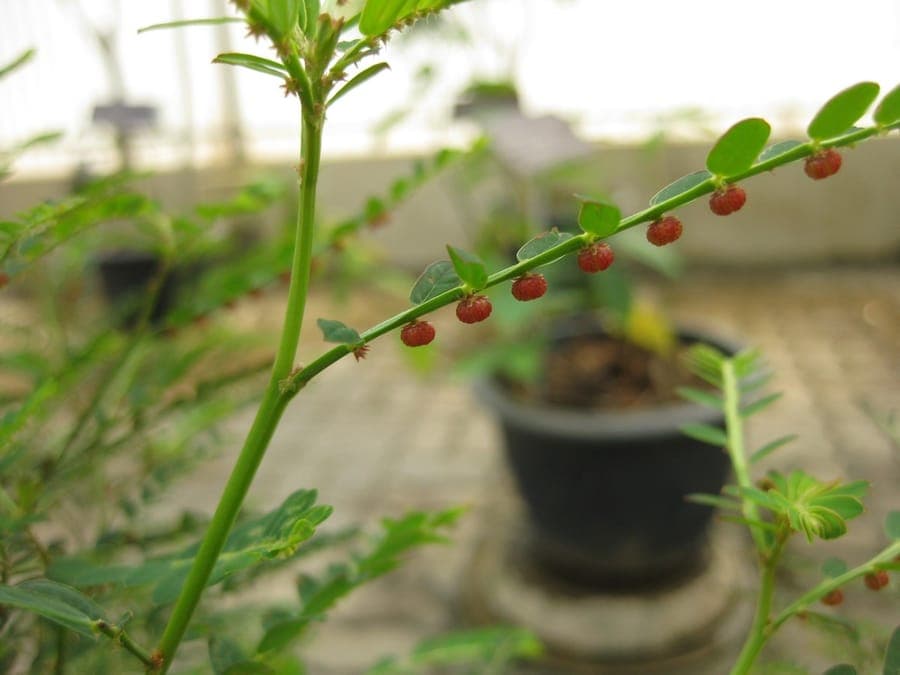
Raffi Kojian / CC BY-SA 3.0, via Wikimedia Commons
Phyllanthus urinaria: complete guide to chamber bitter plant
Phyllanthus urinaria
Want to see Phyllanthus urinaria: complete guide to chamber bitter plant in your garden?
1 minute, no credit card
Overview
Phyllanthus urinaria, also known as chamber bitter, leaf flower, or quebra-pedra (Portuguese), is a small, delicate herb plant native to the tropics and subtropics from Asia to Australia. This unique plant is renowned in many traditional medicine systems, though we focus here on botanical and gardening aspects.
The plant typically reaches 30 to 60 centimeters in height and grows as a delicate, finely branched shrub. The most striking feature is its almost fern-like leaves with a very fine, particularly graceful architecture. This gives the plant an elegant appearance comparable to a miniature fern.
Appearance and Bloom
The leaves of Phyllanthus urinaria are this plant's strong point. They are very small, approximately 0.5 to 1.5 centimeters long, and are doubly feathered (bipinnate), making them appear almost fern-like. They grow alternately along thin, green stems. Overall, this structure gives the plant a very delicate, almost fairy-tale appearance.
The flowers are very small and inconspicuous, whitish to greenish, providing little aesthetic value. The fruits are far more interesting: they are small, green to brown capsules neatly hidden under the leaves, which explains the name "leaf flower."
The plant grows quite rapidly in warm conditions and can add several centimeters monthly.
Ideal Location
Phyllanthus urinaria thrives best in locations with:
- Bright indirect light to partial shade
- Can grow almost anywhere except deep shade
- Suitable for indoor plants in tropical and subtropical climates
- Can also grow outdoors in warm regions
- Perfect for terrariums and closed ecosystems
The plant tolerates many light conditions and is highly adaptable.
Free design
Want to see Phyllanthus urinaria: complete guide to chamber bitter plant in your garden? Make a free design now.
Soil Requirements
Phyllanthus urinaria prefers:
- Light, nutrient-rich, well-draining soil
- pH between 5.5 and 7.5
- Sandy to loamy soil
- Well-drained pots
Watering
Watering must be regular but not excessive:
- Keep soil moderately moist during growing period
- Water approximately once weekly, depending on climate
- Ensure good drainage
- Higher humidity is beneficial
- Less water during cooler periods
The plant tolerates moderate drought better than excessive moisture.
Pruning
Pruning helps maintain form:
- Light pinching of stem tips stimulates branching
- Remove dead or wilted parts
- Plant responds well to careful pruning
- Can be cut and shaped according to preference
Maintenance Calendar
March to October: Growing period. Water weekly, fertilize monthly. November to February: Quieter period. Water less frequently.
Winter Hardiness
Phyllanthus urinaria is highly cold-sensitive:
- Does not survive below 10 degrees Celsius
- In cold climates: indoor cultivation only
- Grow as an annual plant in cold areas
- Requires warmth for growth
Companion Plants
Combines well with:
- Other fine-foliaged plants
- Small mosses and ferns
- Light ground-covering plants
- Other tropical herb plants
Final Thoughts
Phyllanthus urinaria is a charming small plant with an elegant, delicately branched structure. With its fern-like leaves and compact growth, it is a perfect choice for those who love delicate, refined plants. For more gardening ideas, visit gardenworld.app.
Want to see Phyllanthus urinaria: complete guide to chamber bitter plant in your garden? Make a free design now.
Upload a photo, pick a style, and get a photorealistic design with plant list in under a minute.
No credit card required


Similar plants
Peperomia pellucida: complete guide to man-to-man herb
Peperomia pellucida
Master Peperomia pellucida, a compact herbaceous plant with translucent leaves ideal for indoor gardening and cool garden corners.
Phlox carolina: complete guide to thick-leaf phlox
Phlox carolina
Discover Phlox carolina, a North American perennial with thick glossy leaves and fragrant pink flowers perfect for borders and native gardens.