
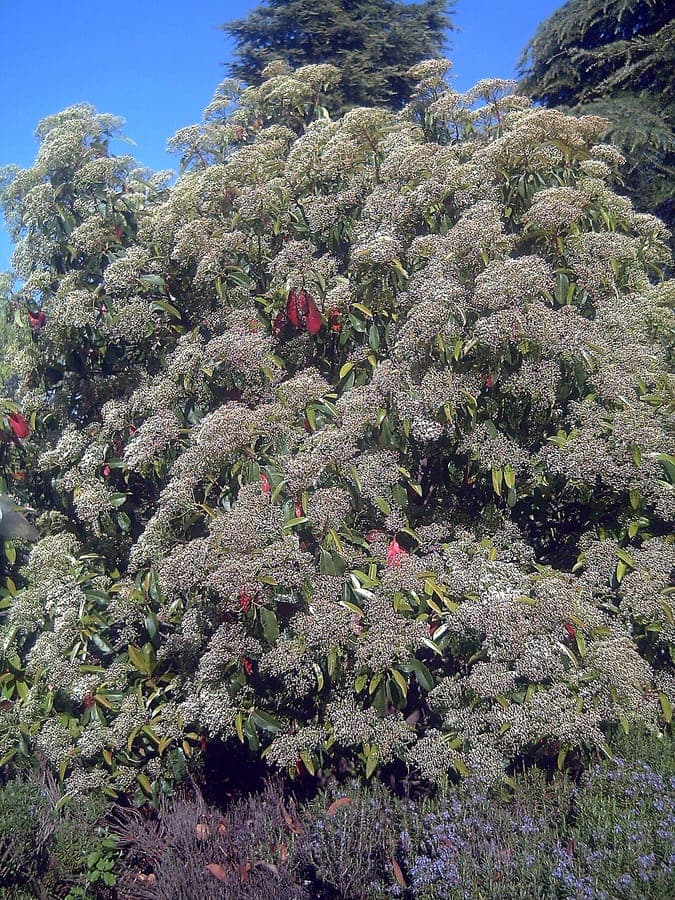
Javier martin / Public domain, via Wikimedia Commons
Photinia serratifolia: complete guide
Photinia serratifolia
Want to see Photinia serratifolia: complete guide in your garden?
1 minute, no credit card
Overview
Japanese Photinia (Photinia serratifolia), also known as Taiwanese Photinia or Red Tip Photinia, is an impressive tree native to China, Taiwan, and the Philippines. This tree is especially beloved for its spectacular red young foliage that emerges in spring, contrasting beautifully with deep green mature leaves. With its striking white spring flowers and decorative red berries in autumn, Photinia serratifolia offers year-round seasonal interest. At gardenworld.app, we help you integrate this impressive specimen perfectly into your garden design.
Appearance & Bloom
Photinia serratifolia grows into a tree of 5-7 meters tall (sometimes taller in ideal conditions). The plant forms a dense, oval to pyramidal crown. The most distinctive feature is its foliage: young leaves are bright red to yellow-orange, gradually turning deep green as they mature. This creates a continuous color display throughout spring.
White flowers appear in May-June in dense, flat flower clusters. These are fragrant and attract pollinators. After flowering, red to dark red berries develop, becoming highly decorative in autumn. The dark bark is also attractive, especially in winter.
Ideal Location
Photinia serratifolia thrives in full sun to partial shade. For the most spectacular red foliage display, choose a location with at least 6 hours of direct sunlight daily. In the Netherlands, a southwest-facing, sunny position is ideal. The tree tolerates partial shade but will produce fewer red leaves.
Avoid very exposed, windy locations; while the tree tolerates moderate wind, extreme exposure can cause damage.
Soil
Photinia serratifolia prefers well-draining soil but is not overly particular. Heavy clay soils can be improved with sand, compost, or garden soil. The plant tolerates both acidic and neutral soils. An ideal pH range is 5.5 to 7.0.
Ensure excellent drainage, particularly in young trees. Mulching with organic material helps retain soil moisture and provides nutrients.
Free design
Want to see Photinia serratifolia: complete guide in your garden? Make a free design now.
Watering
During the first two years after planting, Photinia serratifolia requires regular watering. Water more deeply when the soil feels dry to about 10 cm depth. Once established (after 2-3 years), this tree becomes fairly drought-tolerant.
During the growing season (April-September), provide more consistent water. In winter, significantly reduce watering. Ensure deep watering so roots develop deep systems. Pay special attention to young trees during dry periods.
Pruning
Photinia serratifolia can be pruned to maintain shape and encourage beauty. The best time is immediately after flowering (July). For hedging purposes, more frequent pruning can be done to promote density.
Remove dead or damaged branches in early spring. Pruning after winter can be beneficial for encouraging more red foliage. This tree grows vigorously and can be cut back fairly hard.
Maintenance Calendar
March-April: Prune past frost damage, add compost, check drainage. May-June: Water regularly, monitor for pests, enjoy flowers. July-August: Prune for shape and density after flowering. September-October: Reduce watering, enjoy red berries. November-December: Minimal watering, prepare for winter. January-February: Heavy pruning possible during mild periods.
Winter Hardiness
Photinia serratifolia is moderately winter-hardy in the Netherlands. In the south (down to -10 degrees), this tree can grow outdoors with protection. In central and northern regions, severe winters can be damaging and winter protection may be necessary.
Container-grown specimens should be moved indoors during winter in northern regions. In open ground, mulching and wind protection can help.
Companion Plants
Photinia serratifolia works best as a specimen tree but can be combined with:
- Acer palmatum (Japanese maple) - similar Asian aesthetic
- Ilex crenata (Japanese holly) - screening and contrast
- Sarcococca confusa (Sweet box) - winter fragrance and contrast
- Osmunda (Royal fern) - moist ground underplanting
- Heuchera (Coral bells) - colored groundcover
Conclusion
Photinia serratifolia is a spectacular choice for gardens wanting to emphasize seasonal changes. With its red spring foliage, white spring flowers, and red autumn berries, this tree provides visual interest throughout the year. Discover more trees and design your dream garden at gardenworld.app.
Want to see Photinia serratifolia: complete guide in your garden? Make a free design now.
Upload a photo, pick a style, and get a photorealistic design with plant list in under a minute.
No credit card required


Similar plants
Siberian crab apple: complete guide
Malus x robusta
Complete guide to the Siberian crab apple (Malus x robusta): location, soil, pruning, winter hardiness and the best companion plants for your garden.
Chinese flowering crabapple (Malus x spectabilis): complete guide
Malus x spectabilis
Meet the Chinese flowering crabapple (Malus x spectabilis): a classic spring bloomer with carmine buds and pink blossom.
Potentilla crassinervia: complete guide
Potentilla crassinervia
Potentilla crassinervia, the Corsican cinquefoil, grows wild on Corsica and Sardinia's peaks. Discover how to grow this hardy alpine rock garden gem.