
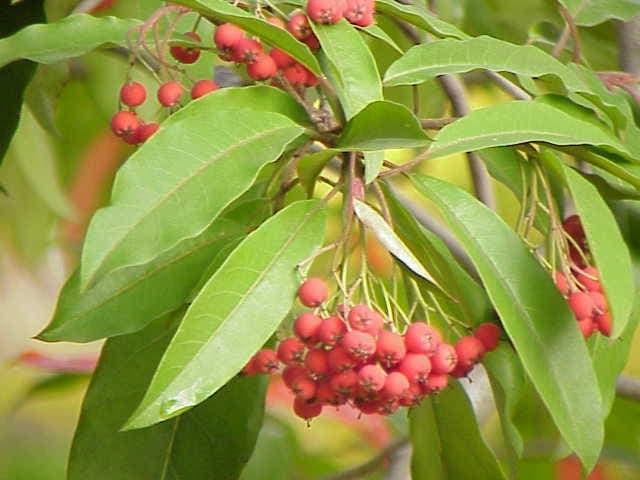
Kurt Stüber [1] / CC BY-SA 3.0, via Wikimedia Commons
Photinia davidiana: complete guide
Photinia davidiana
Want to see Photinia davidiana: complete guide in your garden?
1 minute, no credit card
Overview
Photinia davidiana, also called Stranvaesia or Chinese photinia, is a semi-evergreen to evergreen shrub native to central and southern China, Taiwan, and northern Vietnam. This attractive shrub reaches 4 to 6 meters in height and is valued for its glossy, leathery foliage and abundant red berries that persist on branches for weeks. White flowers appearing in April to May are subtle yet attractive, drawing pollinators. This is an excellent plant for groundcover, hedging, and as a specimen where winter interest is desired.
Appearance and bloom
Photinia davidiana distinguishes itself through its beautifully glossy, leathery foliage that remains dark green throughout much of the year. Leaves are oblong-lanceolate, approximately 8 to 12 cm long, with a highly glossy upper surface and lighter underside. In cold winters, foliage can turn reddish-purple, providing extra winter ornament. White flowers appear in May in cluster-like panicles and are fragrant, though modest in size. Following bloom, slowly ripening berries first turn orange, then bright red. These fruits persist on the plant until November-December, providing bird food.
Ideal location
This shrub thrives best in full sun to light shade. In full sun, blooming is enhanced and fruit ripens more quickly. Some shade is tolerated but may result in reduced berry production. A sheltered position is desirable as heavy winds can damage the attractive flower display. Avoid planting directly against walls where heat stagnates, though wall protection in colder regions may be beneficial. A location with good air circulation reduces fungal disease pressure.
Soil
Photinia davidiana grows in a broad range of soils but prefers well-draining, moderately fertile ground. A pH between 6 to 7.5 is favorable. Avoid strongly acidic soils. Clay soils without drainage improvement may promote root weakness and fungal problems. Amend planting areas with composted bark or garden compost. This shrub is reasonably drought-tolerant once established but grows better in moderate moisture conditions.
Free design
Want to see Photinia davidiana: complete guide in your garden? Make a free design now.
Watering
Regular watering is necessary in the first growing season, particularly during dry periods. Once well-established (after 2 to 3 years), the shrub is reasonably drought-tolerant and requires no supplemental water in normal seasons. However, in very dry summers, additional watering may be beneficial. Avoid waterlogging; the plant dislikes wet feet. Mulching with 5 cm of organic material aids moisture retention.
Pruning
Photinia davidiana requires moderate pruning. Formal shapes can be pruned in April following flowering completion. Remove crossing branches and dead wood in late winter. Heavy pruning wounds can introduce disease; work carefully. Young plants may receive selective pruning to establish strong structure. Hedge formation is possible but requires two pruning sessions per season.
Maintenance calendar
March-April: Inspect for winter damage, remove dead wood. Apply fertilizer as soil warms. May-June: Enjoy flowers and young fruit development. Monitor for powdery mildew. July-August: Ensure adequate moisture if drought threatens. Check for disease. September-October: Fruits ripen to red; photograph for garden documentation. No feeding. November-December: Enjoy red fruits and bird visits. Pruning can occur. January-February: Check for frost damage, plan pruning strategy.
Winter hardiness
Photinia davidiana is hardy in USDA zones 8 to 10 but marginal in zone 7 with protection. In northerly locations (zone 6), wall protection is recommended. The plant tolerates approximately -15 degrees Celsius, though young plants prefer winter protection in their first season. In extremely cold areas, branch dieback may occur but recovery is normal.
Companion plants
Photinia davidiana combines well with other red-fruited shrubs such as cotoneaster and pyracantha. Underplanting with dark-foliaged grasses and hellebores highlights the glossy foliage. Light-growing ground covers add textural interest. White-flowering clematis or small jasmine can climb against the shrub for color contrast. Group multiple Photinia specimens for enhanced winter interest.
Closing thoughts
Photinia davidiana offers garden owners an ornamental shrub with excellent winter interest. Its glossy foliage, modest flowers, and long-lasting red berries make it valuable in landscape plantings. With proper care, it grows effortlessly into fine specimens. This plant is available at major garden centres. GardenWorld supports your winter interest designs.
Want to see Photinia davidiana: complete guide in your garden? Make a free design now.
Upload a photo, pick a style, and get a photorealistic design with plant list in under a minute.
No credit card required


Similar plants
Siberian crab apple: complete guide
Malus x robusta
Complete guide to the Siberian crab apple (Malus x robusta): location, soil, pruning, winter hardiness and the best companion plants for your garden.
Chinese flowering crabapple (Malus x spectabilis): complete guide
Malus x spectabilis
Meet the Chinese flowering crabapple (Malus x spectabilis): a classic spring bloomer with carmine buds and pink blossom.
Potentilla crassinervia: complete guide
Potentilla crassinervia
Potentilla crassinervia, the Corsican cinquefoil, grows wild on Corsica and Sardinia's peaks. Discover how to grow this hardy alpine rock garden gem.