
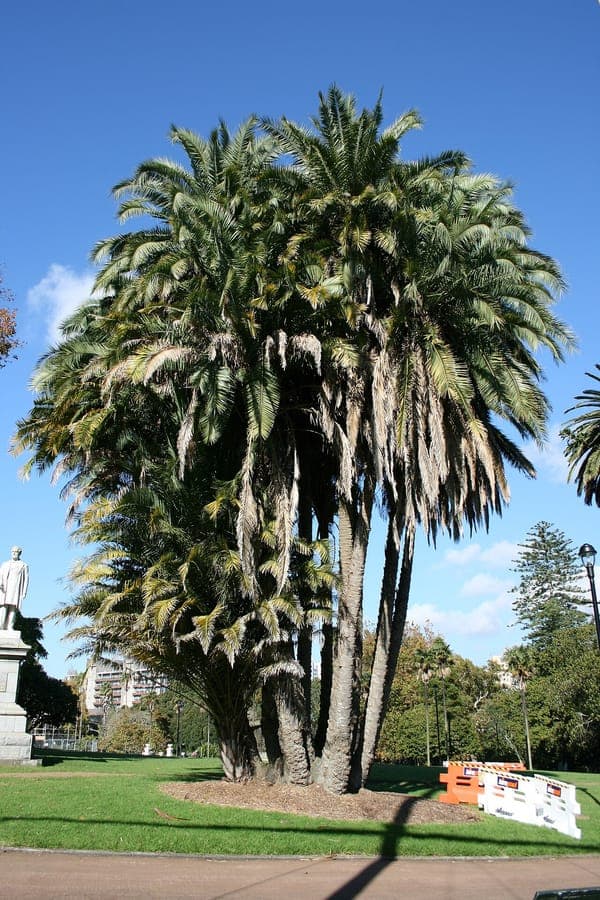
Kahuroa / Public domain, via Wikimedia Commons
Senegal Date Palm: complete guide
Phoenix reclinata
Want to see Senegal Date Palm: complete guide in your garden?
1 minute, no credit card
Overview
Senegal Date Palm (Phoenix reclinata) is an elegant, multi-stemmed palm native to Africa and Madagascar. Belonging to the Arecaceae family, this plant is prized for its graceful, drooping fronds and characteristic golden-brown trunks that frame dramatically against the sky. It represents an ideal choice for gardeners seeking tropical effects with substantial architectural impact and relatively low maintenance requirements.
Senegal Date Palm reaches approximately 3-5 meters in height under garden conditions with a broad, open crown. The plant can develop impressive, large specimens over years. This makes it a striking accent in gardens, particularly in warm climates.
Appearance and bloom
The fronds of Phoenix reclinata are pinnate (feather-shaped), approximately 1.5-2.5 meters long, and droop elegantly from the trunk. Each frond has a long leaf stalk with innumerable small, lance-shaped leaflets attached along its length. Coloration is green, sometimes assuming a grayish tint in very sunny locations.
Flowers are small, yellow-white colored, and appear in dense spikes between leaf bases. Flowering occurs spring through summer. Female palms produce orange to red-colored fruits measuring approximately 1-2 centimeters in diameter. These fruits persist long on the plant, attracting numerous bird species.
Ideal location
Senegal Date Palm performs optimally in full sun positions receiving minimum 6-8 hours of direct daily sunlight. The plant tolerates some afternoon shade but develops better in full sun. In very hot climates, some afternoon shade may prove beneficial.
This plant excels as a specimen tree, planted in groups, or as a structural element in tropical gardens. It suits container cultivation in cold climates, though large specimens require substantial pots. This versatility allows flexible use in various garden styles.
Soil
Senegal Date Palm is remarkably soil-tolerant. It thrives in sandy, gravelly, and heavy soils, provided drainage is reasonable. The plant tolerates salt-containing soils well, an advantage in coastal areas.
Optimal pH is neutral to slightly alkaline (7.0-8.0). For pot cultivation, use rich, well-draining potting soil. Adding palm-specific fertilizer leads to improved growth. The plant thrives in poor soils but grows faster when good nutrition is available.
Watering
Senegal Date Palm appreciates regular moisture during the growing season but tolerates drought once established. During the first year after planting, provide regular water until the root system develops fully. In container cultivation, water regularly, especially during warm periods.
During winter periods, watering can be substantially reduced. Overwatering is harmful, particularly in pot cultivation. Ensure good drainage in all growing conditions. In established ground cultivation, the plant usually requires no supplemental water except during exceptional droughts.
Free design
Want to see Senegal Date Palm: complete guide in your garden? Make a free design now.
Pruning and care
Senegal Date Palm demands minimal intervention. Remove dead or yellowing fronds at the plant base for neatness. This promotes better air circulation. In container cultivation, you can remove overgrown stems, though this is not absolutely necessary.
Heavy pruning is not recommended: allow the plant to maintain its natural appearance. The plant self-prunes when beneficial for its development. Spring and summer application of palm-specific fertilizer promotes growth and health.
Maintenance calendar
March to April: Inspect previous season's growth. Remove dead fronds. Begin feeding. Check pot size in container cultivation.
April to May: Growing season begins. Regular moisture important. Water cautiously - excess is harmful.
May to June: Rapid growth period. Regular feeding helps. Flowering begins. Ensure good drainage.
July to August: Peak growth. Regular feeding and water critical. Remove dead fronds.
September to October: Growth slows. Remove very dead fronds. Begin feeding reduction.
November to December: Plant slowing down. Minimal feeding. Water less frequently.
January to February: Dormant period. Minimal water. Monitor for pest damage.
Winter hardiness
Senegal Date Palm is frost-sensitive and suitable for USDA zones 9-11 (warm subtropical to tropical zones). In zone 8, it can survive in highly protected locations against south-facing walls. In colder zones, it must be grown in greenhouse/conservatory settings.
In areas with winter freezing, the plant may experience frost damage, particularly on young or recently planted specimens. Mulching around the base can provide protection in zone 8. In all colder zones, container cultivation is recommended.
Companion plants
Senegal Date Palm combines beautifully with other tropical and subtropical plants:
- Strelitzia (Bird of Paradise): Orange flowers contrast nicely
- Clivia: Orange flowers, green foliage
- Dracaena: Structural form, varied foliage textures
- Yucca: Architectural foliage, yellow flowers
- Fatsia japonica: Large leaves, winter-hardy to zone 8
- Cordyline: Colorful foliage variation
- Agapanthus: Blue flowers for contrast
Closing thoughts
Senegal Date Palm is an elegant, long-lived palm for warm gardens. With graceful drooping fronds and architectural impact, it provides decades of garden value. Ideal for tropical landscaping and as a specimen tree in subtropical gardens.
Ready to acquire Senegal Date Palm? For additional advice about this palm and other tropical selections, visit gardenworld.app for personalized garden designs.
Want to see Senegal Date Palm: complete guide in your garden? Make a free design now.
Upload a photo, pick a style, and get a photorealistic design with plant list in under a minute.
No credit card required


Similar plants
Needle palm: complete guide
Rhapidophyllum hystrix
Everything about the needle palm: the world's hardiest palm, suitable for gardens in temperate climates down to USDA zone 7b.
Saw palmetto: complete guide
Serenoa repens
A complete guide to saw palmetto (Serenoa repens), the iconic fan palm from Florida and the southeastern United States, prized for its toughness.
Puerto Rican hat palm: complete guide
Sabal causiarum
Grow Puerto Rican hat palm successfully. A majestic fan palm with tropical presence suited to sheltered Mediterranean-style gardens.