
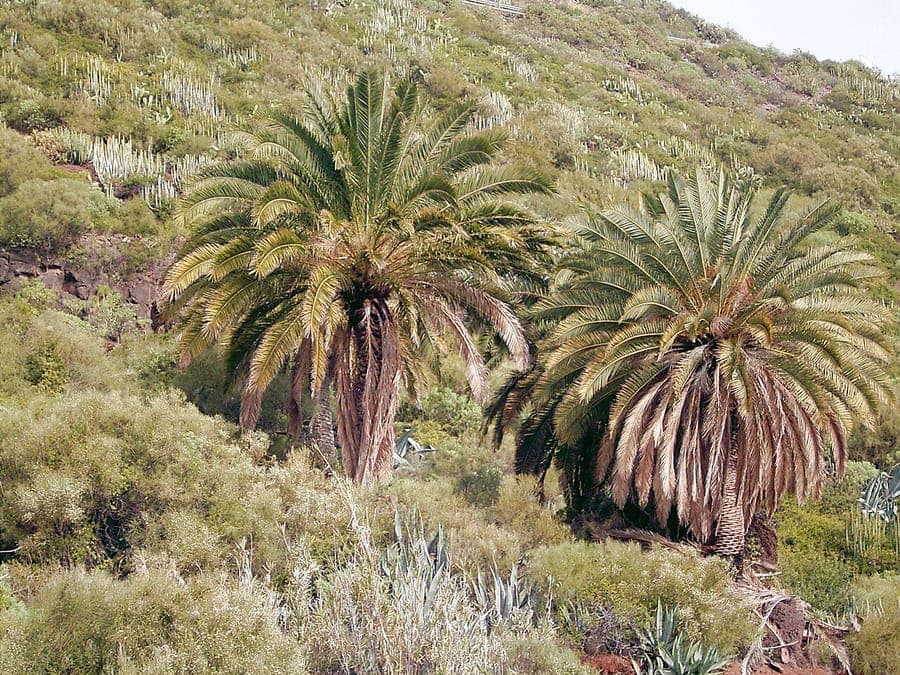
Frank Vincentz / CC BY-SA 3.0, via Wikimedia Commons
Canary Island date palm: complete guide
Phoenix canariensis
Want to see Canary Island date palm: complete guide in your garden?
1 minute, no credit card
Overview
Phoenix canariensis, the Canary Island date palm, is one of the most spectacular and monumental palm trees in the world. Native to the Canary Islands (Spain), this species is known for its enormous, feathery leaves and strong, robust trunk. Phoenix canariensis grows to massive heights with a very thick trunk, making it a perfect choice for large garden installations, public parks, and warmer climatic zones. The plant is also widely used in Mediterranean landscapes and subtropical regions worldwide.
The Canary Island date palm can reach 50 to 65 feet tall with an extremely thick trunk measuring 2 to 3 feet in diameter. The leaves can reach 20 feet long and form enormous, undulating crowns. This plant also produces yellow flowers followed by orange-red fruits that attract numerous insects and birds.
Appearance and bloom
Phoenix canariensis grows as a strong, thick-trunked palm with rough, grayish-brown bark. The bark displays distinct patterns of old leaf scars, giving mature specimens a characteristic textured appearance. The trunk is relatively thin in the first decade but thickens substantially as the plant ages.
The leaves are large, compound, and pinnate (feather-like) with hundreds of small, sharp leaflets extending in different directions. Each frond can reach 13 to 20 feet long and weighs dozens of kilograms. Leaves are glossy dark green on top with a grayish-white underside. Old leaves eventually die and sometimes hang around the crown for months before dropping (dead palm fronds must be manually removed for safety and aesthetics).
Flowers are small, yellow, and highly fragrant, appearing in large, drooping clusters between the leaves in May-June. These flowers are followed by fruits: approximately 0.8 inch ovoid berries that change from green to orange to deep red when ripe. These fruits are eaten by numerous birds and small mammals.
Ideal location
Phoenix canariensis thrives in a fully sunny location with a minimum of 6 hours of direct sunlight daily. Plants also perform well in partial shade, though growth becomes slower. In very hot climates, some protection from midday sun can be beneficial, though this species tolerates considerable heat.
The plant prefers sheltered positions protected from strong, persistent winds. Strong side winds can tear fronds and affect growth direction. In windy climates, wind protection from other trees or structures can be valuable.
Phoenix canariensis grows well in USDA zones 9-11. In zone 8, it may survive but grows slowly and can experience frost damage during extremely cold winters. In zones 7 and colder, this plant is not winter hardy without significant protection. Many growers in non-ideal zones plant this in large containers that can be moved indoors for winter.
Soil
This palm performs best in well-draining, sandy to sandy loam soil. A pH between 6.0 and 8.0 is acceptable, though this species is very tolerant of diverse soil types. The primary requirement is good drainage; waterlogging and stagnant water will lead to root rot in a relatively short time.
At planting time, amend heavy soil with sand, perlite, and compost to improve drainage. Once established, Phoenix canariensis is extremely drought-tolerant and requires very little supplemental water except in very arid climates.
The plant is also very salt-tolerant, making it suitable for coastal gardens. It can thrive in salt spray and saline groundwater to a much greater extent than most other palms.
Free design
Want to see Canary Island date palm: complete guide in your garden? Make a free design now.
Watering
Newly planted Phoenix canariensis require regular watering for the first two years until the root system is deep and broadly established. Water when soil 2 inches below the surface feels dry, but prefer deep and regular watering rather than shallow and frequent.
Once established (after approximately 2-3 years), this palm has very minimal water needs in temperate climates with regular rainfall. In arid regions, occasional summer irrigation can be valuable, especially for larger specimens.
Watering should be stopped or drastically reduced in winter in zones where the plant is winter hardy, as this is a dormancy period.
Pruning
Phoenix canariensis requires minimal pruning, but regular removal of dead fronds is necessary for neat appearance and to reduce fire hazard. When fronds are completely brown, they can be carefully removed at the base with a saw or pruner.
Do not remove green or partially-green fronds, as this may introduce damage or disease. Many growers use pole pruners or hire professional arborists for safe high-level pruning.
Flower clusters can be removed after flowering if desired, though many growers leave them to support fruit production and natural beauty.
Maintenance calendar
JANUARY-MARCH: Inspect for frost damage in cold zones. Remove dead fronds. Light fertilizer application. APRIL-MAY: Prepare for growing season. Increase fertilizer. JUNE-AUGUST: Peak growth period. Regular watering in dry spells. SEPTEMBER-OCTOBER: Reduce fertilizer as season slows. NOVEMBER-DECEMBER: Winter preparations. No fertilizing.
Winter hardiness
Phoenix canariensis is winter hardy in USDA zones 9-11. In zone 8, the plant may survive but grows slowly and can experience frost damage during extremely cold winters; some growers protect young plants in zone 8 with burlap wrapping in winter.
In zones 7 and colder, this plant is not suitable for outdoor cultivation without significant protection. Container cultivation is recommended here, with plants moved indoors in October and outdoors in May.
Even in zone 9, very young plants may benefit from protection against repeated frost episodes.
Companion plants
Phoenix canariensis works well in Mediterranean landscapes with other warm-loving plants. Agapanthus, Rosmarinus, Cistus, and Lavandula are natural partners sharing similar preferences.
In subtropical and warmer zones, it combines well with other large palms such as Trachycarpus and Chamaerops, as well as with baobabs and other imposing tree species.
For smaller gardens, Phoenix canariensis can serve as a central focal tree, surrounded by lower-growing structures or groundcovers.
Closing
Phoenix canariensis is a spectacular, monumental palm that can provide decades of enjoyment in suitable climates. This plant grows slowly, so patience is required, but the ultimate results are highly rewarding. Whether you live in a Mediterranean setting or warmer zone, you can enjoy the grandeur of the Canary Island date palm. Quality garden centers and nurseries throughout the UK and Europe stock this species. In North America, specialized tropical plant nurseries often carry mature specimens. GardenWorld.app also advises on large palm selections. With the right location and patience, you will own a living monument.
Want to see Canary Island date palm: complete guide in your garden? Make a free design now.
Upload a photo, pick a style, and get a photorealistic design with plant list in under a minute.
No credit card required


Similar plants
Needle palm: complete guide
Rhapidophyllum hystrix
Everything about the needle palm: the world's hardiest palm, suitable for gardens in temperate climates down to USDA zone 7b.
Saw palmetto: complete guide
Serenoa repens
A complete guide to saw palmetto (Serenoa repens), the iconic fan palm from Florida and the southeastern United States, prized for its toughness.
Puerto Rican hat palm: complete guide
Sabal causiarum
Grow Puerto Rican hat palm successfully. A majestic fan palm with tropical presence suited to sheltered Mediterranean-style gardens.