
Wikimedia Commons / CC BY-SA 3.0, via Wikimedia Commons
Moss phlox: complete guide
Phlox subulata
Want to see Moss phlox: complete guide in your garden?
1 minute, no credit card
Overview
Moss phlox, or Phlox subulata, is a staple in cottage gardens and rockeries across temperate zones. Native to regions like Arkansas, Kentucky, and Indiana, this herbaceous perennial from the Polemoniaceae family thrives in well-drained soils and full sun. It's a subshrub that forms dense, creeping mats just 10–15 cm tall but spreading up to 30 cm wide. Hardy to USDA zone 3 (-25°C), it's a reliable performer even in colder UK and northern US climates.
Perfect for filling gaps between stepping stones or softening the edges of retaining walls, moss phlox is both ornamental and functional. Its evergreen to semi-evergreen foliage provides year-round texture, while its vibrant spring bloom adds a bold splash of color. Once established, it requires minimal care, making it a go-to for low-maintenance landscapes.
Using gardenworld.app, you can design a garden layout that highlights moss phlox along pathways or slopes where erosion control is needed.
Appearance & bloom cycle
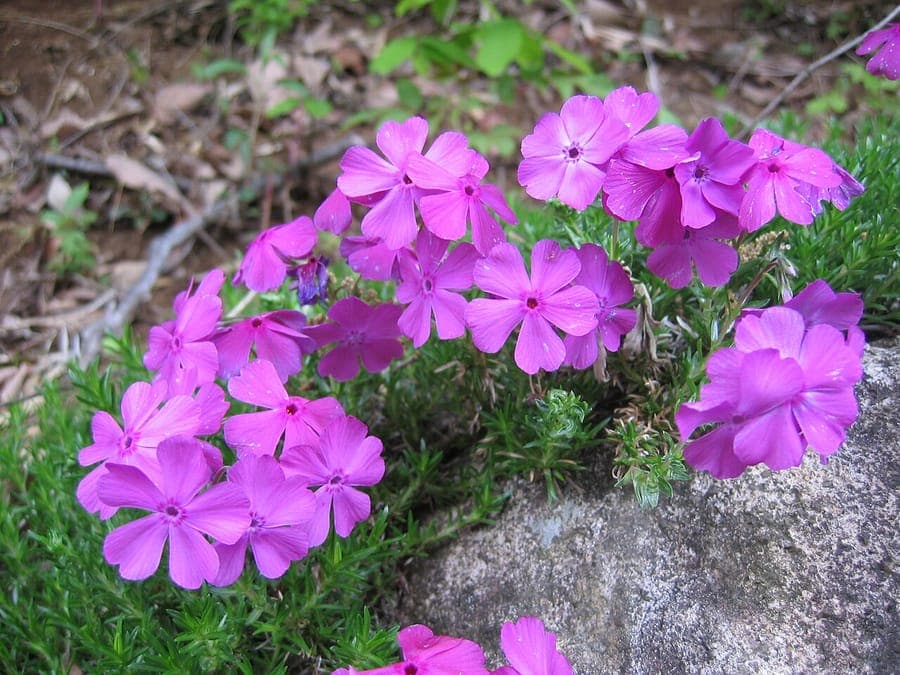
The foliage of Phlox subulata is narrow, needle-like, and deep green, forming a tight carpet. The leaves may take on a bronzy hue in winter, especially in colder zones, but rarely die back completely. From late April to mid-June, depending on local climate, clusters of star-shaped purple flowers emerge in dense terminal heads. Each flower is about 2–3 cm across, with five rounded lobes and a faint, sweet fragrance that draws pollinators.
The bloom period is intense and relatively short, but the visual impact is dramatic. After flowering, the plant remains tidy and green, ready for light pruning. In milder summers, a light repeat bloom may occur in late August if the plant is trimmed promptly after the first flush.
Ideal location
Full sun is best - aim for at least 6 hours of direct sunlight daily. Moss phlox can tolerate light shade, but flowering diminishes and stems may stretch. South- or southwest-facing slopes, rock gardens, or gravel beds are ideal. It also works well in wall crevices or over low retaining walls, where its trailing habit can cascade slightly.
Avoid low-lying, damp areas or spots under dense tree canopies where moisture lingers. This plant evolved in dry, rocky habitats and performs poorly in soggy soil.
Soil requirements
Moss phlox prefers lean, well-drained soil. Rich, heavy soils promote excessive foliage at the expense of blooms. A sandy or loamy mix with a pH between 5.7 and 7.5 is perfect. If your soil is clay-heavy, amend planting holes with horticultural grit or coarse sand to improve drainage. While it tolerates slightly alkaline conditions, avoid highly calcareous soils.
Check your soil conditions using the analysis tools on gardenworld.app to ensure optimal planting success.
Free design
Want to see Moss phlox: complete guide in your garden? Make a free design now.
Watering
During the first growing season, water weekly to help roots establish. After that, moss phlox is highly drought-tolerant. Once rooted, deep watering every two weeks during dry spells is sufficient. Always water at the base to prevent foliar diseases like powdery mildew, which can develop in humid conditions.
Drip irrigation or soaker hoses work well in larger plantings, conserving water and delivering it directly to the roots.
Pruning
After the main bloom in June, shear back the plant by about one-third. Use sharp shears or hedge trimmers for even results. This encourages bushier growth, prevents the center from becoming woody, and may trigger a second bloom. Avoid cutting into old wood, as regrowth from bare stems is unreliable.
Pruning also improves air circulation, reducing fungal issues in humid summers.
Maintenance calendar
- January: No action needed. Snow cover is beneficial.
- February: Check for signs of crown rot in wet areas.
- March: Remove any winter-damaged stems or debris.
- April: Apply a light top-dressing of compost.
- May: Peak bloom. Monitor for slugs or aphids.
- June: Shear after flowering.
- July: Inspect for powdery mildew, especially in shaded spots.
- August: Water deeply during prolonged droughts.
- September: Stop pruning to allow new growth to harden before winter.
- October: Clear fallen leaves to prevent smothering.
- November: No care required.
- December: Leave standing - it provides winter texture.
Winter hardiness
Moss phlox is fully winter-hardy in USDA zones 3–9. It requires no mulching or protection in most regions. The foliage may bronze but generally stays intact. In areas with heavy winter wetness, ensure excellent drainage to prevent root and crown rot.
Companion plants
Pair moss phlox with other sun-loving, drought-tolerant species like creeping thyme (Thymus serpyllum), sedums, or dwarf iris. It contrasts beautifully with silver-foliaged plants such as Artemisia or Lamb's ear (Stachys byzantina). Avoid aggressive spreaders like mint or bishop's weed.
Closing
Moss phlox is a dependable, colorful ground cover that delivers high impact with low effort. Its spring bloom is unmatched in mass plantings, and its tidy habit makes it ideal for edging or slope stabilization. Purchase plants from reputable garden centres, where healthy stock is often locally grown. With the help of gardenworld.app, you can plan your garden layout to maximize color impact and seasonal interest using moss phlox as a focal ground cover.
Want to see Moss phlox: complete guide in your garden? Make a free design now.
Upload a photo, pick a style, and get a photorealistic design with plant list in under a minute.
No credit card required


Similar plants
Phlox alyssifolia: complete guide to Alyssum-leaf Phlox
Phlox alyssifolia
Alyssum-leaf phlox is a compact alpine pink bloomer from North America. Discover care, location and all growing requirements.
Phlox richardsonii: complete guide to Richardson's Phlox
Phlox richardsonii
Richardson's phlox is an arctic bloomer exceptionally robust. Learn cultivation in extreme conditions and complete care guide.
Polemonium foliosissimum: complete guide
Polemonium foliosissimum
Polemonium foliosissimum is a vigorous Rocky Mountain perennial with blue-purple summer flowers that attract pollinators and thrive in borders.