
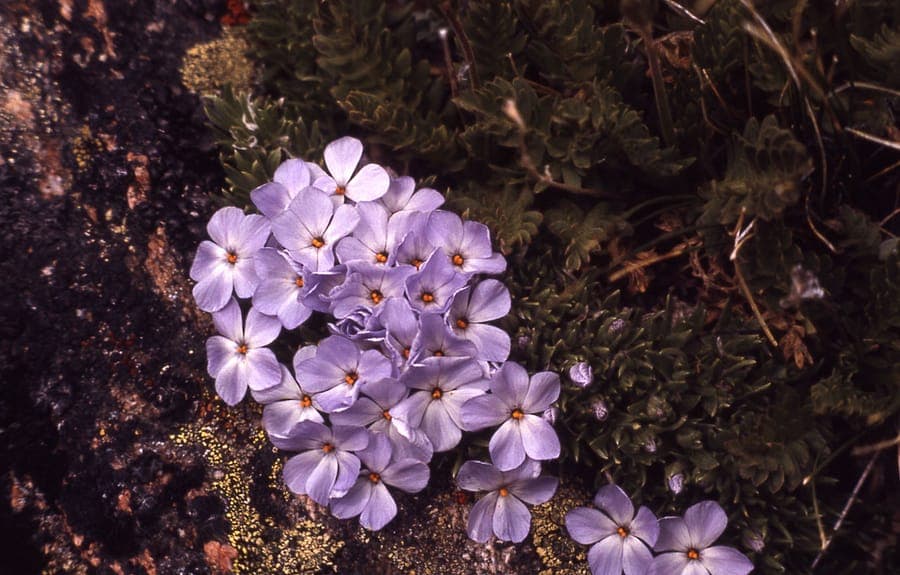
JR Douglass / Public domain, via Wikimedia Commons
Cushion phlox: complete guide
Phlox pulvinata
Want to see Cushion phlox: complete guide in your garden?
1 minute, no credit card
Overview
Phlox pulvinata, commonly known as Cushion phlox or Powder phlox, is a compact, low-growing perennial native to the western North American mountains, particularly the Rocky Mountains where it naturally occurs in alpine meadows and rocky crevices. This beautiful alpine gem reaches only 5 to 15 cm in height, forming dense, cushion-like mats of narrow foliage covered in countless small flowers in shades of pink, white, or violet. Flowers appear from April to June, attracting butterflies and bees. This is an ideal plant for rock gardens, alpine troughs, and scree gardens where excellent drainage is essential.
Appearance and bloom
The Cushion phlox earns its common name from its distinctive growth habit: tight, compact mats that resemble decorative cushions or pillows. Leaves are needle-like, narrow, and dark green, measuring just millimeters across, tightly packed into rosettes. This foliage provides visual interest even outside the flowering season with its fine, almost bonsai-like texture. Flowers are small, approximately 1 cm in diameter, often pale pink or white with sometimes a deeper-colored eye. Some cultivars display purple or violet hues. The flowering period is concentrated in spring (April through June) when the entire plant appears covered in blooms creating a stunning floral display.
Ideal location
This alpine plant demands a very sunny location with full sun exposure throughout the growing season. Shade results in leggy, sparse growth and poor flowering. Plant it in a prominent location in your garden, such as on a rock garden or raised bed, where the plant is fully visible and where air circulation is optimal. Avoid low-lying areas where water pools after rain, as this can lead to root rot. The plant thrives against stonework or in planting pockets between rocks.
Soil
Excellent drainage is absolutely critical for Phlox pulvinata. This plant tolerates no waterlogging and demands strongly gritty to sandy substrate with generous amounts of perlite, pumice, or coarse sand. A pH between 6 to 7.5 is favorable. A mixture of 60 percent gravel/grit, 30 percent garden soil, and 10 percent composted bark yields excellent results. Some gardeners add limestone gravel for its slightly alkaline effect and improved drainage. Ensure water drains rapidly; this is not a plant for clay or heavy soils.
Watering
This is a drought-tolerant plant requiring minimal water once well-established. During the active growing season (March through June), provide moderate watering only when the soil surface feels dry. Excessive moisture during dormancy (July through September) must be strictly avoided. In moist winter months, water percolates deeper into the root zone, but surface areas should remain dry. A light misting on warm days is acceptable, provided the foliage dries quickly.
Free design
Want to see Cushion phlox: complete guide in your garden? Make a free design now.
Pruning
Phlox pulvinata requires almost no pruning. Remove spent flowers after the blooming period (June-July) to limit self-seeding and maintain a neat appearance. Dead leaves or stems can be gently removed. Toward the end of autumn, any deformed or damaged foliage can be carefully trimmed back close to the ground. Avoid harsh cuts that damage this delicate plant.
Maintenance calendar
March: Check for winter damage, remove dead foliage remnants. Begin more frequent watering as new growth emerges. April-May: Enjoy the floral display, regularly deadhead spent flowers. Monitor for powdery mildew during damp periods. June: Blooming ends; either allow seed capsules to fall for natural self-seeding or remove spent flower clusters. July-September: Dry season; minimal watering. Monitor for plant damage or pest infestations. October-November: Begin moderately increasing moisture as temperatures decline. December-February: Dormancy period. Protect against hard freezing; heavy snow cover can damage the plant.
Winter hardiness
Phlox pulvinata is extremely cold hardy, thriving in USDA zones 3 through 9 (-40 to -20 degrees Celsius). This exceptional hardiness makes it ideal for continental and harsh-climate gardens. Young seedlings, however, may suffer in wet winters; excellent drainage provides their best protection. In milder climates, poor ventilation sometimes poses a greater challenge than frost.
Companion plants
This diminutive alpine treasure pairs beautifully with other rock garden specimens such as saxifraga, sedums, and alpine aubretia. Small cushion-forming species (draba) create color variation. Dwarf grass species like Festuca glauca add textural contrast. Avoid vigorous growers that would overshadow this delicate plant. Other alpine phloxes in different color shades create a gorgeous tapestry. Hardy alpine gaura and eriogonum serve as excellent companions without competition.
Closing thoughts
Phlox pulvinata offers garden owners a spectacular alpine treasure with minimal maintenance requirements. Its compact, cushion-like growth, fine foliage texture, and abundance of flowers make it invaluable in rock gardens and alpine collections. With proper drainage and correct placement, it provides year-round beauty. This plant is available at major garden centres. GardenWorld can help you realize alpine garden designs.
Want to see Cushion phlox: complete guide in your garden? Make a free design now.
Upload a photo, pick a style, and get a photorealistic design with plant list in under a minute.
No credit card required


Similar plants
Phlox alyssifolia: complete guide to Alyssum-leaf Phlox
Phlox alyssifolia
Alyssum-leaf phlox is a compact alpine pink bloomer from North America. Discover care, location and all growing requirements.
Phlox richardsonii: complete guide to Richardson's Phlox
Phlox richardsonii
Richardson's phlox is an arctic bloomer exceptionally robust. Learn cultivation in extreme conditions and complete care guide.
Polemonium foliosissimum: complete guide
Polemonium foliosissimum
Polemonium foliosissimum is a vigorous Rocky Mountain perennial with blue-purple summer flowers that attract pollinators and thrive in borders.