
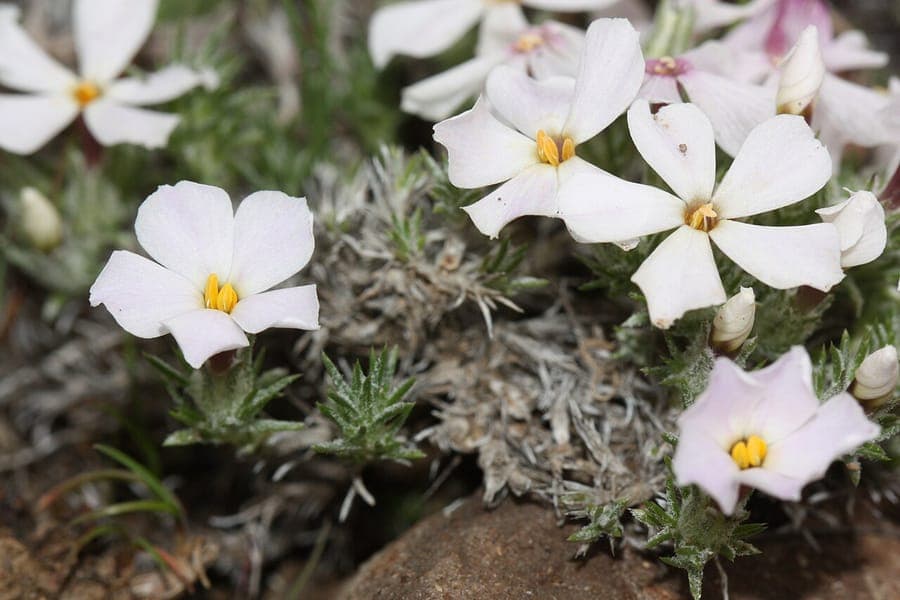
Walter Siegmund (talk) / CC BY-SA 3.0, via Wikimedia Commons
Moss phlox: complete guide
Phlox hoodii
Want to see Moss phlox: complete guide in your garden?
1 minute, no credit card
Overview
Phlox hoodii, commonly known as moss phlox, moss-pink, or Hood's phlox, is an extremely dense, alpine groundcover ranging from Alaska to central North America. This Polemoniaceae member forms rigid, moss-like mats only 10-15 cm tall, completely carpeted with tiny pink to white flowers in May-June. Remarkably cold-hardy and drought-tolerant, it is a natural choice for rock gardens and alpine plant collections.
Appearance and bloom time
Moss phlox forms exceptionally compact, tightly packed mats approximately 30-50 cm wide and only 10-15 cm tall. Growth is extremely dense and rigid, almost moss-like in character. Foliage is minute: fine, needle-like to linear leaves, about 0.5-1 cm long, deep green. This incredibly fine leafwork imparts moss phlox its characteristic needle-textured appearance. Flowers are miniature, roughly 0.8-1.2 cm across, pink, white, or bi-color, blooming profusely in May-June. Fragrance is subtle but present.
Ideal location
Moss phlox thrives in full sun, extremely well-ventilated positions. Minimum 6-8 hours of direct daily light is desirable; even 10+ hours causes no stress. The plant actually prefers windy, open alpine terrain to sheltered spots. Absolutely avoid dense shade, humid-warm corners, or positions where night dew lingers for hours. Alpine conditions are ideal.
Soil
Moss phlox demands extremely well-draining, nearly stony soil. A blend of coarse sand, gravel, small stones, and perlite is ideal. In gardens: raise beds significantly with gravel. In pots: use purely rocky mix or very coarse cactus blend. Moisture retention must remain minimal. Neutral to slightly acidic pH is fine.
Free design
Want to see Moss phlox: complete guide in your garden? Make a free design now.
Watering
Moss phlox tolerates extended drought once established. Newly planted specimens require moderate water during the first growing season. Water sparingly: only when the top 2-3 cm feels very dry and the plant shows slight wilting. Summer rainfall usually suffices. Absolutely avoid waterlogging. Avoid overhead watering.
Pruning
Moss phlox requires virtually no pruning. After bloom concludes, spent flower stems may be removed, but this is optional. Never cut hard. Light removal of dead foliage in spring is all that is required. The plant itself maintains its own compact form.
Maintenance calendar
April: Light dead-foliage removal. May-June: Peak bloom. Minimal care required. July-August: Bloom concludes. Water very sparingly if drought is extreme. September-October: Fall approaches slowly. November-March: Winter dormancy.
Winter hardiness
Moss phlox is exceptionally hardy, tolerating USDA zones 2-3. This renders it suitable for virtually all of northern Europe including Scandinavia. Snow cover protects against the worst cold, but the plant survives open winters as well. Young plants require no protection. This is genuinely a plant for severe climates.
Companion plants
Moss phlox harmonizes beautifully with other alpine groundcovers. Tiny Sedums, small Sempervivums, Saxifraga, Thymus (creeping thyme), Armeria, small Dianthus, Silene (campion). For subtle contrast: yellow Alyssum saxatile, white Arabis, orange Helianthemum. In rock gardens paired with alpine stone accents.
Conclusion
Moss phlox is for serious dry-garden purists. Extremely compact, spectacularly florid in May-June, remarkably hardy, and moisture-sensitive. Place it where other groundcovers fail. Once established, it thrives virtually unattended for decades. This is genuine rock-alpine flora.
Want to see Moss phlox: complete guide in your garden? Make a free design now.
Upload a photo, pick a style, and get a photorealistic design with plant list in under a minute.
No credit card required


Similar plants
Phlox alyssifolia: complete guide to Alyssum-leaf Phlox
Phlox alyssifolia
Alyssum-leaf phlox is a compact alpine pink bloomer from North America. Discover care, location and all growing requirements.
Phlox richardsonii: complete guide to Richardson's Phlox
Phlox richardsonii
Richardson's phlox is an arctic bloomer exceptionally robust. Learn cultivation in extreme conditions and complete care guide.
Polemonium foliosissimum: complete guide
Polemonium foliosissimum
Polemonium foliosissimum is a vigorous Rocky Mountain perennial with blue-purple summer flowers that attract pollinators and thrive in borders.