
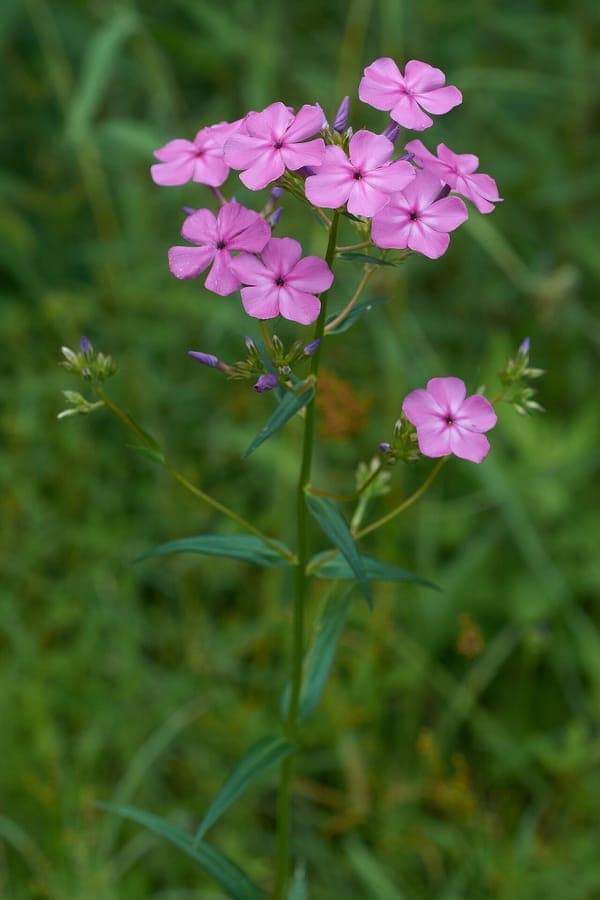
Eric Hunt / CC BY-SA 4.0, via Wikimedia Commons
Phlox glaberrima: complete guide
Phlox glaberrima
Want to see Phlox glaberrima: complete guide in your garden?
1 minute, no credit card
Overview
Phlox glaberrima, commonly known as smooth phlox, is a delightful perennial shrub from the Polemoniaceae family. This North American native is found wild across the eastern United States, thriving in warm to temperate regions. The plant is celebrated for its profusion of delicate flowers clustered in attractive cone-shaped inflorescences, making it a perfect choice for front gardens seeking vibrant seasonal color.
This species typically reaches heights of 30 to 60 centimeters and is known for its vigorous growth habits. Blooming from June through August, smooth phlox attracts butterflies and bees, making it an excellent choice for pollinator-friendly gardens. The extended flowering period ensures your garden remains colorful throughout the summer months.
Appearance and Bloom
Smooth phlox exhibits an upright growth form with semi-woody stems. Its foliage features narrow, linear leaves with a smooth surface (hence the name "glaberrima"), displaying a fresh green hue. The true spectacle comes with the flowers: they form dense, pyramidal clusters and appear in shades of pink, purple, and red, depending on the variety.
Each individual flower measures 1-2 centimeters across with five petals. The blooms carry a pleasant fragrance and are highly attractive to pollinators. The flowering period extends for several weeks, providing sustained garden color. Following blooming, attractive seed heads develop, which can be harvested for propagation or left standing for wildlife.
Ideal Location
Smooth phlox performs best in full sun to partial shade environments. The plant requires at least 4-6 hours of direct sunlight daily for optimal flowering. In shaded conditions, blooming becomes sparse and stems may become leggy and weak.
The plant is quite resilient and tolerates windy exposure, though sturdier stems develop in slightly sheltered locations. A southwestern-facing position in your front garden (in the Northern Hemisphere) is ideal, providing warm afternoon light without excessive heat stress during extreme summer days.
Good air circulation is essential to prevent fungal diseases. Avoid planting directly against walls where air stagnates, but choose locations with gentle air movement.
Soil
Smooth phlox prefers well-draining, nutrient-rich soil with a pH between 5.8 and 7.0. The plant thrives in both acidic and neutral soils but avoids strongly alkaline conditions. For best results, incorporate compost or organic matter into the planting hole.
Soil should remain moderately moist but not waterlogged. Waterlogging promotes root rot. When planting, add a 5-7 centimeter layer of compost if your soil is heavy or clayey. Sandy soils benefit from the addition of peat moss or compost for improved water retention.
Ensure adequate drainage by slightly elevating the planting bed if necessary or amending soil with perlite. A drainage layer is recommended in low-lying areas.
Free design
Want to see Phlox glaberrima: complete guide in your garden? Make a free design now.
Watering
Regular watering is crucial, especially during the first growing season after planting. Keep the soil consistently moist but not soggy. During dry summers, weekly watering may be necessary depending on your climate and soil type.
Water in early morning rather than evening to prevent fungal diseases. Water at the base of plants, never overhead. A 3-5 centimeter mulch layer of straw or compost helps retain moisture and regulates soil temperature.
Avoid excessive overhead watering, which increases the risk of powdery mildew and other fungal infections. Drip irrigation or soaker hoses are ideal. During rainy periods, supplemental watering can be omitted.
Pruning and Maintenance
Smooth phlox responds well to preventive pruning. After blooming, remove spent flower clusters (deadheading) to encourage continued flowering and maintain neat form. This also prevents excessive self-seeding.
In early spring (March-April, depending on your region), cut back damaged or dead stems. Overgrown plants can be half-pruned to encourage vigorous new growth. This is best done in early spring before active growth begins.
During the growing season, pinch back young plant tips to encourage bushier growth and more branching. This also prevents lodging (flopping over under heavy bloom). Remove foliage affected by fungal diseases immediately.
Maintenance Calendar
January-February: Planning, soil preparation. March: Planting new specimens, pruning from previous year. April-May: Regular watering, check thinning opportunities. June-August: Blooming period, deadheading, watering during dry spells. September-October: Seed collection possible, plant preparation for winter. November-December: Fallen leaf removal, frost protection measures if needed.
Winter Hardiness
Smooth phlox is very winter hardy and tolerates temperatures down to approximately -20 to -25 degrees Celsius. In temperate regions (USDA zones 6-7), the plant overwinters without difficulty. In colder areas (north of zone 5), a protective mulch layer is beneficial.
The plant survives normal winters completely, even though above-ground portions may suffer from heavy frost. New shoots emerge vigorously from the root system in spring.
Young plants are more susceptible to damage from extreme cold and freeze-thaw cycles. A 10-15 centimeter leaf mulch layer in November provides insurance for newly planted specimens.
Companion Plants
Smooth phlox combines beautifully with other summer bloomers and perennials:
- Coreopsis (tickseed) - yellow blooms create striking contrast
- Lavender - purple tones harmonize and attract the same beneficial insects
- Salvia (sage) - excellent structural contrast
- Gaura - airy texture, late blooming extends the season
- Rudbeckia (coneflower) - orange and yellow tones create warm palettes
- Echinacea - purple tones harmonize perfectly
- Nepeta (catmint) - blue-purple tones attract pollinators
- Ornamental grasses - fine texture contrasts with flower masses
Conclusion
Smooth phlox is a must-have for lovers of classic summer gardens. With its abundance of blooms, pollinator appeal, and ease of cultivation, this plant offers tremendous value to any front garden design. Plant in groups of at least 3-5 specimens for maximum visual impact. Your garden will enjoy continuous, colorful, fragrant blooms throughout the summer.
With proper care and location selection, your smooth phlox will flourish for many years. Visit your local garden centers for healthy specimens. GardenWorld helps you design your perfect front garden with this stunning plant.
Want to see Phlox glaberrima: complete guide in your garden? Make a free design now.
Upload a photo, pick a style, and get a photorealistic design with plant list in under a minute.
No credit card required


Similar plants
Phlox alyssifolia: complete guide to Alyssum-leaf Phlox
Phlox alyssifolia
Alyssum-leaf phlox is a compact alpine pink bloomer from North America. Discover care, location and all growing requirements.
Phlox richardsonii: complete guide to Richardson's Phlox
Phlox richardsonii
Richardson's phlox is an arctic bloomer exceptionally robust. Learn cultivation in extreme conditions and complete care guide.
Polemonium foliosissimum: complete guide
Polemonium foliosissimum
Polemonium foliosissimum is a vigorous Rocky Mountain perennial with blue-purple summer flowers that attract pollinators and thrive in borders.