
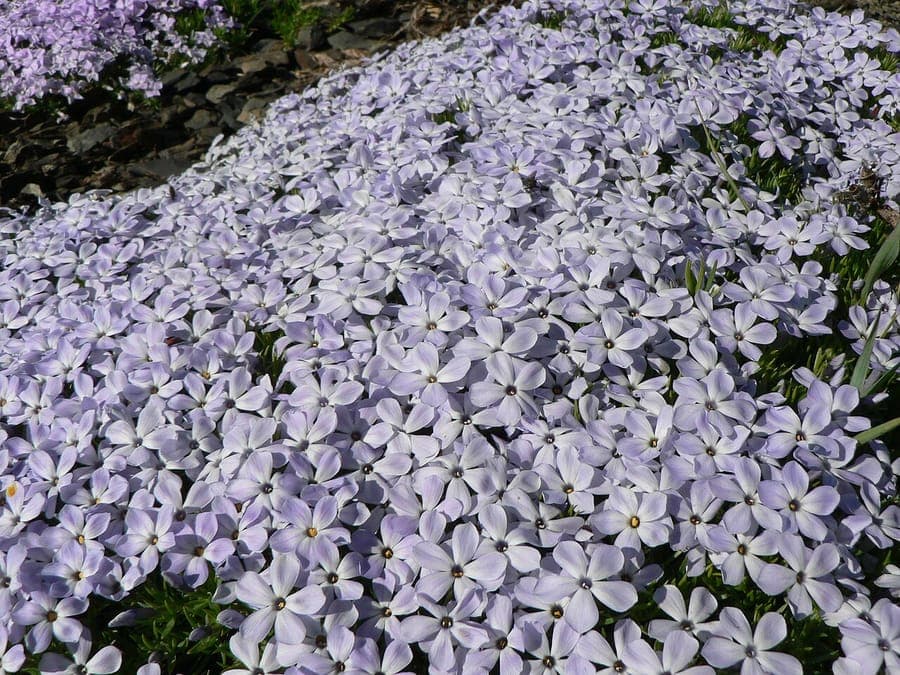
Walter Siegmund (talk) / CC BY 2.5, via Wikimedia Commons
Spreading phlox: complete guide
Phlox diffusa
Want to see Spreading phlox: complete guide in your garden?
1 minute, no credit card
Overview
Phlox diffusa, commonly called spreading phlox or mat phlox, is a compact, low-growing groundcover native to the mountains of southern Oregon, northern California, and northwestern Nevada. This Polemoniaceae member thrives naturally in rocky, exposed alpine terrain. In gardens, it forms neat, dense mats 15-25 cm tall adorned with purple to violet blooms. An ideal choice for rock gardens, containers, border edges, and dry slopes.
Appearance and bloom time
Spreading phlox develops extensive, compact mats roughly 30-50 cm wide and only 15-25 cm tall. Stems are slender, rigid, and creeping at ground level. Foliage is fine-textured: linear to lanceolate leaves, about 1-2 cm long, dark green. This delicate leaf character defines the plant's appeal. Flowers emerge in May-June as tiny, five-petaled blooms in shades of purple, violet, or occasionally pale pink. Blooms are softly fragrant.
Ideal location
Spreading phlox thrives in full sun with a minimum of 6 hours of direct daily light. It tolerates light shade (4-6 hours sun) but produces fewer flowers. Strong afternoon heat causes no stress. Preference for well-ventilated, open positions is marked. Avoid dense shade where humidity remains high. Protection from severe wind is beneficial.
Soil
Spreading phlox demands well-draining, sandy or gritty soil with neutral to slightly acidic pH. Heavy clay or persistently wet soil causes death by root rot. Soil amendment: add sand, gravel, or perlite to heavy soils. In pots: use cactus/succulent mix or universal mix + perlite (50:50 blend). Organic matter in modest quantities only. Over-feeding produces weak growth.
Free design
Want to see Spreading phlox: complete guide in your garden? Make a free design now.
Watering
Established plants tolerate substantial drought. Newly planted specimens require more frequent watering. During the first growing season, water when the top 2-3 cm feels dry. Once established (after 1-2 years), water only during prolonged droughts. Waterlogging is lethal; avoid it entirely. Container specimens need slightly more frequent watering.
Pruning
Spreading phlox requires minimal pruning. Following bloom (July), spent flowers may be removed, though this is not essential. Long, lanky stems extending beyond the neat mat can be cut back to 2-3 cm. In spring (March-April), remove dead, tired foliage. Avoid harsh cuts.
Maintenance calendar
March-April: Remove dead foliage. Light feeding. May-June: Peak bloom. Water young plants regularly. July-August: Bloom concludes. Manage spent material. September-October: Growth slows. November-March: Winter dormancy.
Winter hardiness
Spreading phlox is winter-hardy to USDA zones 5-6. This renders it suitable for northern Europe including the Netherlands and Belgium. In severe winters, some damage may occur, but established plants usually survive. Young plants benefit from light mulch in the first winter.
Companion plants
Spreading phlox pairs beautifully with other alpine and rockery residents. Dianthus (pinks), Arabis (rockcress), Pulsatilla, small Sedums, Sempervivums, and Alpine Poppies. For foliage contrast: silvery Artemisia. For flower contrast: yellow Alyssum, orange Helianthemum, pink small Draba, or blue Veronica.
Conclusion
Spreading phlox is the answer for gardeners with dry, sunny sites. Compact, self-sufficient, with steady purple flower production. Perfect for rocky slopes where heavier plants struggle. Centre it in your alpine or xeriscape garden.
Want to see Spreading phlox: complete guide in your garden? Make a free design now.
Upload a photo, pick a style, and get a photorealistic design with plant list in under a minute.
No credit card required


Similar plants
Phlox alyssifolia: complete guide to Alyssum-leaf Phlox
Phlox alyssifolia
Alyssum-leaf phlox is a compact alpine pink bloomer from North America. Discover care, location and all growing requirements.
Phlox richardsonii: complete guide to Richardson's Phlox
Phlox richardsonii
Richardson's phlox is an arctic bloomer exceptionally robust. Learn cultivation in extreme conditions and complete care guide.
Polemonium foliosissimum: complete guide
Polemonium foliosissimum
Polemonium foliosissimum is a vigorous Rocky Mountain perennial with blue-purple summer flowers that attract pollinators and thrive in borders.