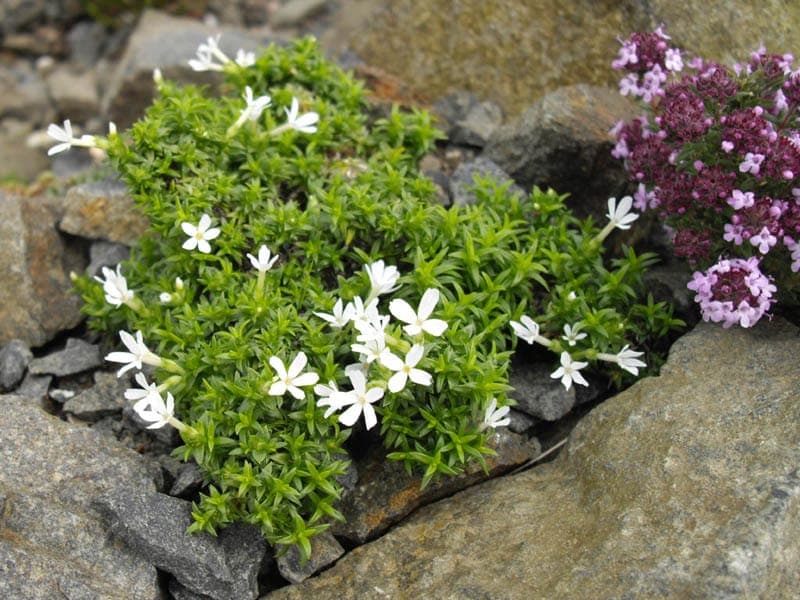
Ghislain118 http://www.fleurs-des-montagnes.net / CC BY-SA 3.0, via Wikimedia Commons
Phlox austromontana: complete guide
Phlox austromontana
Want to see Phlox austromontana: complete guide in your garden?
Full design in HD: €7.99
Look after your Phlox austromontana with the GardenWorld app
Identify plants with your camera and get a care calendar with reminders for this plant.


Overview
Phlox austromontana, commonly called Desert phlox or mountain phlox, is a hardy alpine perennial from the mountains of southwestern North America. This beautiful blooming plant grows naturally on dry mountain slopes, plateaus and desert margins from Arizona to Oregon and even into Mexico. The plant produces rich purple to magenta flowers from May to June. With its alpine habit, extreme drought tolerance and wildlife-friendly character, it is an ideal choice for mountain gardens, desert landscaping and xeriscaping projects.
Appearance and bloom
Desert phlox reaches 20 to 50 centimeters tall with narrow, gray-green foliage giving the plant a silvery sheen. Flowers are bright purple to magenta and appear in dense clusters atop shorter stems. The flowers are approximately 1.5 to 2 centimeters in diameter. The blooming period extends May through July, with peak bloom in June. The plant forms a compact, bushy clump.
Ideal location
Full sun is essential for this alpine plant. Choose a spot with at least 6 to 8 hours of direct daily sunlight. The farther from the coast, the better the plant thrives. Place on raised beds or rocky sites where air can circulate freely.
Soil
Extremely well-draining, dry rocky soil is critical. The plant grows best in sand, gravel, shale or other rocky substrates. Heavy clay is absolutely forbidden. A pH between 6.5 and 8.5 is ideal. Add gravel or shale to garden beds.
Free preview
Want to see Phlox austromontana: complete guide in your garden? Make a free preview of your design.
Watering
Once established, this phlox is extremely drought-tolerant. Water sparingly after planting. Excessive water, especially in winter, is very harmful and leads to root rot. This plant expects dry conditions.
Pruning
Remove faded flowers after blooming in July. Pruning is rarely needed on this compact plant. In spring, dead stems from the previous year can be removed. Handle gently.
Maintenance calendar
Spring: Add dry compost, remove dead stems. Summer: No water except at planting. Fall: No maintenance. Winter: Plant is hardy, no water.
Winter hardiness
Desert phlox is fully hardy to -20C and grows in USDA zones 4-9, though most common in zones 6-9. The plant tolerates snow, frost and extreme dry conditions without issue.
Companion plants
Combine with other alpine drought-tolerant plants such as Silene, Armeria, dwarf Coreopsis and small Sedums. Also combine with rocks, gravel and grass plantings. Create beautiful alpine rockeries or xeriscapes.
Closing
Phlox austromontana is a remarkable alpine perennial with great potential for front yard designs in mountain regions. The combination of beautiful purple flowers, extreme drought tolerance and alpine growth makes it perfect for xeriscaping and mountain gardens. Bring this desert beauty to your garden and enjoy years of floral abundance with GardenWorld.app.
From our garden design expertise: Perfect choice for mountainsides, alpine terraces and dry mountain landscaping. Available at major garden centers. Design professional gardens with gardenworld.app.
Frequently asked questions about Phlox austromontana
Is Phlox austromontana winter hardy?
Desert phlox is fully hardy to -20C and grows in USDA zones 4-9, though most common in zones 6-9. The plant tolerates snow, frost and extreme dry conditions without issue.
When and how do you prune Phlox austromontana?
Remove faded flowers after blooming in July. Pruning is rarely needed on this compact plant.
How much water does Phlox austromontana need?
Once established, this phlox is extremely drought-tolerant. Water sparingly after planting.
Where does Phlox austromontana grow best?
Full sun is essential for this alpine plant. Choose a spot with at least 6 to 8 hours of direct daily sunlight.
What soil does Phlox austromontana need?
Extremely well-draining, dry rocky soil is critical. The plant grows best in sand, gravel, shale or other rocky substrates.

See it in your garden
See Phlox austromontana in your garden
One photo of your garden and a few questions. You see the result in about a minute.
Try it with a photoIdentify this plant in your own garden. Identify a plant
Similar plants
Tufted phlox (Phlox douglasii): complete guide
Phlox douglasii
How to grow tufted phlox (Phlox douglasii): position, soil, watering, trimming and propagating this low evergreen cushion plant that covers rock gardens in spring flowers.
Phlox alyssifolia: complete guide to Alyssum-leaf Phlox
Phlox alyssifolia
Alyssum-leaf phlox is a compact alpine pink bloomer from North America. Discover care, location and all growing requirements.
Phlox richardsonii: complete guide to Richardson's Phlox
Phlox richardsonii
Richardson's phlox is an arctic bloomer exceptionally robust. Learn cultivation in extreme conditions and complete care guide.
