
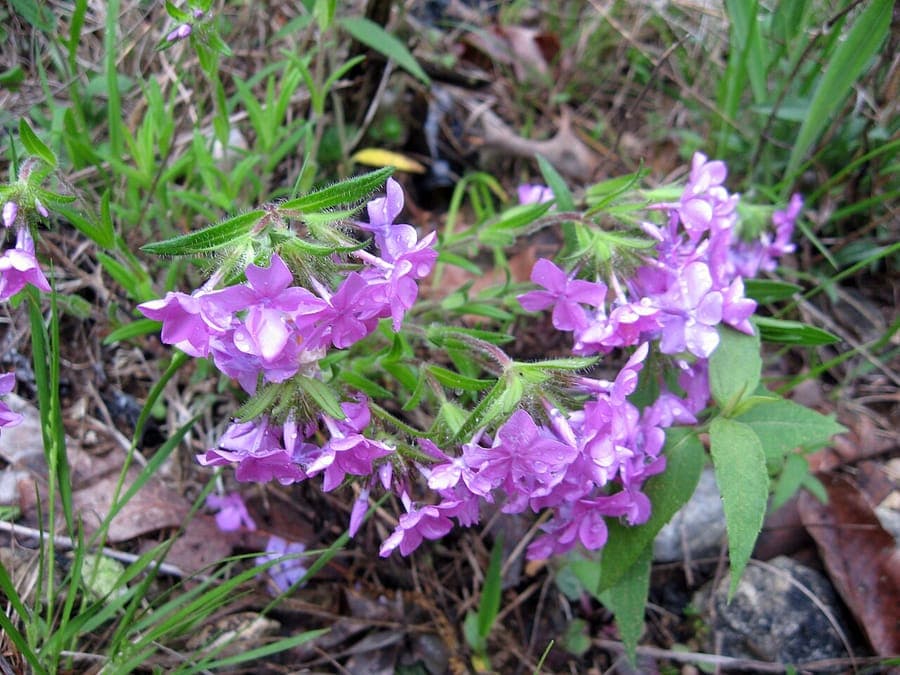
Mason Brock (Masebrock) / Public domain, via Wikimedia Commons
Phlox amoena: complete guide
Phlox amoena
Want to see Phlox amoena: complete guide in your garden?
1 minute, no credit card
Overview
Hairy Phlox (Phlox amoena) is a beautiful low-growing plant native to the southeastern United States. Known for its vibrant pink to red star-shaped flowers that bloom in May and June, this compact perennial is an excellent choice for garden designs. With its dense growth habit and extended blooming period, Phlox amoena serves as both an eye-catching focal point and a reliable groundcover. At gardenworld.app, we help you incorporate this stunning bloom perfectly into your garden design.
Appearance & Bloom
Phlox amoena grows as a herbaceous plant reaching 30-40 cm in height, forming dense, compact mounds. The plant's stems are noticeably hairy. Flowers are small and star-shaped, appearing in dense clusters at the stem tips. Bloom color ranges from bright pink to deep red, often with a white or pale center. The flowering period extends from May through July.
The foliage consists of small, linear to lanceolate leaves in a fresh green color. Even outside the blooming season, this fine-textured foliage adds visual interest.
Ideal Location
Hairy Phlox thrives in full sun to partial shade. Select a location receiving at least 4-5 hours of direct sunlight daily for optimal blooming. In the Netherlands, full sun exposure produces the most spectacular results. In warmer regions, afternoon shade can be beneficial.
This adaptable plant tolerates various light conditions but blooms most profusely in full sun.
Soil
Phlox amoena is not particular about soil type as long as drainage is good. Heavy clay soils can be amended with compost, sand, or garden soil. The plant tolerates dry conditions but performs best in moderately moist soil. An ideal pH range is 6.0 to 7.5.
Ensure good drainage to prevent waterlogging, particularly in wet winters. Enrich poor soils with compost.
Free design
Want to see Phlox amoena: complete guide in your garden? Make a free design now.
Watering
Hairy Phlox requires moderate water. Water regularly when the soil feels dry to approximately 5 cm depth. After planting, water thoroughly for the first 4-6 weeks. Once established, this plant becomes quite drought-tolerant.
During the growing season (May-October), provide more consistent moisture. In winter, significantly reduce watering. Water in early morning to prevent fungal diseases.
Pruning
Phlox amoena requires minimal pruning. After flowering (July-August), deadhead spent flowers to encourage further blooming and maintain a compact shape.
In early spring (March), remove any weak or damaged stems. Complete cutting back is usually unnecessary.
Maintenance Calendar
March: Remove weak shoots, add compost. April: Begin watering, monitor for pests. May-July: Regular watering, deadhead flowers. August-September: Reduce watering as temperatures decline. October-November: Remove dead foliage, prepare for winter. December-February: Minimal care, water during frost-free periods.
Winter Hardiness
Phlox amoena is fairly winter-hardy in the Netherlands, withstanding temperatures down to approximately -15 degrees Celsius. In southern Netherlands, this plant survives outdoors without protection. In the north, winter protection can be beneficial.
Mulch the plant base with 5-7 cm of organic material to provide frost protection. Container-grown specimens should be moved indoors during extreme cold periods.
Companion Plants
Hairy Phlox pairs beautifully with Stipa sibirica, Dianthus carthusianorum, Geranium sanguineum, Nepeta x faassenii and Sempervivum. These combinations create beautiful color and texture arrangements.
Conclusion
Hairy Phlox is a low-maintenance, reliable choice for any garden style. With its compact growth, stunning blooms, and minimal care requirements, this plant deserves a place in every garden design. Discover more plants at gardenworld.app.
Want to see Phlox amoena: complete guide in your garden? Make a free design now.
Upload a photo, pick a style, and get a photorealistic design with plant list in under a minute.
No credit card required


Similar plants
Phlox alyssifolia: complete guide to Alyssum-leaf Phlox
Phlox alyssifolia
Alyssum-leaf phlox is a compact alpine pink bloomer from North America. Discover care, location and all growing requirements.
Phlox richardsonii: complete guide to Richardson's Phlox
Phlox richardsonii
Richardson's phlox is an arctic bloomer exceptionally robust. Learn cultivation in extreme conditions and complete care guide.
Polemonium foliosissimum: complete guide
Polemonium foliosissimum
Polemonium foliosissimum is a vigorous Rocky Mountain perennial with blue-purple summer flowers that attract pollinators and thrive in borders.