KENPEI / CC BY-SA 3.0, via Wikimedia Commons
Heartleaf philodendron (Philodendron hederaceum): complete guide
Philodendron hederaceum
Want to see Heartleaf philodendron (Philodendron hederaceum): complete guide in your garden?
Full design in HD: €7.99
Look after your Heartleaf philodendron with the GardenWorld app
Identify plants with your camera and get a care calendar with reminders for this plant.


Overview
The heartleaf philodendron (Philodendron hederaceum) is the parent species behind a whole range of popular trailing philodendrons. You may know it by its older names Philodendron scandens or Philodendron oxycardium. It belongs to the arum family (Araceae) and grows wild in the tropical rainforests from Mexico to south-eastern Brazil and across the Caribbean, where it climbs tree trunks with its aerial roots or scrambles across the forest floor.
Indoors it is one of the most tolerant houseplants you can grow. It grows quickly, manages with moderate light and forgives the odd missed watering. With its glossy, heart-shaped leaves and supple stems it suits a hanging basket, the top of a bookcase or a moss pole. At gardenworld.app you can have a garden design made, and anyone who furnishes their home with plants soon finds the same principles apply indoors: the right plant in the right place.
Well-known forms include 'Brasil', with a yellow to lime-green central stripe, 'Lemon Lime', with entirely neon-green leaves, and 'Micans', a variety with velvety bronze-green foliage that shimmers purple in the light.
Appearance and growth
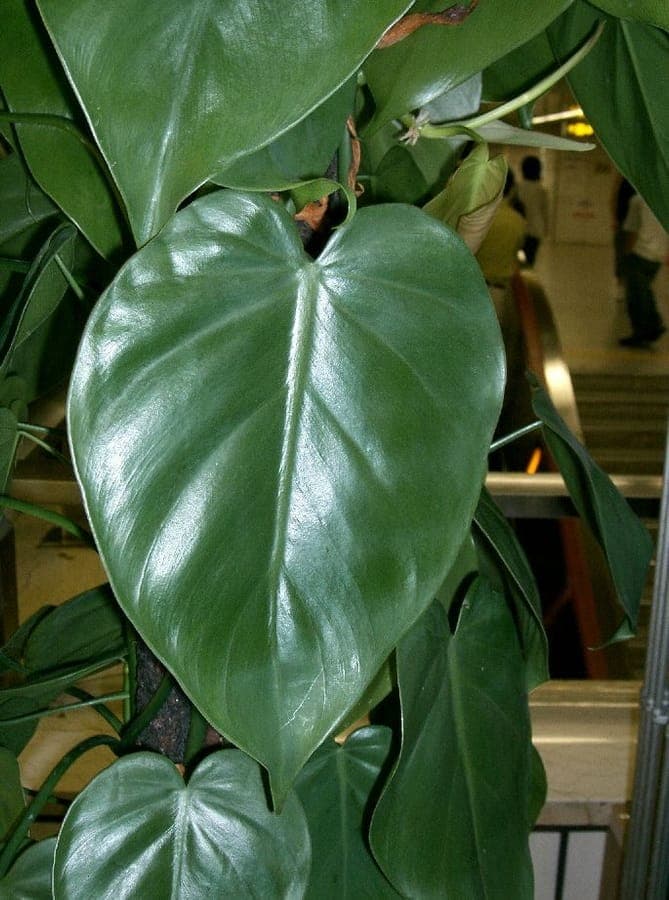
The leaves are heart-shaped with a long, pointed tip, 7 to 15 cm long on young indoor plants, and deep green and glossy. When the plant climbs a sturdy support, the leaves can reach 20 to 30 cm. The photograph above shows just such a climbing specimen with large, shiny leaves. New leaves unfurl from a papery sheath, called a cataphyll, which later turns brown and drops off. Indoors the stems easily reach 2 to 4 metres.
The heartleaf philodendron is often confused with golden pothos (Epipremnum aureum). The difference lies in the leaf stalk: on pothos it has a clear groove, while on the philodendron it is round. The philodendron leaf is also thinner and softer, and each new leaf emerges from a sheath. In terms of care it makes little difference, as both plants need almost the same treatment.
It rarely flowers indoors. If it does, you will see a typical arum-style flower: a greenish-white spathe wrapped around a central spadix.
Position in the home
A bright spot without direct midday sun is ideal, for example 1 to 3 metres from a window. Morning or evening sun is well tolerated. Philodendron hederaceum is known for coping with low light and will even grow in a hallway or an office under fluorescent lighting. In such dim spots, though, the gaps between leaves get longer and the leaves themselves smaller. Variegated forms such as 'Brasil' lose their markings if light is too poor.
The ideal temperature is 18 to 27 °C. Below 15 °C growth stops, and below 10 °C damage occurs. Keep the plant out of draughts and away from radiators. Normal humidity is fine, but slightly moister air, in a bright bathroom for instance, produces larger leaves. If you want it to climb, give it a moss pole or coir pole and tie the stems in loosely at first; after a few weeks the aerial roots will grip by themselves.
Compost and repotting
Use an open mix: houseplant compost with a third perlite, or an aroid mix with bark. The roots should get air quickly after watering, so a pot with drainage holes is essential.
Repot every two years in spring, or sooner if roots are growing out of the pot. Choose a pot 2 to 4 cm larger. A slightly snug pot is no problem, whereas an oversized one stays wet for too long.
Free preview
Want to see Heartleaf philodendron (Philodendron hederaceum): complete guide in your garden? Make a free preview of your design.
Watering and feeding
Water when the top 2 to 3 cm of compost feels dry. In summer that is usually weekly, in winter every two weeks. Drooping leaves are a sign of thirst. Yellow lower leaves, especially when the compost is still wet, usually indicate overwatering. Brown, crispy leaf edges are more often caused by very dry air or irregular watering.
From March to September feed every three to four weeks with a liquid houseplant fertiliser at the recommended rate. Do not feed in winter. Wipe the leaves with a damp cloth now and then; it keeps them glossy and lets you spot spider mite, mealybug or thrips straight away.
Pruning and propagation
Cut long, bare stems back in spring or summer to just above a node. New shoots will grow from there and the plant becomes fuller. Wear gloves if you have sensitive skin, as the sap can irritate.
Propagation almost always succeeds. Take a section of stem 10 to 15 cm long with at least one node and preferably an aerial root. Root it in water or directly in moist compost. Within two to four weeks you will have roots. Plant several cuttings back into the mother pot to fill out a sparse plant.
Care calendar
January–February: water sparingly, no feeding. Wipe the leaves clean and check for pests.
March–April: repot if needed. Cut back bare stems. Start feeding.
May–June: ideal time for cuttings. Tie new stems onto the moss pole.
July–August: water weekly, feed monthly. Shade from strong midday sun.
September–October: less water, last feed in September.
November–December: slow growth. Keep the plant away from hot radiators.
Temperature and overwintering
Philodendron hederaceum is a tropical plant and is not hardy in any British or north-west European garden. It may spend summer on a sheltered, shady patio but must come indoors as soon as nights drop below 15 °C. In winter it stays in a heated room. It does not need a cool rest, but it does need less water, because in low light the plant uses hardly any moisture.
Toxicity to people and pets
Philodendron hederaceum is toxic to people and animals. All parts contain needle-shaped crystals of calcium oxalate. Chewing a leaf causes immediate burning pain and swelling of the mouth, tongue and throat. Cats and dogs drool heavily, paw at their mouths and sometimes vomit. Most animals stop after one bite, so severe poisoning is rare, but small pets such as rabbits, guinea pigs and birds can be more seriously affected.
Hang or place the plant out of reach of pets and children, and pick up fallen leaves and trimmed stems. If there has been contact with the mouth, rinse well with water and contact your vet or a poison advice service if symptoms persist.
Companion plants
The heartleaf philodendron pairs nicely with other members of the arum family. A Monstera adansonii with its holed leaves makes a playful combination, and a Syngonium podophyllum with arrow-shaped leaves needs very similar care. For a calm lower layer, a Chinese evergreen (Aglaonema commutatum) also tolerates partial shade. To dress up a dark corner, add a cast-iron plant (Aspidistra elatior). A Chinese money plant (Pilea peperomioides) provides contrast with its round, flat leaves.
Final thoughts
Philodendron hederaceum is the ideal houseplant for anyone short of time or looking to fill a spot with moderate light. A bright position away from harsh sun, water when the surface is dry and an occasional trim are enough for years of greenery. Just keep it out of reach of pets and children.
Want to know when to repot, take cuttings or stop feeding? The plant calendar at gardenworld.app shows month by month what your houseplants and garden plants need. That way your heartleaf philodendron stays full, glossy and healthy.
Frequently asked questions about Heartleaf philodendron
When and how do you prune Heartleaf philodendron?
Cut long, bare stems back in spring or summer to just above a node. New shoots will grow from there and the plant becomes fuller.
How much water does Heartleaf philodendron need?
Water when the top 2 to 3 cm of compost feels dry. In summer that is usually weekly, in winter every two weeks.

See it in your garden
See Heartleaf philodendron in your garden
One photo of your garden and a few questions. You see the result in about a minute.
Try it with a photoIdentify this plant in your own garden. Identify a plant
Similar plants
Monstera adansonii: complete guide
Monstera adansonii
Tarovine - an elegant climbing plant with unique perforated leaves. Tropical, easy-care, and hugely popular as an indoor plant.
Syngonium podophyllum: complete guide
Syngonium podophyllum
Master the care of Syngonium podophyllum (Arrowhead Vine) with this comprehensive guide covering watering, light, propagation and common problems.
Chinese Evergreen: complete guide
Aglaonema commutatum
Chinese Evergreen is a popular houseplant with silver-spotted leaves. This tropical plant grows to 60 centimeters and is perfect for semi-shaded interiors. Very easy to maintain.
