
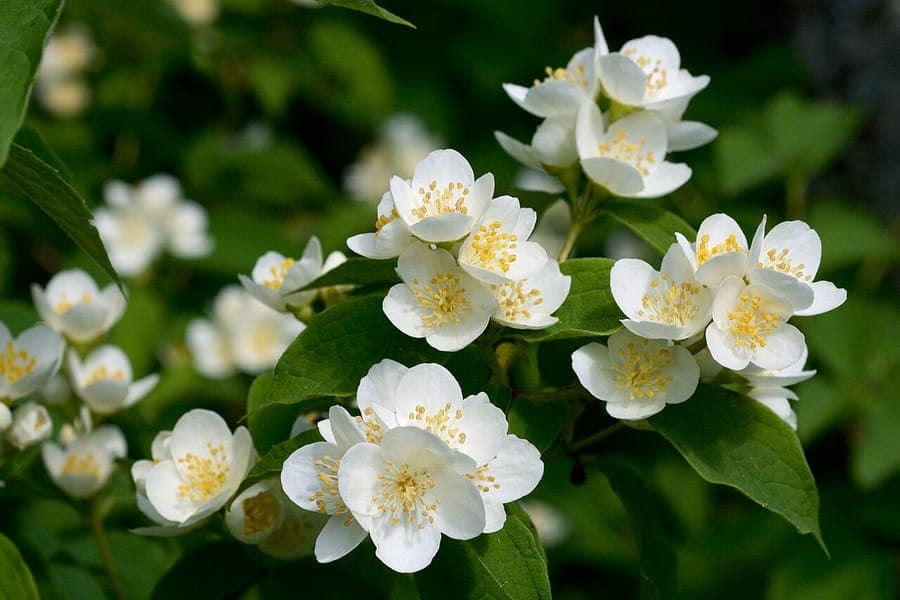
Eric Hunt / CC BY-SA 4.0, via Wikimedia Commons
Broadleaf mock orange: complete guide
Philadelphus pubescens
Want to see Broadleaf mock orange: complete guide in your garden?
1 minute, no credit card
Overview
Philadelphus pubescens, commonly known as broadleaf mock orange, is a graceful yet tough shrub that brings old-fashioned charm and powerful fragrance to the garden. Native to the southeastern United States-spanning from Alabama to Texas-this species thrives in open woodlands and along forest edges. It's an excellent choice for gardeners seeking a low-effort, high-reward shrub that blooms reliably and smells incredible.
Reaching 5 to 8 feet (1.5–2.5 m) tall and 4 to 6 feet (1.2–2 m) wide, it works well as a standalone specimen, in mixed borders, or as part of a loose, natural hedge. Unlike some more formal shrubs, it grows with an open, airy habit, letting light filter through its branches.
The name 'pubescens' refers to the fine, soft hairs on the undersides of its leaves and young stems-a key identifier that separates it from other mock orange varieties. Though not a true orange or jasmine, its scent is unmistakable: sweet, citrusy, and intense enough to fill a garden on a still evening.
On gardenworld.app you can design your planting layout to showcase fragrant shrubs like broadleaf mock orange, ensuring optimal spacing and airflow.
Appearance & bloom cycle
This shrub features broad, oval leaves 1.5 to 3 inches (4–8 cm) long with a slightly toothed edge. The leaf surface is medium green, while the underside is covered in fine, downy hairs, giving it a soft, greyish appearance. New growth in spring has a reddish tinge before maturing to green.
Flowering occurs from late June to early July. The pure white, four- to five-petaled flowers appear in clusters of 3 to 9, each bloom measuring 1 to 1.5 inches (2.5–3.5 cm) across. At the center, golden stamens add contrast and attract pollinators like bees and hoverflies.
The fragrance peaks in the early evening, making it ideal for planting near patios or pathways. After blooming, small, dry capsules form but aren't particularly ornamental. Fall color is modest-leaves turn pale yellow to light brown-but it's not why you grow this shrub.
Ideal location
Broadleaf mock orange performs best in full sun to light shade. For maximum flowering, aim for at least 6 hours of direct sunlight per day. In dense shade, it becomes leggy and blooms poorly.
Give it room to spread. Plant at least 5 feet (1.5 m) from other large shrubs or trees to allow for air movement. Good airflow is crucial-this species is moderately susceptible to powdery mildew, especially in humid summers.
It fits beautifully in cottage gardens, woodland edges, or informal hedges. Pair it with shrubs like buttonbush (Cephalanthus), native viburnums, or elderberry for a naturalistic effect.
Soil requirements
This shrub adapts to a range of soils but prefers moist, well-drained loam or clay-loam. It tolerates slightly acidic to neutral pH (5.5–7.0). In sandy soils, amend with compost or well-rotted manure to improve moisture retention.
Avoid sites with standing water. While it handles occasional wet spells, prolonged soggy roots lead to root rot. In heavy clay, consider raised beds or improving drainage with grit or organic matter.
On gardenworld.app, you can upload a soil test report to receive tailored recommendations for preparing your bed for mock orange.
Free design
Want to see Broadleaf mock orange: complete guide in your garden? Make a free design now.
Watering
Water deeply once a week during the first growing season, applying 10–15 liters per plant. Use a soaker hose or water at the base to keep foliage dry. Mulch with 2–3 inches (5–8 cm) of shredded bark or leaf mold to conserve moisture.
Once established, it's moderately drought-tolerant but blooms best with consistent soil moisture. During dry spells lasting over two weeks, water weekly.
Avoid overhead watering, especially in the evening, to reduce fungal risks.
Pruning
Prune immediately after flowering-by late July at the latest. Cutting in fall or spring removes flower buds formed the previous summer.
Remove up to one-third of the oldest, thickest stems at ground level to encourage new growth from the base. This rejuvenation pruning keeps the plant vigorous and well-shaped. Also trim any crossing or inward-growing branches.
If you prefer a natural look, minimal pruning is fine. Avoid shearing into tight forms-this species isn't suited for formal hedges. For tighter shapes, consider Philadelphus x virginalis instead.
Maintenance calendar
- February–March: Inspect for winter damage. Remove dead wood if needed.
- April–May: Apply 2–3 inches (5 cm) of compost around the base. Begin regular watering if spring is dry.
- June–July: Peak bloom. Enjoy the fragrance. Avoid pruning. Watch for powdery mildew in humid weather.
- August: Prune after bloom. Apply slow-release organic fertilizer.
- September–October: Let fallen leaves decompose as natural mulch. No feeding.
- November–January: Dormant. No action required unless snow threatens to bend branches.
Winter hardiness
Hardy in USDA zones 5–8 (-20°C to -10°C). In most of the UK, Ireland, and the northern US, it survives winter with no protection. In exposed sites, young shoots may suffer minor frost damage, but it recovers quickly in spring.
Apply a layer of mulch in late autumn to protect roots from freeze-thaw cycles.
Companion plants
The soft texture and upright form pair well with:
- Nepeta racemosa – for blue flowers and contrast
- Eutrochium maculatum – for late summer height and pollinators
- Festuca ovina glauca – for silvery foliage
- Hydrangea arborescens – for lush texture
- Carex comans – for fine grassy structure
Avoid overly aggressive plants like mint or bamboo that can crowd it out.
Closing
Broadleaf mock orange is a reliable, fragrant shrub that asks little and gives much. With basic care and one annual prune, it'll bloom year after year. It's perfect for gardeners who value scent, simplicity, and resilience.
Available at garden centres across the UK and US. Check labels carefully-sometimes sold as Philadelphus coronarius, which lacks the hairy undersides. For planting ideas and layout tools, visit gardenworld.app.
Want to see Broadleaf mock orange: complete guide in your garden? Make a free design now.
Upload a photo, pick a style, and get a photorealistic design with plant list in under a minute.
No credit card required


Similar plants
Cliff fendlerbush: complete guide
Fendlera rupicola
Everything about Fendlera rupicola, the rare rocky-slope shrub with fragrant white spring flowers that thrives on lean, dry, calcareous soils.
Fivepetal cliffbush: complete guide
Jamesia americana
Everything about Jamesia americana, the fivepetal cliffbush: rocky sites, white blooms, autumn colour, winter hardiness and garden care.
Deutzia parviflora: complete guide
Deutzia parviflora
Discover Deutzia parviflora, an elegant flowering shrub with white blossoms. Growing guide with tips for sunny placement, fertile soil, and regular pruning.