
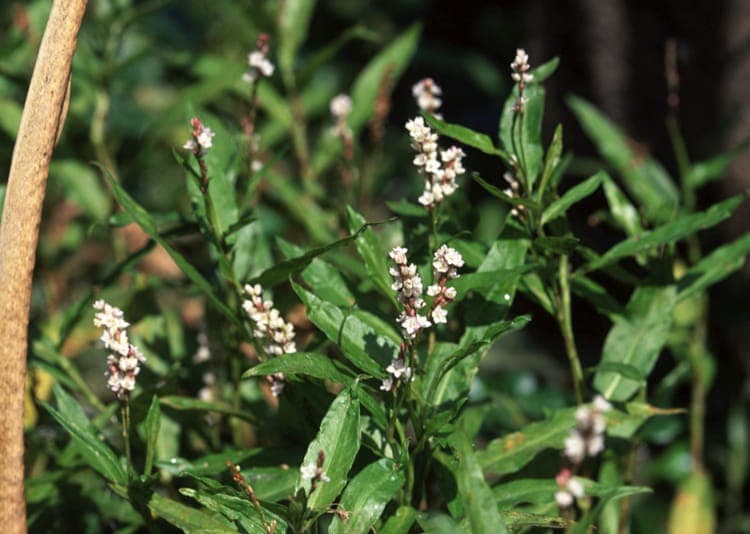
Gordon Leppig & Andrea J. Pickart / Public domain, via Wikimedia Commons
False water-pepper: complete guide
Persicaria hydropiperoides
Want to see False water-pepper: complete guide in your garden?
1 minute, no credit card
Overview
False water-pepper (Persicaria hydropiperoides), commonly known as swamp smartweed or mild water-pepper, is a native North American aquatic perennial from the Polygonaceae family. This slender-growing herbaceous plant is distinguished by its compact flower spikes and characteristically aromatic foliage. While the species thrives in the wild along watercourses and wetland margins, it also performs exceptionally well in damper garden settings.
The plant remains relatively uncommon in European cultivation, yet it offers excellent opportunities for ecological garden designs where water features and wetland zones play a central role. False water-pepper is non-toxic and has been traditionally used as an herb in some regions.
Appearance and bloom
False water-pepper reaches approximately 60-80 centimeters in height, developing soft green foliage that creates a fine-textured appearance. The leaves are lanceolate, measuring 7-15 centimeters in length, and feature a characteristic parallel veining pattern that adds visual interest.
Flowers emerge from July through October in tight, upright spikes 3-8 centimeters long. Individual blooms are pale pink or white, sometimes with greenish tones. While each flower is small, they form visually appealing clusters that attract pollinators. Following bloom, small seeds develop that provide valuable food for birds.
Ideal location
This plant is genuinely moisture-intelligent and thrives in wet to waterlogged sites. It grows exceptionally well along pond margins, in shallow wetlands, along stream banks, or in rain garden installations. Ideally, position it in a spot receiving 4-6 hours of direct sunlight daily. The plant tolerates partial shade to light shade, though flowering will be more abundant in full sun.
In deeper shade, growth becomes more rank and leggy. When used in gardens without permanent water features, choose a spot where water naturally collects after rainfall, such as a site depression or low point in the terrain.
Soil
False water-pepper makes no special soil demands. The plant flourishes in virtually any soil type, from heavy clay to sandy conditions, provided it remains consistently moist. In fact, the wetter the soil, the better: this plant feels at home in water just centimeters deep.
When planting in regular garden borders, we recommend adding organic matter (compost, peat, or peat alternatives) to increase water-retention capacity. Drainage is unnecessary; indeed, excessively free-draining soil is a disadvantage.
Soil pH can vary from acidic to neutral without issue. Nutrition is not critical; the plant grows well even in nutrient-poor conditions.
Free design
Want to see False water-pepper: complete guide in your garden? Make a free design now.
Watering
Watering in the traditional sense becomes unnecessary once the plant is established. In fact, the opposite applies: ensure consistent moisture. In hot summers, soil around the plant must never dry completely.
During establishment in garden borders, water regularly for at least 3-4 weeks. Thereafter, supplementary watering is usually unnecessary, thanks to rainfall. Stagnant water poses no problem, as this is a moisture-loving species.
In prolonged dry periods, leaf margins may brown slightly: provide extra water in these conditions.
Pruning
Pruning of false water-pepper is limited to maintenance. After flowering (October-November), you can remove dead portions. This improves appearance and makes room for new spring growth. Wait until spring (March-April) if you prefer to retain seed heads for bird forage.
During summer, you can control rampant growth by cutting back the plant. This encourages a more compact growth form and richer flowering.
Removed material can be added to the compost heap.
Maintenance calendar
February-March: Remove last year's dead stems, either with a low-set mower or by hand. April-May: New growth emerges. Apply support structures if needed for excessively leggy plants. June-July: Flowering begins. Water regularly during dry spells. August-September: Peak bloom. Enjoy visiting butterflies and bees. October-November: Bloom ends. Seeds ripen; birds feed extensively. December-January: Plant is dormant. Minimal maintenance required.
Winter hardiness
False water-pepper is winter hardy in temperate climates down to USDA zone 4-5 (roughly minus 30 degrees Celsius). In the Netherlands and Belgium it overwinters without any protection.
In more severe continental climates, mulching with leaves or straw may provide benefit. In frost-free regions, the plant displays semi-evergreen characteristics.
Companion plants
False water-pepper combines beautifully with other moisture-loving species. Excellent companions include:
- Astilbe (Astilbe varieties) for contrasting flower form
- Reed grasses (Phragmites, Calamagrostis) for textural interest
- Japanese iris (Iris laevigata, Iris ensata) for form and color
- Marsh marigold (Caltha palustris) for early yellow bloom
- Water mint (Mentha aquatica) for fragrance and beneficial insects
- Club moss (Lycopodium) in shadier aquatic sites
In semi-moist borders, pair effectively with daylilies, hostas, and other wetland perennials.
Conclusion
False water-pepper deserves greater recognition in Dutch and Belgian gardens. It is a tough, easy-to-maintain perennial that supports water garden ecosystems whilst providing food for birds and beneficial insects. Plant it along your pond margin, in a rain garden, or in a wetland corner: this plant will repay you with years of reliable flowering.
At GardenWorld we help you select water plants perfectly suited to your garden. Learn more on gardenworld.app.
Want to see False water-pepper: complete guide in your garden? Make a free design now.
Upload a photo, pick a style, and get a photorealistic design with plant list in under a minute.
10,000+ gardens designed already
No credit card required


Similar plants
Crosby's wild buckwheat: complete guide
Eriogonum crosbyae
Full guide to growing Eriogonum crosbyae: ideal site, soil, watering, winter hardiness and companion plants for this rare western wild buckwheat.
Spreading buckwheat: complete guide
Eriogonum effusum
Full guide to growing Eriogonum effusum: ideal site, soil, watering, winter hardiness and companion plants for this prairie subshrub from the American West.
Tall woolly buckwheat: complete guide
Eriogonum elatum
Full guide to Eriogonum elatum: siting, soil, watering, pruning and companion plants for this elegant white-flowered buckwheat from the western United States.