
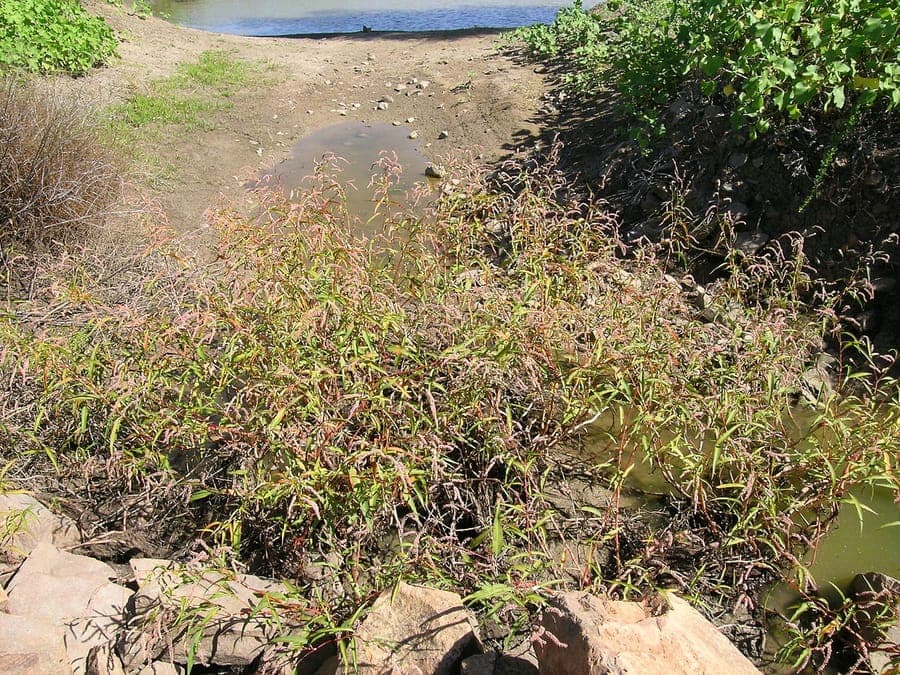
Harry Rose from South West Rocks, Australia / CC BY 2.0, via Wikimedia Commons
Persicaria decipiens: complete guide
Persicaria decipiens
Want to see Persicaria decipiens: complete guide in your garden?
1 minute, no credit card
Overview
Persicaria decipiens, commonly known as Slender knotweed or Willow-weed, is an elegant perennial from the Polygonaceae family. This plant is widely distributed across tropical and subtropical regions worldwide, from Africa to Australia. The name 'decipiens' refers to its deceptively delicate appearance - despite slender, willow-like foliage, it is a vigorous grower.
In European gardens, Persicaria decipiens deserves far greater recognition. It combines elegant appearance with practical advantages for borders and group plantings. The plant performs well in varying conditions and is relatively simple to cultivate, making it ideal for novice and experienced gardeners alike.
Appearance & bloom
Slender knotweed grows as a compact to mid-sized herbaceous plant with long, narrow, willow-like leaves. The foliage is deep green, often with subtle red tinting along nerves and petioles. The texture is fine and graceful, giving the plant an airy appearance in borders.
The flowers are the true attraction. They grow in vertical, slender spikes in white to light-purple, depending on climate and growing conditions. Flowering extends from June to October, providing months of color and insect activity. The flowers attract insects and butterflies.
The plant reaches 60-90 cm in height, depending on growing conditions, with a spread of 40-50 cm.
Ideal location
Persicaria decipiens thrives in semi-shade to full sun. Ideal is a location with morning sun and afternoon light, especially in warmer climates. In southern regions, full sun with afternoon protection in July-August is preferred.
The plant performs well in borders, group plantings, and waterside locations. It works beautifully beside water as it naturally inhabits moist habitats. Position it in mixed borders among other perennials for maximum impact.
It can also be grown in containers, especially if you wish to control growth.
Soil
Persicaria decipiens accepts a wide soil range, from dry to moderately moist. Optimal soil is moist, well-draining, and rich in organic matter. Add compost or leaf mould at planting time. This plant accepts both heavy clay and lighter sand, provided sufficient moisture retention.
The pH can range from acidic to neutral to slightly alkaline (pH 5-7.5). The plant is highly adaptable.
In dry conditions, the plant grows more slowly and flowering may be reduced. Ideally, moderately moist soil is preferred.
Free design
Want to see Persicaria decipiens: complete guide in your garden? Make a free design now.
Watering
Persicaria decipiens prefers moist soil. Water regularly during the growing season, especially in the first year after planting. Once established, the plant tolerates dry periods but grows better with regular moisture.
In containers, more frequent watering is necessary. Ensure water never stagnates, but also never completely dries. Drip irrigation works well for borders containing this plant.
In autumn and winter, water less frequently but maintain soil moisture.
Pruning
Pruning is straightforward. In early spring (March), cut back dead growth to ground level. This encourages compact new growth. During the season, you may remove spent flowers for neatness and extra bloom stimulation.
In autumn, leave dead growth standing until spring for winter structure and bird food.
The plant is not aggressive and doesn't require strict pruning.
Maintenance calendar
March-April: Cut back dead growth; add compost around base; water thoroughly if rain is sparse. May-June: Flowering begins; ensure regular moisture; apply organic fertilizer. July-August: Continue watering in warm, dry periods; remove spent flowers. September-October: Continued flowering; gradually reduce watering. November-February: Minimal watering; leave dead growth standing; apply mulch for protection.
Winter hardiness
Persicaria decipiens is a perennial, thus winter hardy. It performs well in most Dutch regions. The plant dies back to ground level in winter but re-emerges in spring.
In very severe winters or northern regions, additional winter protection (mulch) may be beneficial, though not always necessary.
The plant is highly adaptable to climate variations.
Companion plants
Persicaria decipiens works beautifully alongside other moisture-lovers such as Hosta, Astilbe, and Lythrum. In white and green planting schemes, it contrasts well. It also adds graceful texture to mixed borders with other perennials.
The elegant flowers attract butterflies and honeybees, making it additionally valuable for ecological garden designs.
Conclusion
Persicaria decipiens is an underrated perennial that deserves greater recognition. With its elegant foliage, extended flowering, and practical growth habit, it's an excellent choice for sustainable garden designs. Try it in your borders and enjoy months of gentle blooms.
Source seedlings and plants from specialized perennial growers. Consult gardenworld.app for garden inspiration!
Want to discover more plant guides? Visit gardenworld.app for dozens of garden design articles.
Want to see Persicaria decipiens: complete guide in your garden? Make a free design now.
Upload a photo, pick a style, and get a photorealistic design with plant list in under a minute.
No credit card required


Similar plants
Crosby's wild buckwheat: complete guide
Eriogonum crosbyae
Full guide to growing Eriogonum crosbyae: ideal site, soil, watering, winter hardiness and companion plants for this rare western wild buckwheat.
Spreading buckwheat: complete guide
Eriogonum effusum
Full guide to growing Eriogonum effusum: ideal site, soil, watering, winter hardiness and companion plants for this prairie subshrub from the American West.
Tall woolly buckwheat: complete guide
Eriogonum elatum
Full guide to Eriogonum elatum: siting, soil, watering, pruning and companion plants for this elegant white-flowered buckwheat from the western United States.