Didier Descouens / CC BY-SA 4.0, via Wikimedia Commons
Emerald Ripple Peperomia: care guide
Peperomia caperata
Want to see Emerald Ripple Peperomia: care guide in your garden?
Full design in HD: €7.99
Look after your Emerald Ripple Peperomia with the GardenWorld app
Identify plants with your camera and get a care calendar with reminders for this plant.


Overview
Peperomia caperata is a small houseplant with a big personality. Its heart-shaped leaves are so deeply rippled they look like pleated velvet, and it forms a compact rosette that sits perfectly on a windowsill, a desk or a narrow bookshelf. In English it is known as emerald ripple peperomia or simply ripple peperomia. The plant probably comes from the tropical forests of Brazil, where it grows in shade on the forest floor and on mossy trunks. The species was described in the 1950s from cultivated plants and has been a houseplant staple ever since.
In garden centres it is usually sold as peperomia, often with a cultivar name such as 'Rosso', 'Schumi Red' or 'Lilian'. The genus Peperomia belongs to the pepper family (Piperaceae), the same family as black pepper, although you will neither smell nor taste anything peppery in this plant.
Peperomia caperata is ideal if you are short of space or just starting out with houseplants. It stays small, grows slowly and asks for little, with one condition: not too much water. If you want indoors and outdoors to flow together, at gardenworld.app you can have a garden design made for your patio or conservatory, so your green look carries on from the windowsill into the garden.
Appearance and bloom cycle
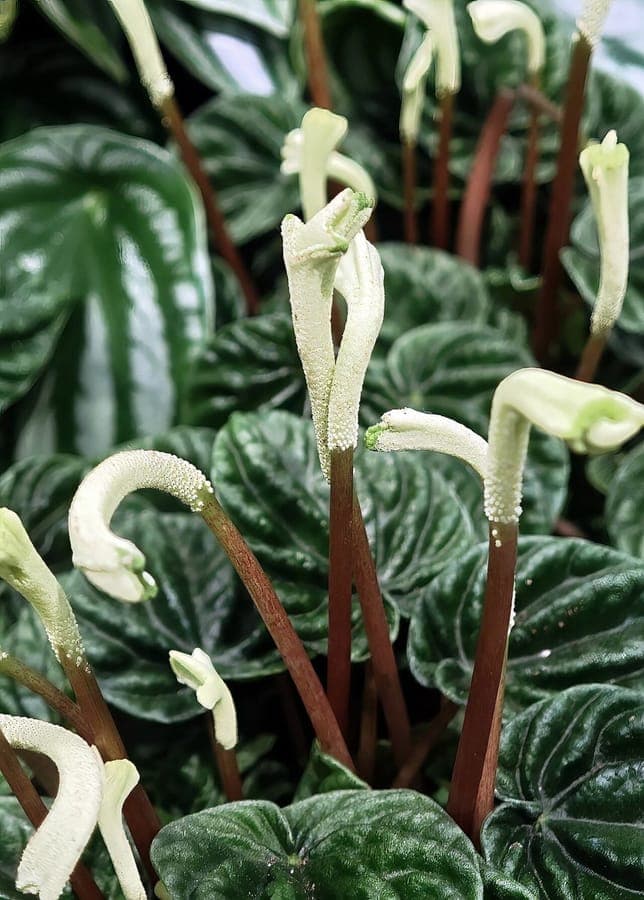
The plant rarely grows taller or wider than 15 to 25 cm. The leaves are round to heart-shaped, 3 to 5 cm long, thick and slightly fleshy, with deep, sunken veins that create the characteristic ripple pattern. Leaf colour ranges from emerald to almost black-green, with a silvery sheen on the ridges. Cultivars add variety: 'Rosso' has wine-red undersides, 'Schumi Red' is almost entirely burgundy and 'Frost' has silvery grey leaves. The leaf stalks are often pink to red.
From spring to autumn, slender cream-white flower spikes appear among the leaves on reddish brown stalks that rise above the foliage. They consist of hundreds of tiny petal-less flowers. The photo shows these white spikes with a curled, almost lily-like tip, as in the cultivar 'Lilian', above the dark green, heavily rippled leaves. The spikes have no scent and are mainly a fun extra; you can simply snip them off once they fade.
Ideal location
Peperomia caperata likes bright, indirect light. A spot by an east- or west-facing window, or a metre or two back from a south-facing one, is ideal. It copes well with a little morning sun, but harsh midday sun through glass scorches the leaves. In too little light the stalks stretch, the rosette becomes loose and floppy and the leaves lose their deep colour. It also grows happily under a simple grow light.
The plant prefers humidity of 40 to 60%, but it is less fussy than many tropical plants. Avoid draughts and the direct warm air from a radiator. Thanks to its small size it also suits an open terrarium or a glass cloche, as long as there is enough ventilation.
Potting mix
The roots are fine and delicate and rot quickly in wet, heavy compost. Use an airy mix instead: for example half houseplant compost and half perlite, or a blend of compost, orchid bark and some cactus compost. A small pot with a drainage hole is essential. Peperomia likes to be slightly pot-bound; an oversized pot holds water for too long.
Repot only when roots are really growing out of the pot, on average every two to three years, and choose a pot just 1 to 2 cm wider.
Free preview
Want to see Emerald Ripple Peperomia: care guide in your garden? Make a free preview of your design.
Watering
Overwatering is the main cause of death for Peperomia caperata. The thick leaves store moisture, so the plant handles a dry spell well. Water only when the top half of the compost feels dry. In summer that works out at roughly once a week to once every ten days, in winter once every two to three weeks. Do not pour water into the heart of the rosette; water around the edge of the pot, or stand the pot in a bowl of water for fifteen minutes and then let it drain well.
Drooping, soft leaves and black stalks at the base indicate root rot from too much water. Wrinkled, thin leaves mean the plant is thirsty. From April to September, feed once a month with a houseplant fertiliser at half strength; more is not needed.
Care and propagation
This plant needs very little maintenance. Remove yellow or damaged leaves and faded spikes now and then. Brush dust out of the ridges with a soft paintbrush; a damp cloth does not work as well on the rippled leaves. Check occasionally for mealybug, which likes to hide in the folds and leaf axils.
Propagation is easy. Cut off a healthy leaf with 2 to 3 cm of stalk and insert the stalk into moist cutting compost or perlite. Keep it warm (20 to 25 °C) and bright, and keep the compost lightly moist. After a few weeks roots form, followed by small new plantlets at the base of the stalk. Dividing an older plant when repotting also works well.
Maintenance calendar
March–April: The growing season begins. Repot if needed and start light feeding.
May–June: Ideal time to take leaf cuttings. The first flower spikes appear.
July–August: Water once the top half has dried out. Protect from harsh midday sun.
September–October: Stop feeding. Snip off faded spikes.
November–February: Rest period. Water sparingly and move the plant to the brightest spot in the house. To keep track of everything, add watering, feeding and repotting to the planting calendar on gardenworld.app.
Temperature and overwintering
Peperomia caperata grows best at 18 to 24 °C. It tolerates 12 to 15 °C for short periods, but below 10 °C damage occurs. It simply overwinters indoors. In winter, watch out for cold windowsills: do not push the pot against icy glass and keep it away from draughts by an opening window. In a room that cools down sharply at night, water even more sparingly.
Toxicity to pets
Good news for pet owners: the ASPCA lists Peperomia caperata as non-toxic to cats and dogs. No toxic substances are known for people either. That makes it one of the safest houseplants for a home with cats, dogs or small children. A cat nibbling the leaves may at most get a mild upset stomach, as with any plant material. Do take care with plant food and pesticides, though: those can be harmful if an animal licks them.
Companion plants
Combine Peperomia caperata with other small, pet-friendly houseplants. The Chinese money plant (Pilea peperomioides) has round, smooth leaves that contrast nicely with the rippled foliage. The spider plant (Chlorophytum comosum) adds light, graceful lines. A moth orchid (Phalaenopsis amabilis) needs the same bright, indirect light. A succulent such as Echeveria elegans and mind-your-own-business (Soleirolia soleirolii) complete a varied windowsill group. According to the ASPCA, all of these plants are safe for cats and dogs.
Final thoughts
Peperomia caperata is a small plant with plenty of character. With its rippled leaves, quirky white flower spikes and modest size, it fits in anywhere. Give it bright light, airy compost and above all not too much water, and it will stay attractive for years. And because it is non-toxic, you can place it with peace of mind wherever your cat or dog likes to roam.
Frequently asked questions about Emerald Ripple Peperomia
How much water does Emerald Ripple Peperomia need?
Overwatering is the main cause of death for Peperomia caperata. The thick leaves store moisture, so the plant handles a dry spell well.
Where does Emerald Ripple Peperomia grow best?
Peperomia caperata likes bright, indirect light. A spot by an east- or west-facing window, or a metre or two back from a south-facing one, is ideal.

See it in your garden
See Emerald Ripple Peperomia in your garden
One photo of your garden and a few questions. You see the result in about a minute.
Try it with a photoIdentify this plant in your own garden. Identify a plant
Similar plants
Chinese Money Plant: complete guide
Pilea peperomioides
Chinese Money Plant (Pilea peperomioides) is a trendy houseplant from China featuring distinctive round, mint-green leaves. This Instagram-famous plant has become a favorite for modern homes with its elegant appearance and easy-care nature.
Chlorophytum comosum: complete guide
Chlorophytum comosum
Discover everything about Chlorophytum comosum (spider plant). Learn care requirements, propagation, location and maintenance for thriving indoor plants.
Phalaenopsis amabilis: complete guide
Phalaenopsis amabilis (L.) Blume
Phalaenopsis amabilis (Moon Orchid) is an elegant houseplant with gorgeous white flowers. Learn care, watering, and blooming techniques.
