James Steakley / CC BY-SA 3.0, via Wikimedia Commons
Watermelon peperomia (Peperomia argyreia): a care guide
Peperomia argyreia
Want to see Watermelon peperomia (Peperomia argyreia): a care guide in your garden?
Full design in HD: €7.99
Look after your Watermelon peperomia with the GardenWorld app
Identify plants with your camera and get a care calendar with reminders for this plant.


Overview
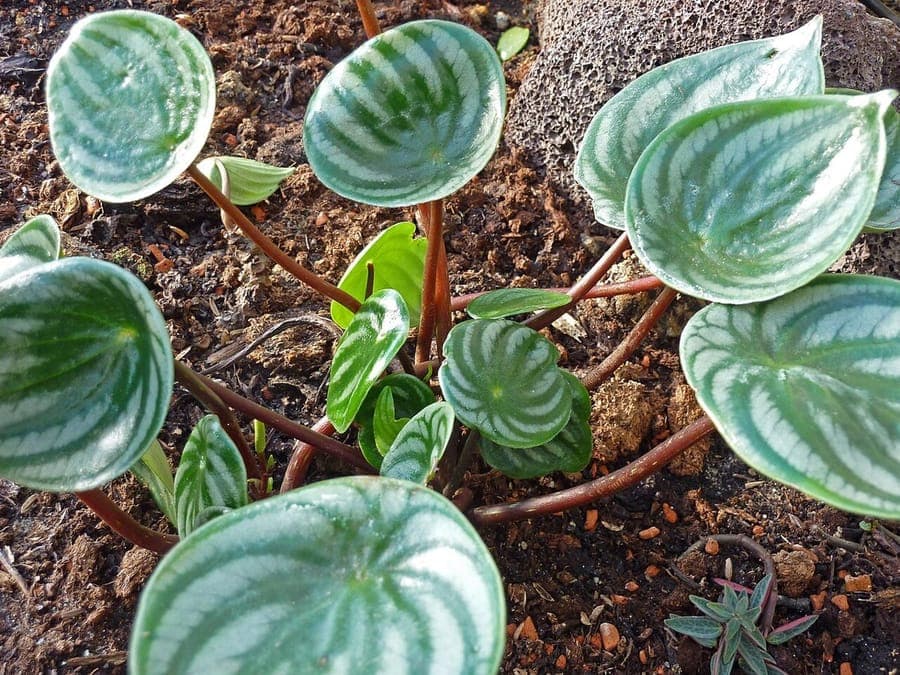
Watermelon peperomia (Peperomia argyreia) owes its name to one thing: its leaves look uncannily like the rind of a watermelon. Each rounded, glossy leaf is marked with broad silver bands alternating with dark green stripes that fan out from the centre towards the edge. Held upright on slender red stalks above a compact clump, these little shields make it one of the most graphic houseplants you can put on a windowsill.
The species comes from tropical South America, including Brazil and Venezuela, where it grows in the understorey of humid forests, often among leaf litter and moss. Older books and some plant labels still use the outdated name Peperomia sandersii. Like every peperomia it belongs to the pepper family (Piperaceae), though you will find no peppery scent or taste here.
Unlike many fashionable foliage plants, watermelon peperomia stays small and well behaved. It needs no glasshouse and no humidifier, only a light touch with the watering can. If you already grow a crinkly Peperomia caperata or a glossy Peperomia obtusifolia, you will soon notice that argyreia behaves differently: its leaf stalks are juicy and brittle, and it rots at the base more quickly if the compost stays wet.
Appearance and flowering
A mature plant grows 15 to 30 cm tall and about as wide. The leaves are oval to almost round with a short tip, 5 to 10 cm long, thick and fleshy. They are peltate, which means the stalk joins the leaf not at its edge but a little way in on the underside, so each leaf sits on its stalk like a small saucer. The stalks are deep red to reddish brown and all rise from a short, stubby stem just above the soil.
The photo shows exactly that: a young plant in brown soil, with round, silver and green striped leaves on reddish brown stalks and a few smaller, fresh green new leaves in the centre. Young leaves are often paler and less clearly marked; the silver only becomes crisp once a leaf has matured and receives enough light.
In spring and summer thin, greenish to cream flower spikes a few centimetres long appear on reddish stems. They are inconspicuous and unscented. You can leave them or snip them off; it makes little difference to the plant.
Position in the home
Peperomia argyreia is a windowsill plant through and through, provided the sill is not above a hot radiator. It likes an even room temperature and a spot where it won't be knocked, because the sappy stalks bend or snap easily. A desk, a plant shelf or a narrow ledge near a window all work well.
Give the pot a quarter turn now and then. The leaves angle themselves towards the light, and without turning the clump grows lopsided.
Light
Provide bright, indirect light. An east or north-east window is ideal, as is a spot a metre back from a west or south window. A little morning sun is welcome, but full midday sun through glass bleaches the leaves and causes brown scorch marks. In too little light the stalks stretch, the leaves lean outwards and the silver pattern fades. In winter it can stand closer to the window than in summer.
Humidity
Here watermelon peperomia is far less demanding than an anthurium or a calathea. Humidity of 40 to 60 % is plenty, and it copes with an ordinary living room in winter without complaint, as long as it is not in the direct stream of warm air from a heater. Misting is unnecessary and best avoided: water that sits in the saucer-like leaves can leave marks.
Potting mix and repotting
The roots are fine and shallow, so a small, shallow pot with a good drainage hole is better than a large, deep one. Use an airy mix: two parts houseplant compost, one part perlite and one part fine orchid bark or coir chips. It dries out quickly enough and lets air reach the roots.
Only repot when roots grow out of the drainage hole, usually every two to three years, in spring. A terracotta pot helps to wick away excess moisture. Keep the plant at the same depth as before; if you bury the stem deeper, the stalks rot at the base.
Free preview
Want to see Watermelon peperomia (Peperomia argyreia): a care guide in your garden? Make a free preview of your design.
Watering and feeding
Water when the top half of the compost is dry. In summer that is roughly once a week, in winter every two to three weeks. Lifting the pot is the surest test: a light pot needs water. Pour around the edge rather than into the centre of the plant, and tip away any water left in the saucer after a quarter of an hour. Use water at room temperature, as cold tap water can cause spots.
Watermelon peperomia tells you when something is wrong. Leaves that go slightly limp and start to curl are thirsty. Black, glassy stalks at the base and leaves that drop off at a touch point to overwatering. Act quickly if you see that: take the plant out of its pot, cut away anything rotten and put healthy leaves aside as cuttings.
From April to September feed once a month with houseplant fertiliser at half strength. It is a slow grower, so it needs no more than that.
Propagation
With this species propagation is almost a party trick. Cut off a healthy leaf with 2 to 3 cm of stalk and push it at an angle into moist cutting compost or perlite. For more plants from a single leaf, cut the leaf across into two halves and insert each half, cut edge down, about a centimetre deep. Roots form along the cut edge within a few weeks, and after two to three months tiny new plantlets appear.
Keep the cuttings in a light, warm place at 20 to 25 °C and the medium just moist. A clear plastic bag or an upturned glass jar speeds things up; remove it briefly each day for fresh air. An older, full plant can also be gently divided into two or three pieces in spring.
Care calendar
March–April: The growing season begins. Repot if needed and start feeding.
May–July: The best time for leaf and half-leaf cuttings. Flower spikes appear.
July–August: Shield from harsh midday sun. Water as soon as the top half of the compost is dry.
September–October: Stop feeding. Move the plant a little closer to the window as the light fades.
November–February: Rest period. Little water, no feed, away from cold glass and hot radiators. The plant calendar on gardenworld.app lets you track watering and feeding plant by plant, so you are less tempted to overwater in winter.
Temperature and winter care
The ideal range is 18 to 25 °C. Below 13 °C the plant struggles and drops leaves, and it will not survive frost, so it stays indoors all year. On a sheltered, covered patio it can spend the warmest weeks of summer outside, but driving rain and chilly nights do it no good. If you want a patio or conservatory with the same fresh, graphic feel, you can have a garden design made on gardenworld.app and match your indoor plants to it.
Toxicity to pets
The ASPCA lists Peperomia argyreia as non-toxic to cats and dogs, under both watermelon peperomia and the confusing name watermelon begonia. No toxic compounds are known for people either, which makes it a good choice for homes with curious cats or young children. An animal that eats a lot of leaves may still get a mild stomach upset, as with any plant material. A cat jumping onto the windowsill will also easily snap the juicy stalks, so a quiet spot is best.
Companion plants
Watermelon peperomia pairs well with other small houseplants that have a distinctive leaf shape. Chinese money plant (Pilea peperomioides) also has round, peltate leaves, but in plain green, which makes a fun pairing. Spider plant (Chlorophytum comosum) adds long, striped leaves that echo the pattern. A moth orchid (Phalaenopsis amabilis) likes the same indirect light and the same careful watering. Mind-your-own-business (Soleirolia soleirolii) and a Christmas cactus (Schlumbergera truncata) complete the group. The ASPCA also lists spider plant, moth orchid, mind-your-own-business and Christmas cactus as non-toxic.
Final thoughts
Peperomia argyreia is small but instantly eye-catching. Its silver-striped shields on red stalks bring a cheerful, graphic touch to any room. Give it bright indirect light, an airy mix in a small pot and water only once the compost is half dry. It will stay compact and handsome for years, and with half a leaf you can raise new plants with almost no effort.

See it in your garden
See Watermelon peperomia in your garden
One photo of your garden and a few questions. You see the result in about a minute.
Try it with a photoIdentify this plant in your own garden. Identify a plant
Similar plants
Chinese Money Plant: complete guide
Pilea peperomioides
Chinese Money Plant (Pilea peperomioides) is a trendy houseplant from China featuring distinctive round, mint-green leaves. This Instagram-famous plant has become a favorite for modern homes with its elegant appearance and easy-care nature.
Chlorophytum comosum: complete guide
Chlorophytum comosum
Discover everything about Chlorophytum comosum (spider plant). Learn care requirements, propagation, location and maintenance for thriving indoor plants.
Phalaenopsis amabilis: complete guide
Phalaenopsis amabilis (L.) Blume
Phalaenopsis amabilis (Moon Orchid) is an elegant houseplant with gorgeous white flowers. Learn care, watering, and blooming techniques.
