
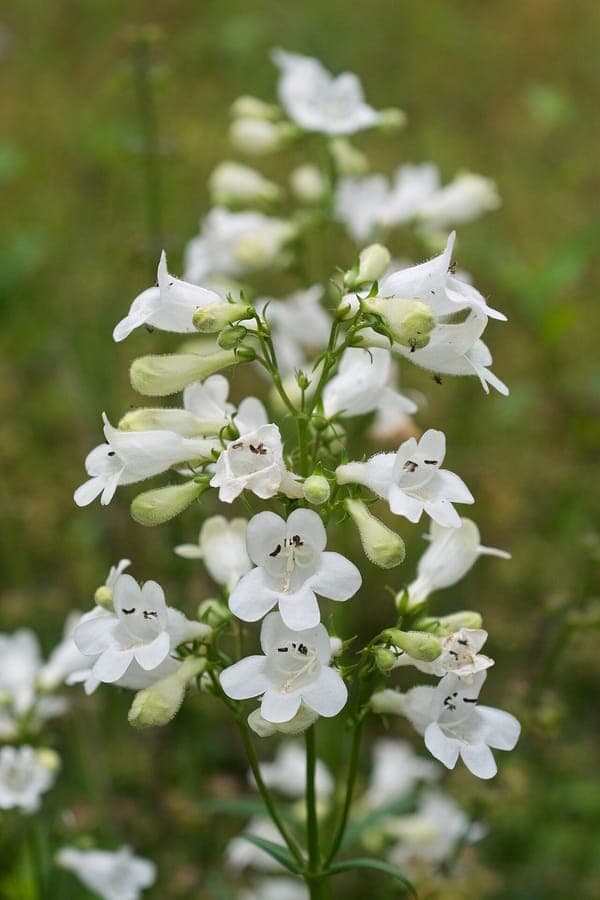
Eric Hunt / CC BY-SA 4.0, via Wikimedia Commons
Foxglove beardtongue: complete guide
Penstemon digitalis
Want to see Foxglove beardtongue: complete guide in your garden?
1 minute, no credit card
Overview
Penstemon digitalis, known as foxglove beardtongue or tall white beardtongue, is one of the most imposing and garden-worthy species in a genus of over 250 North American perennials. First described by Nuttall in 1835, it is native to the central and east-central United States - including Illinois, Indiana, Iowa, Missouri, Ohio, Kansas, Wisconsin, and numerous other states - and has naturalised extensively across the eastern seaboard.
The specific epithet digitalis alludes to the visual resemblance of its flowers to those of the common foxglove (Digitalis purpurea), though the two plants are botanically unrelated, belonging to different families. The comparison is apt: both produce tall, cylindrical white flowers carried in elevated, candelabra-like spikes above the foliage. This stateliness has made P. digitalis a garden favourite wherever tall, structural perennials are needed.
In European gardens, foxglove beardtongue has established itself firmly in the prairie planting movement, where its height (60 to 120 cm), long flowering season, and ecological value as a pollinator plant make it indispensable in naturalistic and mixed herbaceous borders. The cultivar 'Husker Red', introduced in the 1980s, won the Perennial Plant Association's Plant of the Year award in 1996 and remains one of the most widely grown penstemon cultivars worldwide, celebrated for its striking maroon-red foliage and pure white flowers.
Explore garden design ideas featuring foxglove beardtongue and companion plantings at gardenworld.app - an easy starting point for creating vibrant, ecologically rich borders.
Appearance & bloom cycle
Penstemon digitalis is a robust, upright perennial reaching 60 to 120 cm in height at maturity - one of the tallest species in the genus. Stems are stout, often tinged red or purple, particularly in the cultivar 'Husker Red'. Leaves are broad-lance-shaped to elliptical, 5 to 15 cm long, glossy, and in the popular red-leaved cultivars edged with deep burgundy-purple that intensifies in full sun and cool weather.
Flowering occurs in May to June, slightly earlier than many Penstemon species. The white to very pale pink flowers are tubular, approximately 2 to 3 cm long, borne in large, branching panicles on tall, upright stems. Each flower is two-lipped with a distinctly flared throat, and the interior bears fine purple guide-lines directing pollinators to the nectar. The fragrance is delicate and pleasant.
After flowering, conspicuous oval seed capsules develop, ripening to brown in autumn. Self-sown seedlings appear readily around established clumps if the capsules are left in place. The basal leaf rosettes are evergreen to semi-evergreen in mild winters, and in the case of red-leaved cultivars the foliage colour deepens through autumn and winter, providing ornamental interest beyond the flowering season.
Beyond 'Husker Red', notable cultivars include 'Dark Towers' (even deeper foliage colour, slightly later bloom, 90 to 110 cm) and 'Mystica' (more compact at around 70 cm, with rich red leaves). All perform reliably in European gardens from USDA zones 3 to 8.
Ideal location
Full sun to light partial shade suits foxglove beardtongue very well. Unlike many rock-garden penstemon species that demand the driest, most exposed spots, P. digitalis is notably more tolerant of shade and moisture, which dramatically expands the range of garden positions where it can thrive. A sunny border with moderately fertile, evenly moist soil gives the finest results.
Given its considerable height of 60 to 120 cm, this species is best placed in the middle or rear of a mixed border, where it contributes vertical emphasis and draws the eye upward. In prairie-style plantings it works naturally alongside ornamental grasses and other tall North American natives that share its cultural requirements.
Allow 40 to 50 cm between plants to give each clump adequate space for development and to maintain airflow around the foliage - important for reducing the risk of powdery mildew during humid summer periods. When massed, the plants create an impressively textured backdrop of foliage and flower spikes.
Soil requirements
Penstemon digitalis is considerably more flexible in its soil preferences than most of its relatives. It thrives across a wide spectrum of soil types - from sandy loam and ordinary garden soil to moderately heavy clay - provided prolonged waterlogging does not occur. The preferred pH range is 5.5 to 7.0, covering most garden soils in northern and western Europe.
The key distinction from more drought-adapted penstemon species is P. digitalis's tolerance of moderately moist soils. Ordinary garden soil, enriched with well-rotted compost to improve structure and moisture retention, is perfectly adequate. On heavy clay, incorporating coarse grit (approximately 20 to 25% by volume) improves drainage and reduces frost-heave risk in winter.
Fertilise moderately: an annual light dressing of well-rotted compost in early spring supports strong growth and reliable flowering. Excessive nitrogen fertilisation promotes lush vegetative growth at the expense of bloom quality and can make stems floppier than ideal. In red-leaved cultivars, over-rich soil also diminishes the depth and saturation of the foliage colour.
Free design
Want to see Foxglove beardtongue: complete guide in your garden? Make a free design now.
Watering
Foxglove beardtongue has greater moisture requirements than most other Penstemon species, aligning with its native habitat in the central and eastern United States where summer rainfall is more consistent than in the arid western states where many other species originate.
In most European temperate gardens, natural rainfall is sufficient for established plants throughout the growing season. Supplementary watering is most beneficial during the flowering period (May to June) to support a longer and more prolific bloom: water once a week during extended dry spells, wetting the soil thoroughly to a depth of 20 to 30 cm. Water at the base of the plant rather than overhead to reduce fungal risk on the foliage.
After flowering, established plants tolerate shorter dry periods well. No supplementary watering is needed in autumn or winter. New plantings - best made in spring or early autumn - require consistent moisture for the first six to eight weeks to support root establishment. The red-leaved cultivars, particularly 'Husker Red', show somewhat less heat and drought tolerance than the straight species and benefit from slightly more attentive watering during hot, dry spells.
Pruning
Foxglove beardtongue requires little and straightforward maintenance by way of cutting back. After the main flowering flush in June, the spent flower stems can be cut back by one third to one half using clean, sharp secateurs. This tidies the plant, redirects energy away from seed production, and sometimes stimulates a light second bloom in late summer or early autumn.
If you want to exploit the plant's ornamental seed heads and benefit seed-eating birds such as goldfinches, leave the stems standing through winter. The angular capsules are architecturally attractive on frosted mornings. In that case, cut all stems back to just above ground level in early spring - typically March - once fresh shoots are emerging from the base.
The basal rosette is largely evergreen or semi-evergreen and needs no removal. Simply clear away any winter-damaged or yellowed outer leaves in spring. Divide congested clumps every three to five years in early spring or early autumn, replanting the healthiest outer sections at 40 to 50 cm spacing. Divisions of red-leaved cultivars are immediately identifiable by their foliage colour, which simplifies replanting design decisions.
Maintenance calendar
January–February: Leave stems and seed heads standing as winter decoration and bird food. No intervention needed.
March: Cut old stems to the ground once new basal growth appears. Apply a light compost dressing. Check for slug damage on emerging foliage.
April: Growth accelerates. Plant new specimens in prepared positions. Keep new plantings consistently moist.
May: Flowering begins - white spires open progressively from the base upward. Check weekly for aphids or powdery mildew.
June: Peak bloom. Water during extended dry spells. Cut spent first-flush stems back if a second bloom is wanted.
July–August: Seed capsules ripen. Possible light repeat bloom in favourable conditions.
September: Divide congested clumps if needed. Remove weeds around established plants before winter.
October–November: Apply a light mulch on heavy or clay soils before hard frosts. Leave stems standing.
December: Full dormancy. No action required.
Winter hardiness
Penstemon digitalis is an exceptionally hardy perennial, tolerating temperatures as low as -25 °C when drainage is adequate. USDA hardiness zones 3 to 8 cover its full garden range, which includes the Netherlands, Belgium, Germany, France, and the United Kingdom, all of which lie in zones 7 to 8 - considerably milder than much of its native North American habitat.
The red-leaved cultivars 'Husker Red' and 'Dark Towers' are equally hardy to the straight species. Young plants in their first winter benefit from a light mulch of 5 to 7 cm of leaves or straw around the crown for additional protection against hard frosts. By their second year, all established plants overwinter without supplementary protection under normal temperate conditions.
As with all Penstemon species, the primary winter risk is wet soil combined with frost. On heavy or poorly drained soils, improve structure before planting. A grit mulch around the stem base reduces crown-wetting during persistent wet weather. Under normal conditions in Dutch, Belgian, or British gardens, additional winter protection is unnecessary.
Companion plants
Penstemon digitalis combines naturally with a wide range of prairie and meadow perennials:
Echinacea purpurea (purple coneflower): pink-purple flower heads in July–September provide a warm complement to the white penstemon, extending the border's colour season well into late summer.
Rudbeckia fulgida (orange coneflower): warm yellow flowers with dark centres in August–September succeed the penstemon's flowering and carry the border into autumn.
Panicum virgatum (switchgrass): airy reddish plumes throughout summer and autumn harmonise with the vertical penstemon stems; cultivars such as 'Shenandoah' develop fine red autumn colour.
Salvia nemorosa (woodland sage): purple flower spikes bloom simultaneously with penstemon in May–June, creating a striking white and purple combination that attracts bees and butterflies in profusion.
Monarda (bergamot): vivid floral heads in summer pair naturally with tall white penstemons and draw large numbers of bumblebees to the border.
For complete prairie border planting plans and more plant combination ideas, visit gardenworld.app for curated designs tailored to different garden conditions and sizes.
Conclusion
Penstemon digitalis is far more than a rock garden specialist: it is a bold, structural perennial for the full range of mixed and naturalistic borders in European gardens. Its height and stateliness, the ornamental red-leaved cultivars, and its outstanding winter hardiness make it a top-tier choice for gardeners seeking both visual impact and ecological value. From the early summer bloom through to the decorative seed heads of winter, it contributes to the garden across every season.
Want to see Foxglove beardtongue: complete guide in your garden? Make a free design now.
Upload a photo, pick a style, and get a photorealistic design with plant list in under a minute.
10,000+ gardens designed already
No credit card required


Similar plants
White Beardtongue: complete guide
Penstemon albidus
Discover white beardtongue (Penstemon albidus) - elegant perennial with white to cream flowers. Drought-resistant, perfect for prairie and dry gardens.
Longsepal Beardtongue: complete guide
Penstemon calycosus
Discover longsepal beardtongue (Penstemon calycosus) - beautiful perennial with lilac-blue flowers. For partial shade and moist soil. Ideal for naturalized.
Penstemon cusickii: complete guide
Penstemon cusickii
Discover Cusick's beardtongue, a compact alpine flowering plant with violet-pink blooms. Perfect choice for rock gardens and water-wise landscaping.