
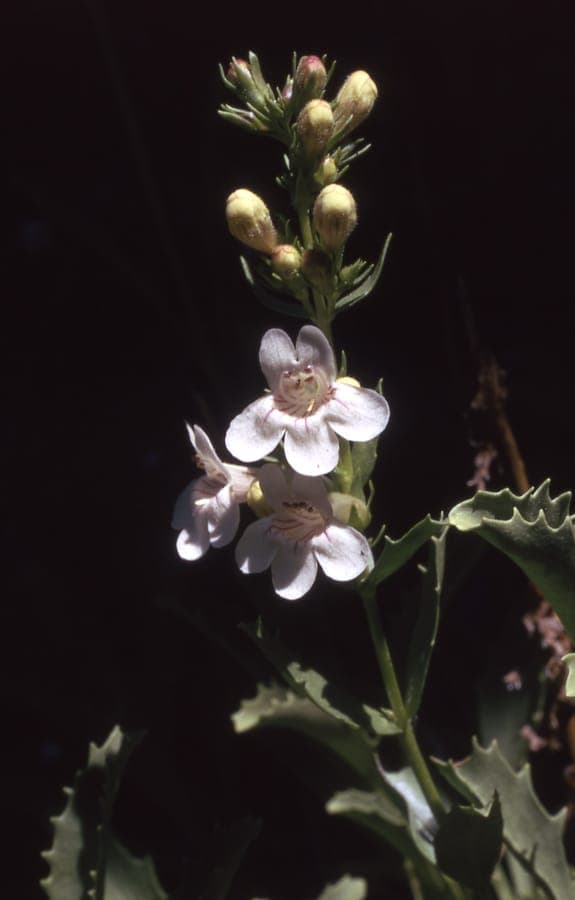
JW Stockert / Public domain, via Wikimedia Commons
Hotrock penstemon: complete guide
Penstemon deustus
Want to see Hotrock penstemon: complete guide in your garden?
1 minute, no credit card
Overview
Hotrock penstemon, known botanically as Penstemon deustus, is a distinctive species within the large genus Penstemon. The Latin name 'deustus' means 'burned' or 'scorched', a reference to the rocky, sun-baked habitats where the plant naturally thrives. The common name 'hotrock penstemon' captures the same idea perfectly, while the alternative 'scabland penstemon' refers to the dry, basaltic plains and slopes of the Pacific Northwest.
The species was described in 1830 by Scottish botanist David Douglas, who extensively explored western North America to catalogue plant species. Penstemon deustus belongs to the family Plantaginaceae and is native across a broad band of the western United States: from California and Nevada in the south to Washington, Oregon, Idaho, Montana, and Wyoming in the north.
For European gardeners, this plant is compelling because of its extraordinary ability to thrive in dry, rocky, and nutrient-poor conditions. The creamy-white flowers are more restrained than those of blue-flowered penstemons, but the compact subshrubby growth habit and wide ecological tolerance make it invaluable for difficult spots. On gardenworld.app, Penstemon deustus is recommended for xeric gardens, rock gardens, and dry borders where few other plants succeed.
Among its synonyms is Penstemon deustus subsp. typicus (D.D. Keck), indicating that several variants of the species exist that may differ somewhat across their ranges.
Appearance and bloom cycle
Penstemon deustus differs visually from most other penstemons that gardeners know. Instead of the typical blue-purple or pink flowers, this species produces small, creamy-white to pale yellow flowers with fine lilac veining inside the tube. The individual blooms are smaller than those of large decorative hybrid penstemons, but they appear in abundance in slender racemes along the stems.
The plant grows as a subshrub with multiple stems fanning out from a woody base. Stems reach 30 to 60 cm in length and are often somewhat arching or zig-zagged. The leaves are obovate to oval with toothed margins, and have a leathery texture and dark green, matte surface.
Flowers appear from May through August depending on elevation and location. At lower elevations the plant blooms as early as May; at higher sites it may not flower until July. The blooming period is long compared with many other perennials. The cream-white colour creates a calm, naturalistic impression in the garden that pairs well with stone, gravel, and other neutral materials.
After blooming, small, oval seed capsules develop containing brown seeds. The fruits are not particularly showy, as in other penstemons.
The woody stem base gives the plant some structure even in winter. In mild winters, the lower leaves may remain partially green.
Ideal location
This penstemon demands a full-sun position. In its natural range it grows on rocky slopes, basalt outcroppings, and dry grassland areas that receive intense western sun all day. Without adequate direct sunlight - at least six hours per day - the plant blooms less freely and becomes more susceptible to root rot.
Penstemon deustus has a multi-stemmed, semi-woody growth habit and suits places where the combination of ornamental value and ruggedness is desired. Think of dry wall tops, cracked rock faces in rock gardens, or the arid, sandy edge of a gravel garden.
The plant also handles periodic waterlogging less well than most garden plants. Wet feet in winter must be absolutely avoided. Raised beds or sloped terrain are ideal.
In terms of climate, the plant fits European gardens in USDA zone 5 to 8. In zone 5, additional protection may be needed in hard winters.
Soil
Penstemon deustus demands little of soil nutrients but has moisture requirements that run directly counter to most garden plants. It thrives on dry, free-draining soils with a pH between 6.0 and 8.0 - a fairly wide range covering both mildly acid and mildly alkaline conditions.
In its natural range the species often grows on basaltic rock, schist, or sandy, coarse-textured soils with almost no water retention. In the garden you need to create similar conditions: work coarse grit or gravel thoroughly into the soil, or build a raised bed with a drainage layer of broken stone or gravel at the base.
Avoid clay-rich soils or soils with high organic matter content: both retain too much moisture and can damage the root system, especially in winter. A thin layer of fine gravel around the plant after planting helps stabilise soil temperature and suppress weeds.
On poor, lean ground there is no need to fertilise. On slightly richer ground, a single light application of a calcium-based fertiliser at planting time is sufficient.
Watering
Penstemon deustus is a genuinely drought-tolerant plant. Its origin from rocky, sun-scorched slopes has driven deep adaptation to meagre water conditions. Once established, the plant needs no supplemental water in most European climates, even through warm summers.
The first three to six months after planting are critical. During this period the plant must receive enough water to put down roots. Water deeply once a week at the base of the plant. After that, allow the soil to dry out thoroughly before watering again.
After this first year, the plant is self-sufficient in most European regions. During extremely dry summers - more than three weeks without rainfall - a single deep watering may help. Never water overhead as wet foliage encourages fungal infection; use drip irrigation or water directly at the base.
In winter the plant must stay dry. Semi-woody penstemons are more vulnerable to wet winters than to cold, and standing water around the roots is the greatest risk factor for winter loss.
Free design
Want to see Hotrock penstemon: complete guide in your garden? Make a free design now.
Pruning
The woody growth habit of Penstemon deustus calls for a slightly different approach than for herbaceous penstemons. Prune spent flowering stems back immediately after blooming, cutting to just above a side bud or a few healthy leaves lower on the stem. This tidies the plant and can encourage a modest second flush.
In late autumn or early winter, cut the stems back to about one third of their length. Always leave enough green growth and woody base, since the plant overwinters on its stems and does not die back fully to the ground as purely herbaceous species do. Over-aggressive autumn pruning can weaken the plant.
In early spring, before new growth is well advanced, remove any dead or damaged stems and clean up the remaining ones. Divide the clump only if it has grown too large, and do so in early spring.
Caution: pruning too late in the season can damage new dormant buds and weaken the plant ahead of winter.
Maintenance calendar
March/April: Inspect the plant after winter. Remove dead or damaged stems. Prune back to just above fresh growth. Apply a thin layer of coarse gravel around the plant if not done in autumn.
May/June: Bloom begins. Enjoy the cream-white flowers and insect activity. Water only if the soil has dried out completely and there has been no rain for more than two weeks.
July/August: Peak bloom at lower elevations; at higher positions flowering may only now be starting. Remove spent flower stems to encourage reblooming.
September: Allow seed capsules to ripen for self-seeding or birds. Begin light pruning if desired.
October/November: Cut stems back to about one third of their length. In cold regions, apply a protective layer of dry leaves or conifer branches. Avoid heavy mulch that impedes air circulation.
December/February: Check for standing water. Coarse gravel around the base keeps excess moisture from the roots. No supplemental water needed.
Winter hardiness
Penstemon deustus is hardy in USDA zones 5 to 8, meaning it can survive minimum temperatures of around -25 degrees Celsius provided the soil is well-drained. In practice the species is well-suited to gardens in temperate northwest Europe, though winter performance depends strongly on moisture conditions.
The woody stem base that distinguishes this species from purely herbaceous penstemons gives some extra protection to the overwintering buds. At the same time, this wood can be somewhat more susceptible to frost damage if it was produced late in the season on overly rich soil.
In particularly severe winters or at sites with fluctuating freeze-thaw cycles, the plant can benefit from a layer of dry leaves or coarse gravel around the stem base. Do not wrap the stems themselves: good air circulation is essential to prevent fungal diseases.
Old, well-established specimens are tougher than young plants. Plant in early spring so new additions have a full growing season before their first winter.
Companion plants
The neutral cream-white flowers of Penstemon deustus lend themselves to diverse colour combinations. The plant pairs especially well with other xerophytes from the western prairies and rock lands of North America. On gardenworld.app you can discover how garden designers use this unusual species in attractive xeric compositions.
Good companions include:
- Artemisia (wormwood/sage): silver foliage provides a beautiful backdrop for the cream-white blooms of the penstemon.
- Sedum (stonecrop): low, tough species such as Sedum reflexum or Sedum album fill the base of the penstemon beautifully.
- Yucca (or Agave in milder climates): give a Southwestern, rocky character to the border.
- Eriogonum (wild buckwheat): a related North American plant that thrives in the same dry, rocky habitats.
- Phlox subulata (creeping phlox): a low carpet that blooms early in the season and covers the ground around the penstemon attractively.
- Calamagrostis (reed grass): upright grass that contrasts well with the semi-woody habit of the penstemon.
Avoid pairing with moisture-loving plants such as hostas, astilbes, or other high-water-demand subjects.
Closing thoughts
Hotrock penstemon may not be the most colourful penstemon, but it is certainly among the toughest and most versatile. Its ability to survive on the most challenging, dry, and poor sites makes it invaluable in sustainable, water-wise gardens. The restrained cream-white flowers, semi-woody form, and long season of interest give it a character entirely its own.
For dry gravel gardens, rock gardens, or experimental prairie borders, Penstemon deustus is an outstanding choice that demands little to no attention for years on end. Want to discover how this unusual plant might look in your garden? Try the design tool at gardenworld.app for a personalised plan tailored to your specific situation.
Want to see Hotrock penstemon: complete guide in your garden? Make a free design now.
Upload a photo, pick a style, and get a photorealistic design with plant list in under a minute.
10,000+ gardens designed already
No credit card required


Similar plants
Narrowleaf beardtongue: complete guide
Penstemon angustifolius
Narrowleaf beardtongue (Penstemon angustifolius) is a drought-tolerant perennial with pink-blue flowers, perfect for dry, sunny borders and prairie-style gardens.
Wasatch beardtongue: complete guide
Penstemon cyananthus
Wasatch beardtongue (Penstemon cyananthus) is a striking perennial with intensely blue flowers, native to the Wasatch Mountains of Utah and Wyoming.