
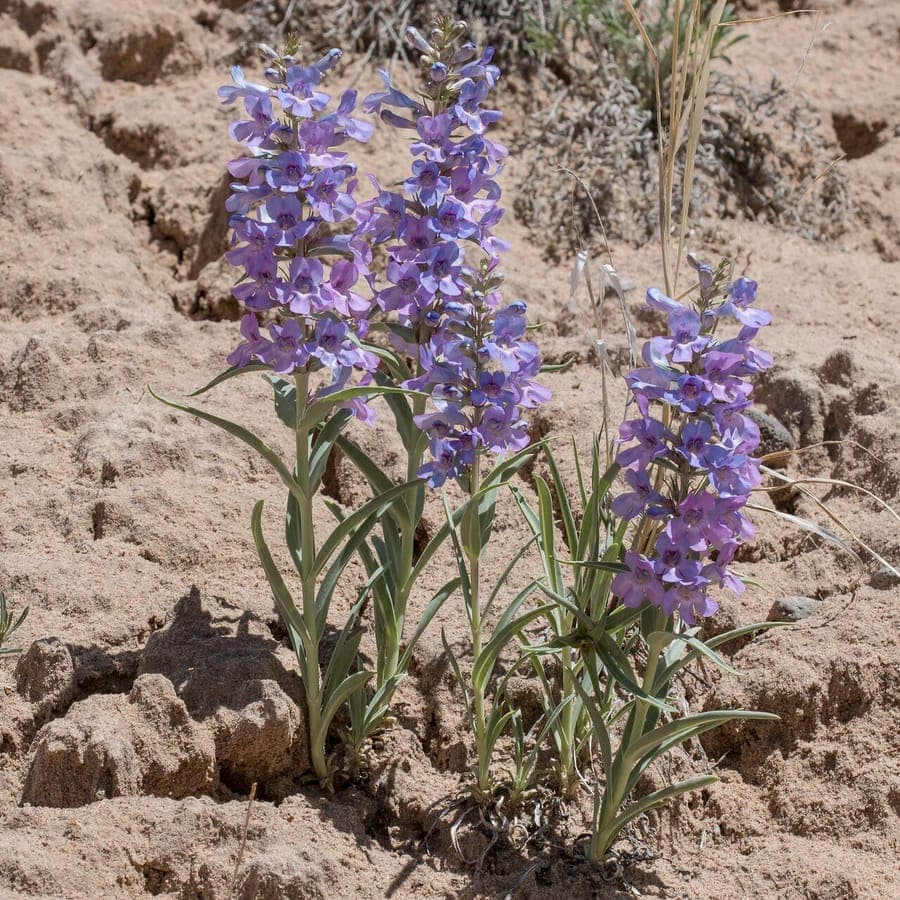
Craig Martin https://www.inaturalist.org/people/craigmartin / CC0, via Wikimedia Commons
Narrowleaf beardtongue: complete guide
Penstemon angustifolius
Want to see Narrowleaf beardtongue: complete guide in your garden?
1 minute, no credit card
Overview
Narrowleaf beardtongue, known botanically as Penstemon angustifolius, is a North American native perennial at home on the wide-open prairies of the central and western United States. First described in 1813 by Nuttall and Pursh, it belongs to the family Plantaginaceae - the same family as plantain. What makes this plant so attractive to gardeners is its remarkable tolerance for drought, wind, and poor soils, combined with cheerful blooms in soft shades of pink and lilac-blue.
The name 'angustifolius' refers to the narrow leaves (Latin: angustus = narrow, folium = leaf), a feature that distinguishes this species from other penstemons with broader foliage. The English common names 'narrowleaf beardtongue' and 'narrowleaf penstemon' both reflect the defining features of the genus: slim leaves and the characteristic hairy staminode that resembles a tongue.
For garden designs on gardenworld.app, Penstemon angustifolius is a top recommendation for dry, sunny borders, rock gardens, and prairie-style planting schemes. It is especially well-suited for gardeners aiming for low maintenance without sacrificing visual appeal.
Appearance and bloom cycle
Penstemon angustifolius grows as an upright, herbaceous perennial with multiple stems emerging from a central crown. The stems typically reach 30 to 60 cm in height, occasionally taller in favourable conditions. The leaves are narrow and lance-shaped, dark green, arranged oppositely along the stem. Basal leaves are somewhat broader than those higher on the stem.
Flowers appear from May through July, depending on location and season. They are tubular to bell-shaped, clustered in slender racemes along the upper half of each stem. Colour ranges from pale pink to lilac-blue, often with a whitish throat. The inner surface of the flower tube is usually lighter and shows fine guide lines that direct pollinators to the nectar. The genus's famous hairy staminode - a sterile stamen covered with yellow hairs - is visible when you peer inside the flower.
After flowering, oval seed capsules develop containing numerous small seeds. These seeds disperse by wind and can establish spontaneously in suitable spots around the garden. The seed capsules remain on the plant through winter, providing structure and food for seed-eating birds.
Ideal location
This penstemon thrives in full sun, ideally receiving at least six hours of direct sunlight per day. Native to regions with hot, dry summers and cold winters, it needs comparable conditions in the garden.
Choose a spot protected from excessive winter moisture, as standing water around the roots in cold weather can cause rot. A slightly raised bed or sloped position greatly improves drainage. Penstemon angustifolius handles wind well and is an excellent choice for exposed, well-ventilated positions that other plants might find too harsh.
In continental climates with cold winters and warm summers it feels right at home. In temperate maritime climates, the key to success is a sheltered, sunny spot with excellent drainage. Pair it with other drought-tolerant species for a planting that looks abundant without demanding constant irrigation.
Soil
Penstemon angustifolius asks little of soil nutrients, but drainage is non-negotiable. In the wild it grows on dry, calcareous or sandy soils with a pH between 7.0 and 8.5, making it particularly suitable for alkaline or nutrient-poor ground where other plants struggle.
In the garden, improve heavy clay soils by working in coarse sand or fine grit. A 5 to 10 cm layer of coarse gravel or grit around the plant further improves drainage and prevents the crown from sitting in moisture after rain.
Avoid rich, humus-heavy soils: on overly fertile ground the plant grows lush but becomes floppy and more disease-prone. Lean soil produces a more compact, robust plant with richer flowering. An annual light application of garden lime can help if your soil tends to be acidic.
Watering
One of the greatest strengths of Penstemon angustifolius is its drought tolerance. Once established, it needs very little supplemental water and can endure dry spells that would stress most border plants.
During the first growing season after planting, regular watering is important to help the plant establish a deep root system. Water thoroughly once a week so moisture penetrates deep into the soil. After that, reduce frequency significantly.
From the second year onwards, rainfall in most temperate summers is sufficient, supplemented only during extended dry spells lasting more than two weeks. Avoid overhead watering as wet foliage encourages fungal problems. Water at the base, ideally in the early morning so the plant enters the day dry.
Overwatering is the greatest threat to this species. Wet roots, especially combined with cold temperatures, cause root problems that can kill the plant outright. With penstemons, less is consistently more.
Free design
Want to see Narrowleaf beardtongue: complete guide in your garden? Make a free design now.
Pruning
Penstemon angustifolius needs minimal pruning. After blooming, cut back spent flower spikes to just above the next set of leaves to tidy the plant and sometimes encourage a second, lighter flush of bloom.
In autumn you can cut the stems back to about 10 cm above the ground, or leave them standing for winter structure and as a food source for birds that pick at the seed capsules. If you choose to leave them, cut back in early spring before new shoots have grown too far.
Important: pruning too late into the season can damage new growth points. In a mild autumn, wait until February or March. Remove dead or damaged stems as soon as you spot them, regardless of the time of year.
Old, heavily woody clumps can be divided in early spring to produce new plants and to rejuvenate the original.
Maintenance calendar
March/April: Cut back remaining stems to 10 cm above the ground. Remove old mulch. Check for winter damage. Apply a thin layer of coarse sand or gravel around the plant to improve drainage.
May/June: Enjoy the first flowers. Water young plants weekly during dry spells. Remove any weeds around the plant before they establish.
July: Cut back spent flower stems. During extended drought, water deeply at the roots once every two weeks.
August/September: Leave seed capsules standing to attract seed-eating birds and allow self-seeding. The plant begins preparing for winter.
October/November: Optionally cut back or leave standing. In cold regions, apply a protective layer of dry leaves or conifer branches around the crown.
December/February: Check periodically for frost damage and standing water. Coarse gravel around the crown keeps excess moisture away from the vulnerable root zone.
Winter hardiness
Penstemon angustifolius is hardy in USDA zones 4 to 8, meaning it can withstand temperatures down to around -30 degrees Celsius. In practice, overwintering in temperate European gardens is entirely feasible provided drainage is excellent.
The plant tolerates hard frost far better than a wet winter rest. Even temperatures of -10 degrees Celsius pose no problem for a healthy, established plant in well-drained soil. On heavy, poorly drained clay, even mild winters can cause root problems.
Young, recently planted specimens are more vulnerable to winter damage and deserve extra care. Cover them with a layer of dry leaves or conifer branches after the first frost, ensuring sufficient air circulation to prevent fungal issues.
In very cold winters with alternating freeze-thaw cycles, the crown may need protection. A 5 to 8 cm layer of coarse gravel around (but not directly on top of) the plant helps moderate soil temperature fluctuations.
Companion plants
Penstemon angustifolius combines beautifully with other drought-tolerant prairie and steppe plants. On gardenworld.app you will find many garden designs that pair this tough perennial with attractive partners.
Good companion plants include:
- Salvia nemorosa (woodland sage): another drought-tolerant perennial with purple spikes that flowers at the same time as the penstemon, creating a lovely colour harmony.
- Echinacea purpurea (purple coneflower): the pink domes of echinacea echo the pink-blue tones of the penstemon and flower slightly later in the season.
- Festuca glauca (blue fescue): the silver-blue leaves provide a calm counterpoint to the vivid flowers.
- Achillea (yarrow): golden-yellow or cream yarrow contrasts beautifully with the cooler tones of the penstemon.
- Agastache (anise hyssop): also drought-tolerant, with long purple flower spikes that attract bees and butterflies just as the penstemon does.
- Sedum/Hylotelephium (stonecrop): succulent sedums add autumn colour when the penstemon has already finished blooming.
Avoid pairing with plants that need frequent watering or rich, moist soils - those requirements conflict with the penstemon's needs and will cause trouble for one or the other.
Closing thoughts
Narrowleaf beardtongue is a plant with real character: it asks little, gives much, and fits into virtually any dry, sunny garden. Whether you are creating a wild prairie border, building a rock garden, or simply wanting a low-maintenance edge, Penstemon angustifolius earns a place in your planting scheme.
The combination of early blooming, appeal to bees and butterflies, winter hardiness, and extreme drought tolerance makes it one of the most versatile perennials for dry gardens. Wondering how narrowleaf beardtongue might look in your own front garden? Try the design tool at gardenworld.app for a personalised plan that takes your soil, location, and style into account.
Want to see Narrowleaf beardtongue: complete guide in your garden? Make a free design now.
Upload a photo, pick a style, and get a photorealistic design with plant list in under a minute.
10,000+ gardens designed already
No credit card required


Similar plants
Wasatch beardtongue: complete guide
Penstemon cyananthus
Wasatch beardtongue (Penstemon cyananthus) is a striking perennial with intensely blue flowers, native to the Wasatch Mountains of Utah and Wyoming.
Hotrock penstemon: complete guide
Penstemon deustus
Hotrock penstemon (Penstemon deustus) is a tough perennial with creamy-white flowers, native to dry rocky slopes of the western United States, perfect for xeric gardens.