SAplants / CC BY-SA 4.0, via Wikimedia Commons
Regal pelargonium (Pelargonium × domesticum): pot plant guide
Pelargonium × domesticum
Want to see Regal pelargonium (Pelargonium × domesticum): pot plant guide in your garden?
Full design in HD: €7.99
Look after your Regal pelargonium with the GardenWorld app
Identify plants with your camera and get a care calendar with reminders for this plant.


Overview
Anyone seeing a regal pelargonium in flower for the first time rarely thinks of the ordinary bedding geranium. The flowers are much larger, up to 5 cm across, and the upper petals carry striking dark blotches and veins, as if someone had painted them with a fine brush. Pelargonium × domesticum is a hybrid of South African species such as Pelargonium cucullatum and Pelargonium grandiflorum, and belongs to the cranesbill family, Geraniaceae. In North America the same plants are often sold as Martha Washington geraniums.
In Britain and north-west Europe this is a true container plant. It will not tolerate frost, dislikes rain on its flowers and does best in a bright, sheltered spot: a covered patio, a conservatory or a sunny windowsill. Treat it as an annual and throw it away in autumn, and you miss the chance to grow it on for years into a sizeable bush. This guide covers how to look after it in a pot, keep it flowering and bring it safely through winter.
Well-known cultivars include 'Lord Bute' (near-black burgundy with a narrow pink edge), 'Aztec' (white with strawberry-red markings) and 'Grand Slam' (rose red). Newer series such as 'Aristo' and 'Elegance' are more compact and flower for longer. To see how pots of pelargoniums would work on your own terrace, you can have a garden design made on gardenworld.app that takes sun, shade and sheltered corners into account.
Appearance and bloom cycle
Regal pelargoniums grow as upright, branching subshrubs 30 to 50 cm tall and wide, and can become larger after a few years in a big pot. The leaves are firm, rounded to heart-shaped, with a toothed or slightly lobed margin. They smell faintly herbal when crushed but lack the strong scent of the scented-leaf pelargoniums.
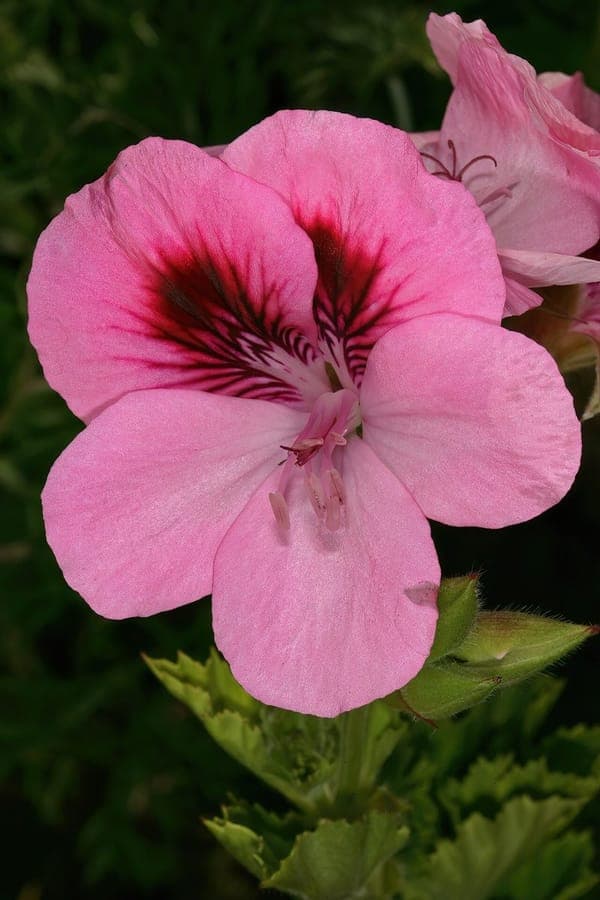
Flowers are held above the foliage in loose clusters of three to ten. Each has five broad, slightly ruffled petals. The two upper petals are larger and carry the characteristic blotch or veining in a darker shade, as in the photograph: a soft pink flower with dark red markings on the upper petals. Colours range through white, pink, salmon, red, purple and almost black, often bicoloured or with frilled edges.
The classic regal pelargonium flowers from April to July. To form buds the plant needs cool nights of around 10 to 15 °C, which is why flowering often stops in a hot summer. Modern cultivars are less sensitive and can carry on until September, especially if you remove faded flowers regularly.
Position indoors and outdoors
Give the plant as much light as possible. Indoors, an east- or west-facing windowsill is ideal; behind south-facing glass the midday sun can scorch the leaves. Outdoors, move the pot out from mid to late May, after the last frost, to a sunny but sheltered spot. A patio under a canopy or a veranda is better than an open balcony, because rain damages the large petals and leaves them spotted.
Protect the plant from strong wind and from the hottest midday hours during heatwaves. Bring it back inside as soon as nights in September or October drop below 5 °C.
Pelargoniums are listed as mildly toxic to cats and dogs. Chewing leaves or flowers can cause vomiting, lethargy and skin irritation in pets. In people the plant is of little concern, although the sap can irritate sensitive skin. Keep pots out of reach of pets that like to nibble plants.
Compost and repotting
Use a free-draining, nutrient-rich compost, such as a good multipurpose or container compost, mixed with about a fifth perlite or fine grit. The pot must have drainage holes, and a layer of clay pebbles at the bottom helps water run away quickly.
Choose a pot only slightly larger than the root ball. In an oversized pot the compost stays wet for too long and the plant produces leaves rather than flowers. Repot in March, when growth resumes, and only ever go up one size at a time. Terracotta pots are ideal because they let moisture evaporate.
Free preview
Want to see Regal pelargonium (Pelargonium × domesticum): pot plant guide in your garden? Make a free preview of your design.
Watering and feeding
Water only when the top 2 to 3 cm of compost feels dry, then water thoroughly until it runs from the base. Never leave water standing in the saucer. On warm summer days this may mean watering daily; in cool weather only a few times a week. Water at the base and keep leaves and flowers dry.
From April to August give a liquid feed for flowering plants every one to two weeks, choosing one high in potash. A feed rich in nitrogen produces lush leaves but few flowers. Stop feeding from September.
Whitefly is a well-known nuisance on regal pelargoniums. Check the undersides of leaves regularly; at the first sign, yellow sticky traps and rinsing the foliage help keep numbers down.
Pruning and cuttings
Remove spent flower clusters by snapping the stalk off at its base. That way the plant puts no energy into seed and keeps flowering.
After the first flush, in July, you can cut the plant back by a third to keep it compact. In autumn, before bringing it indoors, shorten long shoots, and in February or March carry out the main shaping: cut each stem back by about half to just above a leaf joint. Pinch out the tips of young shoots in spring to encourage bushier growth.
Taking cuttings is easy. In August or September cut tip cuttings 8 to 10 cm long just below a leaf joint, remove the lower leaves and let the cut surface dry for a few hours. Insert them in a mix of seed compost and perlite and keep them just moist, never wet. After three to four weeks they will have rooted, giving you young plants to overwinter.
Maintenance calendar
January-February: Overwintering cool and bright, with little water. Cut back at the end of February.
March: Repot if needed and gradually increase warmth and watering.
April: Start feeding. The first buds appear.
May: Full flower indoors. From mid to late May the plant can go outside to a sheltered spot.
June-July: Flowering. Deadhead, check for whitefly and trim lightly after the first flush.
August-September: Take cuttings. Stop feeding.
October: Bring plants in before nights fall below 5 °C. Shorten long shoots.
November-December: Overwintering. Water sparingly and remove yellow leaves.
Overwintering
Pelargonium × domesticum is not hardy. A night below 0 °C will kill it, and it does not enjoy 2 to 3 °C either. Overwinter it somewhere bright at 8 to 12 °C: a cool bedroom, an unheated but frost-free conservatory or a light stairwell. That cool spell is exactly what helps the plant form buds the following spring.
Water sparingly in winter, just enough to stop the root ball drying out completely. A warm living room is less suitable: the plant grows leggy there and flowers less well the next year. Remove yellowing leaves and allow some air movement to prevent grey mould.
Companion plants
A regal pelargonium looks good alone in a handsome pot, but it is even better in a group of containers on the terrace. Ivy-leaved geraniums (Pelargonium peltatum) in a neighbouring trough add a trailing layer that flowers all summer. Lobelia (Lobelia erinus) fills the edge of a mixed container with its fine blue flowers.
The silver-grey leaves of liquorice plant (Helichrysum petiolare) bring calm between the vivid flower colours. A pot of English lavender (Lavandula angustifolia) adds scent and draws bees, and like the pelargonium it hates wet feet. Choose containers for all these partners that you can move easily in autumn.
Final thoughts
The regal pelargonium is not a plant for a forgotten corner but a container plant that lasts for years if treated well. Plenty of light, shelter from rain, moderate watering, regular summer feeding and a cool, bright winter: that is the whole secret. With a few cuttings in late summer you also have fresh plants every year.
So you never forget when to prune, take cuttings or bring the pots indoors, use the plant calendar on gardenworld.app. It sends you a reminder at just the right moment.
Frequently asked questions about Regal pelargonium
When and how do you prune Regal pelargonium?
Remove spent flower clusters by snapping the stalk off at its base. That way the plant puts no energy into seed and keeps flowering.
How much water does Regal pelargonium need?
Water only when the top 2 to 3 cm of compost feels dry, then water thoroughly until it runs from the base. Never leave water standing in the saucer.

See it in your garden
See Regal pelargonium in your garden
One photo of your garden and a few questions. You see the result in about a minute.
Try it with a photoIdentify this plant in your own garden. Identify a plant
Similar plants
Ivyleaf geranium: complete guide
Pelargonium peltatum
Discover ivyleaf geranium, a practical hanging plant with purple and pink flowers. Learn about cultivation, pruning and winter storage in this guide.
Lobelia erinus: complete guide
Lobelia erinus L.
Lobelia erinus is popular trailing plant with blue or red flowers, perfect for hanging baskets and containers. Flowers continuously all summer long.
Helichrysum petiolare: complete guide
Helichrysum petiolare
Helichrysum petiolare, the licorice plant, is a graceful trailing plant with silvery-gray foliage perfect for containers and hanging baskets.
