
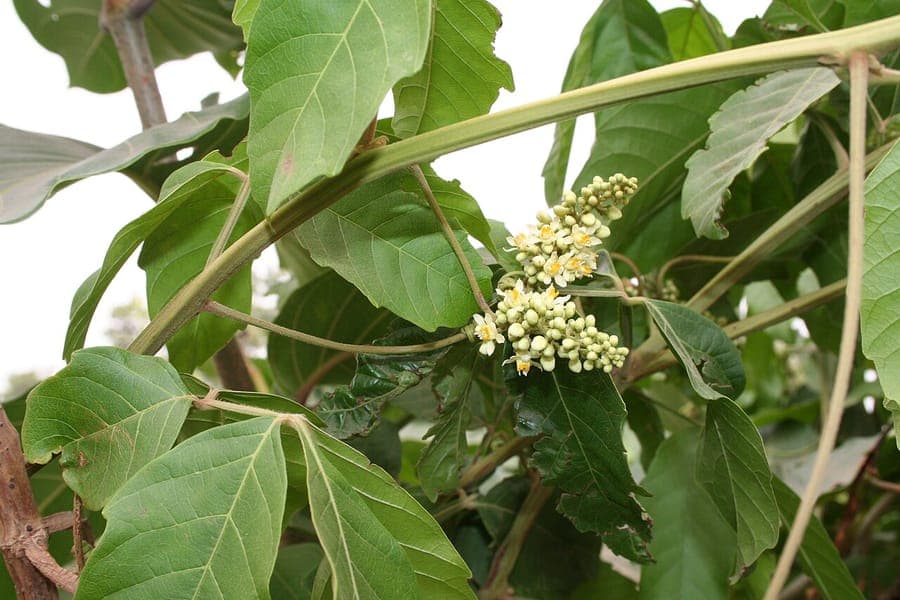
Marco Schmidt / CC BY-SA 2.5, via Wikimedia Commons
Paullinia pinnata: complete guide
Paullinia pinnata
Want to see Paullinia pinnata: complete guide in your garden?
1 minute, no credit card
Overview
Paullinia pinnata, also known as Barbasco or Bread and cheese, is a fascinating climbing vine that naturally grows in tropical Americas and tropical Africa. This vigorous scrambling plant belongs to the Sapindaceae family and is found from Mexico to Brazil, and also in West and Southern Africa.
The plant is known for its toxic properties and has been traditionally used in various cultures. The name "Bread and cheese" likely refers to the appearance of certain plant parts. For gardeners, this plant is primarily interesting as a spectacular vine in subtropical and tropical environments.
Appearance and bloom
Paullinia pinnata grows as a climbing vine with characteristic compound leaves that spread beautifully along its stems. The leaves display a fine structure with multiple leaflets elegantly distributed along the tendrils.
The plants produce yellow flowers followed by interesting fruits. The fruits are striking and play a role in the propagation of this exotic species. The entire plant radiates a wild, tropical character that immediately draws attention in any garden.
Ideal location
Paullinia pinnata thrives best in full to partial shade. In subtropical climates, the plant tolerates full sun, but in warmer regions afternoon shade can be beneficial to prevent leaf scorch.
The plant requires sturdy support structures to climb on. A pergola, trellis, or strong support is essential. Ensure the location offers wind protection, as new growth can be sensitive to strong winds.
This plant is not frost-hardy and must be grown in a pot or protected over winter in climates with frost periods.
Soil
Paullinia pinnata grows optimally in rich, well-draining soil. The plant prefers a substrate with sufficient organic matter and humus. Ensure good drainage to prevent root rot, especially in container cultivation.
Use a mixture of garden soil with compost and sand. A pH between 6 and 7 is ideal. Heavy clay soils should be improved with sand and organic material to enhance aeration.
Watering
Water Paullinia pinnata regularly during the growing season. The soil should not dry out completely, but should not remain permanently wet either. Check the soil with your finger: water when the top 2 cm feels dry.
In winter, when growth slows, watering can be reduced. In tropical regions with a wet season, watering follows the natural pattern of rainfall distribution.
In container cultivation, pay extra attention to regular and even moisture supply. Ensure water drains freely from drainage holes.
Free design
Want to see Paullinia pinnata: complete guide in your garden? Make a free design now.
Pruning
Prune Paullinia pinnata in spring to control its shape and prevent the plant from becoming overgrown. Remove dead or damaged branches immediately.
This vigorous grower can become aggressive and may overrun nearby plants. Regular pruning helps keep the plant compact and encourages branching. After pruning, multiple new shoots typically emerge from each bud.
Be careful: wear gloves and protective clothing because some parts of the plant may be toxic.
Maintenance calendar
Spring: Begin the season with pruning and shaping. Increase feeding weekly with dilute fertilizer. Monitor for pests.
Summer: Provide regular watering and monitor moisture levels. Ensure adequate drainage. Feed monthly.
Autumn: Gradually reduce feeding. Perform final pruning. Prepare for overwintering.
Winter: In non-tropical areas: provide shelter or bring indoors. In tropical areas, the plant continues growing actively.
Winter hardiness
Paullinia pinnata is not frost-hardy and cannot tolerate frost. In temperate climates, the plant must be grown in a pot and brought indoors before winter, or the base must be well protected with mulch.
Each year, protect the plant against temperatures below 50 F (10 C). Ideal winter conditions are temperatures between 59-68 F (15-20 C) with adequate light.
Special characteristics
Barbasco is known for its toxic properties. All parts of the plant can be toxic, especially the seeds. Historically, the plant was used by indigenous peoples because of these properties.
The plant also grows as a spiral-climbing vine that rises impressively quickly. From a botanical perspective, this climbing plant is special because of its specialized climbing hooks and adaptations.
Plant combinations
Be cautious with plant combinations because of the potentially toxic nature of Paullinia pinnata. Place the plant where children and pets cannot easily come into contact with it.
Pair the plant with other tropical climbers that have similar heat and moisture requirements. Well-suited for creating backdrops in tropical gardens.
Closing thoughts
Paullinia pinnata offers gardeners in tropical and subtropical areas a spectacular way to fill vertical spaces. This wild, exotic climbing plant requires some caution because of toxic properties, but rewards careful growers with impressive growth and botanically interesting structures.
Would you like more information about tropical climbers or other exotic species? Visit gardenworld.app for more guides and design inspiration.
Want to see Paullinia pinnata: complete guide in your garden? Make a free design now.
Upload a photo, pick a style, and get a photorealistic design with plant list in under a minute.
No credit card required


Similar plants
Acer pycnanthum: complete guide
Acer pycnanthum
Acer pycnanthum, the Japanese swamp maple, is a fast-growing tree with early red flowers and brilliant autumn color, ideal for damp garden settings.
Freeman maple: complete guide
Acer × freemanii
Everything about the Freeman maple (Acer x freemanii): a fast-growing shade tree with spectacular autumn colour for large gardens.
Wild ackee: complete guide
Cupania americana
A comprehensive guide to Cupania americana, a tropical tree from the Sapindaceae family with conspicuous white flowers and brown fruits, native to tropical America.