
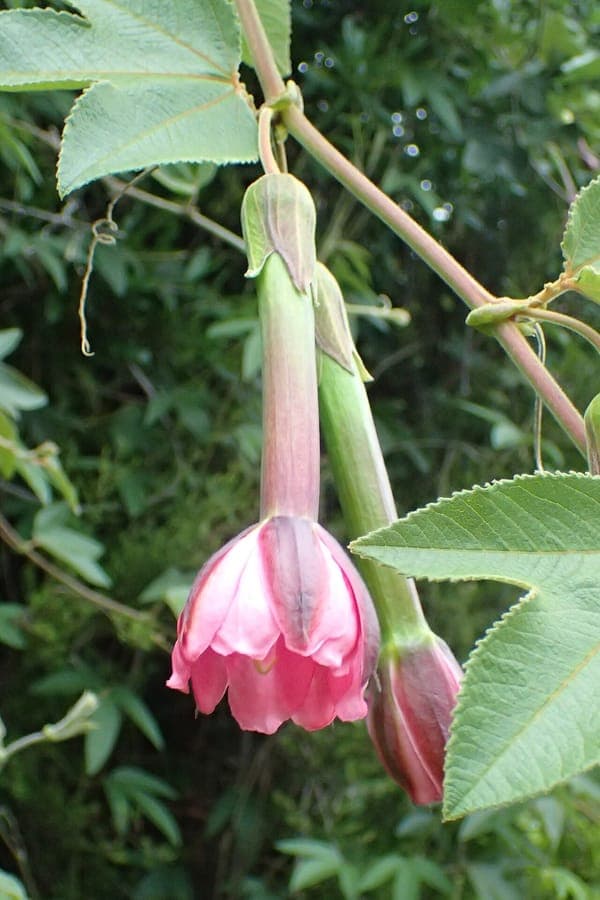
Krzysztof Ziarnek, Kenraiz / CC BY-SA 4.0, via Wikimedia Commons
Banana passion fruit: complete guide
Passiflora mollissima
Want to see Banana passion fruit: complete guide in your garden?
1 minute, no credit card
Banana Passion Fruit: Complete Guide
The Banana Passion Fruit (Passiflora mollissima), also known as Curuba in Spanish-speaking regions, is a fast-growing, vigorous climbing vine originating from the mountain forests of South America, particularly Colombia, Ecuador, Peru and Venezuela. The plant belongs to the family Passifloraceae. It is known for its spectacular, large flowers in bright pink to purple and fairly large, edible fruits that taste of banana and passion fruit combined.
Appearance and Flowering
The plant grows as a semi-woody climber with tendrils reaching more than 5 to 10 meters, with a growth tempo of 50 to 80 cm per month in ideal conditions. The leaves are deeply lobed (3-5 points), green, approximately 8 to 15 cm long, fuzzy-hairy (hence "mollissima" = soft). The flowers are spectacular: very large, 7 to 10 cm across, with striking pink to purple color. The flower crown (corona) consists of two rings of fine, wavy filaments in pink to purple with white tips - this is the most prominent feature. Flowers appear July to October in temperate climates (or May to August in mountain climates). The fragrance is pleasant. Each flower lasts only a few hours open. Fruits follow flowering and ripen September to November. The fruits are elongated, larger than passion fruit, 7 to 10 cm long, yellow when ripe, with smooth flesh and many seeds inside.
Ideal Location
Seek a warm, sunny to part-shade position with strong air flow. Minimum 4 to 6 hours direct sunlight for good flowering. However: in very hot regions (zone 10b-11) part-shade can be beneficial. The plant needs support: garden trellis, pergola, mesh, garden wall or wall. In containers on terrace: use strong stake or spiral support.
Soil
Banana Passion Fruit grows well in nutrient-rich, well-drained soil. Ideal pH: neutral to slightly acidic (6.5 to 7.0). The plant is grateful for plenty of organic matter: add 20 to 30% leaf mold at planting. In pots: heavy potting mix with 30% gravel-mix for drainage. The plant also grows fairly in poorer soil, but thrives in rich garden earth.
Watering
Moderate to regular watering need during growth (March to October). Water when top 2 to 3 cm feels dry. This usually means 2 to 3 times per week in summer, less in spring and fall. Moisture-loving, but no waterlogging; drainage must be perfect. In winter (November to February) much less water: only if soil is very dry. The plant goes partially dormant.
Feeding and Care
During growth phase (April to September) feed monthly with NPK 10:10:20 (potassium-rich for blooming and fruiting). During flowering period: reduce nitrogen (10:30:20 or 0:30:10), increase phosphate. Apply organic fertilizer (compost tea) every two weeks for sustained nutrient cycling. No over-feeding: nitrogen promotes lots of leaf, fewer flowers.
Pruning and Shaping
Firm pruning possible and beneficial. In early spring (February-March) prune previous year's stems back 30 to 50% - this encourages dense, compact growth with more flowering shoots. Side branches straying from trellis can be gently cut back. Remove dead wood year-round. Lower leafless stems can be removed if desired for cleaner appearance. Don't be afraid of pruning: plant regrows quickly.
Maintenance Calendar
February-March: Heavy pruning of last year's wood. Begin watering. Start feeding (NPK 10:10:20).
April-May: Rapid growth. Regular feeding. Check strong supports.
June-July: Flowering begins. Adjust feeding to 10:30:20. Daily watering in dry spells.
August-September: Peak flowering and fruit setting. Maintain feeding. Water heavily.
October-November: Flowering ends. Fruits ripen. Feeding gradually reduce.
December-January: Total dormancy. Minimal water, no feeding. Apply protective mulch (see winter hardiness).
Free design
Want to see Banana passion fruit: complete guide in your garden? Make a free design now.
Winter Hardiness
Banana Passion Fruit is hardy to USDA zone 8-9 (down to -5 to -10 degrees Celsius in brief frosts). This means:
- Zone 9-10 (Southern France, Southern Spain, coasts of Northern Italy): Leave outside with protection. After first frost (November) apply thick mulch layer (10 to 15 cm leaf cover) around plant base. Climbing shoots can be wrapped with burlap. Plant will regrow from roots in early spring.
- Zone 8 (Central France, Southern Germany, Northern Italy): Risky outside. Better to use pot culture with relocation to frost-free place in winter (minimum 5 to 10 degrees Celsius in shed or greenhouse). Sometimes plant survives outside with excellent drainage and south-wall position.
- Zone 7 or colder: Pot culture mandatory. Winter in unheated greenhouse/conservatory (0 to 5 degrees Celsius).
Damp winters are more dangerous than cold. Well-draining soil is essential.
Propagation
From seed: Sow seeds immediately after harvest in moist seed bed (22 to 25 degrees Celsius). Germination time 2 to 3 weeks. Keep young plants indoors first until 15 to 20 cm tall, then transplant.
From cuttings: Cut semi-hardwood cuttings (8 to 10 cm) in summer (June-July). Place in moist seed substrate (50% sand, 50% peat) in plastic container under propagator or warm windowsill. Root in 3 to 4 weeks. Thereafter individual pots. Preference: seed propagation - easier.
Diseases and Pests
Very healthy in full growth. Sometimes:
- Aphids in greenhouse: Spray with neem oil or insecticidal soap.
- Spider mites in dryness: Frequent misting, maintain humid microclimate.
- Powdery mildew: Rare; increase ventilation.
- Fruit fly: In warm climates (tropical); clean up fallen fruits well.
Food Value and Harvest
The fruits are edible and nutritious: vitamins C and A, calcium, iron. Taste: sweet-sour, blend of banana plus passion fruit. Pick fruits when fully yellow and slightly soft. Eat raw (remove skin, suck flesh), or process into juice, jam, or cooked dessert. Yield: one mature plant can produce 50 to 100 fruits per season under favorable conditions.
Interesting Facts
In South America (Colombia, Ecuador) Banana Passion Fruit (curuba) is a commercially cultivated plant - fruits disappear to local markets and export. The plant prefers mountain slopes (1000 to 2000 meters altitude) where temperatures are moderate - this helps explain why it is more frost-tolerant than many tropical passion flower species. The flowers are hugely attractive to pollinators (bumble bees, birds). In subtropical gardens it creates visible bird activity.
Conclusion
Banana Passion Fruit is a dramatic ornamental climber ideal for sunny garden walls, pergolas and trellises in subtropical to temperate climates. Its spectacular pink flowers and fairly generous fruit production make it advantageous over purely decorative Passiflora species. Winter caution is needed above zone 9, but rapid growth and abundant feeding compensate for cutting. Sufficient pruning keeps form neat. For European gardeners: food value plus beauty equals worth the extra care.
Availability: Relatively specialized. Intratuin (Netherlands) rarely stocks passion flowers. Germany: Hornbach sometimes stocks nursery plants. France: Jardiland carries basic species, Curuba rarely. Online nurseries specializing in exotic climbers are best source, both for seed and young plants (45 to 60 cm).
Want to see Banana passion fruit: complete guide in your garden? Make a free design now.
Upload a photo, pick a style, and get a photorealistic design with plant list in under a minute.
10,000+ gardens designed already
No credit card required


Similar plants
Passiflora antioquiensis: complete guide
Passiflora antioquiensis
Passiflora antioquiensis is a Colombian banana passionflower with hanging pink blooms. Discover trellising, soil and winter care.
Purple passionflower: complete guide to growing Passiflora incarnata
Passiflora incarnata
Full growing guide for Passiflora incarnata, the hardy purple passionflower for zones 5-9. Planting, pruning, winter care and companion plants included.
Passiflora tenuiloba: complete guide
Passiflora tenuiloba
Birdwing passionflower blooms exotically and grows rapidly. Learn how to cultivate this passion flower in your garden as a vine or container plant.